 Tamarra Kemsley
Since at least 2024, leaders for The Church of Jesus Christ of Latter-day Saints have been issuing warnings about the limits of artificial intelligence, especially when it comes to matters of faith.
These messages, often delivered by apostle Gerrit W. Gong, have drawn a bright red line between using A.I. for, say, spreadsheets (officially approved) and spiritual guidance (not approved).
As Gong told audiences in an August 2025 presentation at church-owned Brigham Young University’s Education Week, “A.I. cannot provide inspired divine truth or independent moral guidance. As a creation of God, man can create A.I., but A.I. cannot create God.””
Curious to know if the message was breaking through, researchers at BYU-Idaho and the University of Southern California polled nearly 1,800 U.S. Latter-day Saints in 2025 and 2026 about A.I. and its place in religious worship, as well as society generally.
The results suggest Gong and his colleagues face heavy cultural headwinds.
What LDS leaders have said about A.I.
In a January 2024 speech delivered at BYU, apostle David A. Bednar delivered a stark warning.
“Innovations such as artificial intelligence have the potential to both assist you in receiving magnificent blessings and diminish and suffocate your moral agency,” Bednar said. “Please do not allow the supposed accuracy, speed and ease of modern technologies to entice you to avoid or circumvent the righteous work that invites into your life the blessings you will need.”
The following year, an update to the church’s General Handbook included language discouraging members from using the technology to replace the “individual work and spiritual guidance required to prepare divinely inspired talks, lessons, prayers or blessings.”
And this past June, Gong pleaded with church members in a YouTube video on the topic not to let A.I. become a replacement for prayer or meaningful conversation.
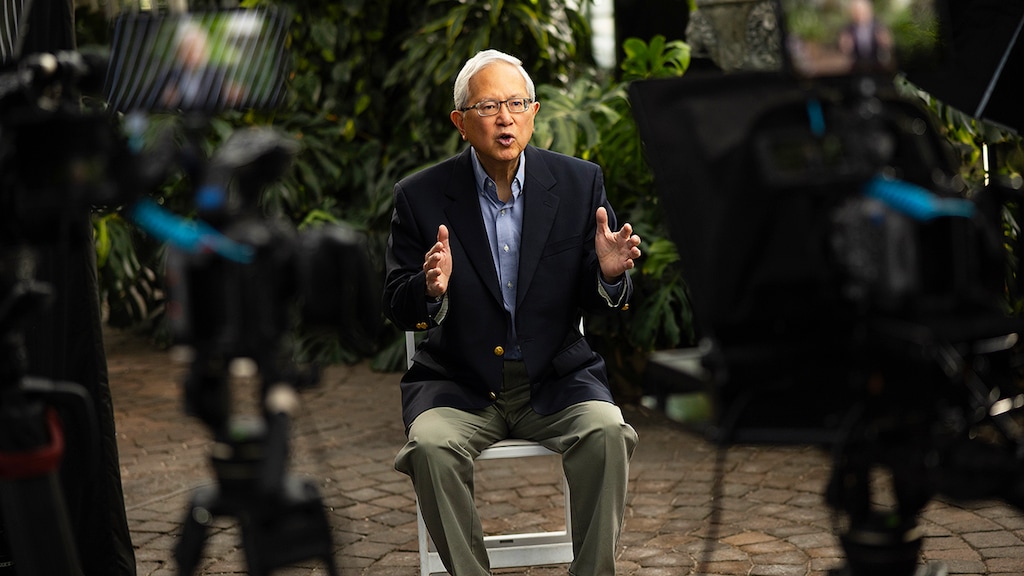
(The Church of Jesus Christ of Latter-day Saints) In a 2024 meeting for church employees, Latter-day Saint apostle Gerrit W. Gong urged listeners to rely on spiritual discernment and trusted sources to counteract the potential dangers of A.I.
“If you feel tempted to confide more in a chatbot than in a parent, leader or friend,” he said, “may I invite you to reach out — today, now — to a real person who knows and loves you.”
About the study
Data collection for the study occurred in three parts: two separate waves of surveys completed by the polling firm Centiment, one in fall 2025 and the other in fall 2026, and a snowball survey by BYU-Idaho students, also conducted in fall 2025.
Together, they gathered responses from 1,797 self-identified church members nationwide. From those, the authors identified three types of Latter-day Saints.
• “Silicon Saints”: These members trend younger and harbor few qualms about A.I., “fully integrating it into their faith life,” write the study’s authors. They account for about a third of U.S. church members — for now. The study suggests this group is gaining steam.
• “The Compartmentalizers”: Although frequent A.I. users, these members set “clear boundaries” reflective of church leaders’ guidance. Around 45% of Latter-day Saints fall into this category, by far the most balanced across age groups.
• “The Spiritual Skeptics”: Heavily made up of baby boomers, this group avoids A.I. in all aspects of their lives. The group shrank noticeably between the first and second wave of surveys, accounting for about 1 in 4 members in all.
The more active in the faith respondents tended to be, the more likely they were to fully embrace A.I. — including in their spiritual lives — despite church leaders’ guidance. Overall, nearly 60% of Silicon Saints identified as “very active,” compared with 49% of Compartmentalizers and 40% of Spiritual Skeptics.
Fast-changing attitudes
Comparing the entire pool of respondents, a few trends emerge. Namely, the more familiar Latter-day Saints become with the technology, the less suspicious they appear to be of it.
The first is a notable decline in concerns about A.I. — from the technology being used to impersonate people (a decline of 10 percentage points between 2025 and 2026) to its potential for bias (an 11-point drop) to fears around the accuracy of the information it provides (a 13-point decrease).
At the same time, Latter-day Saints’ willingness to adopt it as a kind of spiritual or ethical guide increased, never mind the warnings from Gong and others.
In 2025, for instance, about a quarter of all respondents deemed it “appropriate” to use it to “receive advice on personal ethical dilemmas.” In 2026, that number rose to 42%. The percentage of those willing to “discuss my personal worthiness” with an A.I. chatbot, meanwhile, jumped from 17% to 29% in that same time frame. Using A.I. to write a church talk held essentially steady, dropping from 64% to 63%.
If there are signs that leaders’ warnings are having an impact, it is in the percentage of those who view A.I. as an “appropriate” gospel study aid, a number that slipped from 72% to 67%.
(Christopher Cherrington | The Salt Lake Tribune)
The margin of error for each wave was around plus or minus 4 percentage points, versus 2 points for the total sample pool.
A new communications strategy
What all this points to, said co-author Matthew Miles, is a large — and likely growing — disconnect between church leaders and U.S. members on the place of A.I. in one’s worship practices.
(Matthew Miles) BYU-Idaho political scientist Matthew Miles was one of three co-authors of the expansive study.
“There’s this messaging [from leaders] of ‘use A.I. as a tool, but it’s just math,’” the BYU-Idaho political scientist said. And yet, the findings indicate that among Silicon Saints, 60% say “it’s good to use A.I. for a partner or coach to support spiritual growth,” and 73% see no problem using it to write a talk or prepare a lesson.
At the same time, Miles doesn’t believe a steady march toward a full embrace of A.I.-mediated spirituality is inevitable. Church leaders could take steps, he said, to impact members’ views on the matter, starting with being more specific in their direction.
Often, he said, “their messaging is so broad” that members find room for their preferred interpretation.
“As a communications person,” he said, “I would say you need to be very clear.”
LDS views on data centers
Realizing the heat the topic was attracting, Miles and his colleagues added new questions for their 2026 respondents regarding data centers.
What they found was that Latter-day Saints are, at around 65%, about as opposed to their construction as the average American.
(Rick Egan | The Salt Lake Tribune) An overflow crowd at a Juab County Commission in September about data centers.
These numbers were much higher for Spiritual Skeptics and Compartmentalizers (90% and a little less than 80%, respectively), compared with 40% of Silicon Saints.
The margin of error for each of these types is around 4 percentage points.
If A.I. enthusiasts continue to grow, it’s possible that U.S. membership as a group may soften its stance on the resource-taxing centers — good news for the church, which started leasing land for construction of at least one facility, in Texas.
(Christopher Cherrington | The Salt Lake Tribune)
The trend, however, is far from certain.
A consistent trait of those who supported data centers, Miles said, was a feeling of having a voice in the direction of A.I.
As data centers continue to multiply and a rising number of members find developers knocking on their communities’ doors, they may find they’re less in control than they once thought — setting up a possible collision between church investments and members’ attitudes.