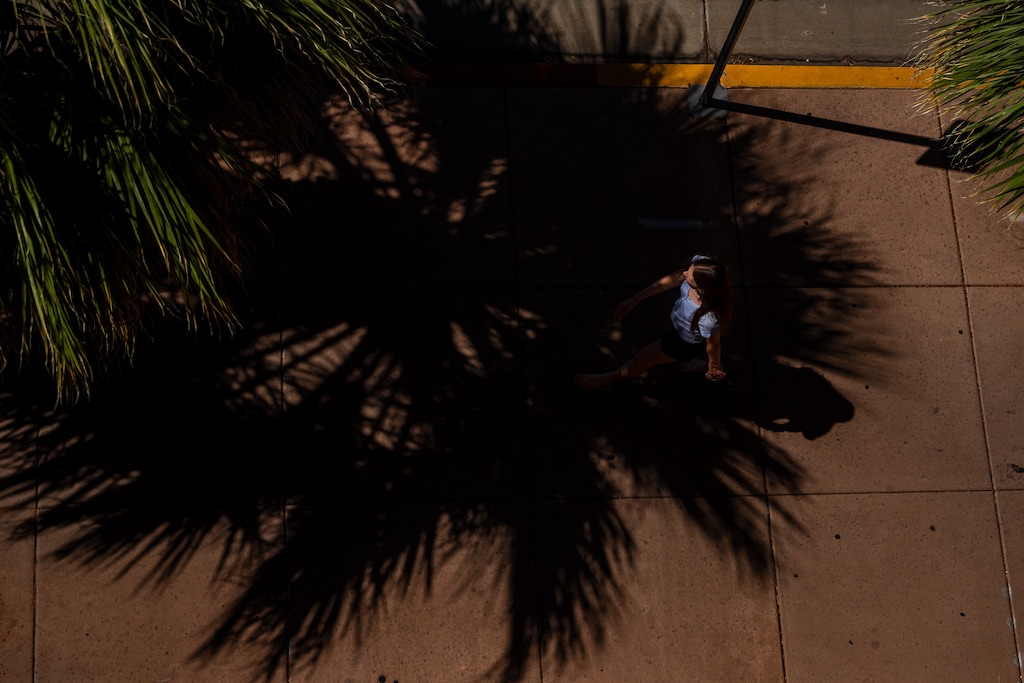
The air in St. George reached a toasty 104 degrees on a Wednesday afternoon in June.
“The wind feels like it’s coming from the Sahara Desert,” said Bonnie Pendleton. But under the shade of two mulberry trees outside the West Village Neighborhood Cafe, she added, the heat felt bearable.
Known as “the plant lady,” Pendleton is a member of the St. George Shade Tree and Beautification Board and a gardening consultant.
Without the old trees that line the sidewalks of much of downtown St. George, where temperatures often break 100 degrees from June to September, the community would roast, Pendleton said. “Our air conditioning units would quit working if we didn’t have shade over some parts of our homes,” she added.
As Utah grapples with extreme heat and scarce water this year, trees may help make cities cooler and more drought tolerant.
Trees are the most effective tool to reduce the urban heat island effect, said Doug Bennett, the conservation manager for the Washington County Water Conservancy District. Trees also need less water than lawns, Bennett said, so with the right irrigation set up, they can more easily survive Utah’s scorching, dry summers.
To encourage more people to plant trees, the district recently added a “treebate” to its water efficient landscape program that incentivizes residents to replace their lawns with drought-tolerant plants. Now participants will receive an additional $100 for each qualifying tree planted with proper drip irrigation.
Every time the district promotes its landscape conversion program, someone complains about urban heat, said Karry Rathje, the district’s public affairs manager. But it’s a common misconception that lawns mitigate hot city temperatures.
“Lawn is fairly neutral to urban heat island effect: it doesn’t create it, but it also can’t stop it,” Bennett said. Trees can intercept ten times more of the sun’s hot energy than lawns, he explained in a video the district made on the urban heat island effect.
“The benefit of a tree is going to extend to the community at large,” Bennett said. “Not that we all don’t like looking at a flower, beautiful shrub or ground cover, but trees, in my opinion, are really what make the neighborhood really attractive and give it a sense of place.”
St. George trees
When looking over downtown St. George from the red cliffs on the north edge of the city, an expanse of tall, green trees tower above the historic homes, casting shade on the sidewalk and streets.
One of the first things Mormon pioneers did when they settled the St. George area was plant trees, Pendleton said. “They had gotten saplings like elm and mulberry and cottonwoods along the way, and planted them as soon as they got here, because they were exposed to the elements. … Even some of the trees that were planted 100 years ago are still here,” she said.
They also planted food trees, including pecans, apples and pomegranates, the fruit of those still making up the “Dixie salad” that some families prepare on Thanksgiving, Pendleton said.
The city’s shade tree board aims to preserve the city’s tree canopy. To remove a healthy tree within 10 feet of a right-of-way during construction activities, a developer must first get approval from the board, according to the city’s zoning regulation. Trees must also be protected and watered during construction activities.
Any development in St. George must have one “water-conserving” tree for every 4,000 square feet of landscaping and a minimum of one tree per property, according to city code. For residential areas, each single-family dwelling must have at least two drought-friendly trees, including at least one planted in the front yard.
(Trent Nelson | The Salt Lake Tribune) Homes shaded by trees in St. George on Thursday, June 25, 2026.
“We need to keep the canopy to stop the heat island effect,” Pendleton said. “Our downtown is a great example of keeping our canopy, because there’s a lot of places that you can walk in the old downtown St. George, and you are staying underneath the canopy of trees.”
Planting trees for the desert
The water district has a list of its top ten “shady characters” that are most likely to succeed in southwest Utah’s desert environment. That includes the wide-spreading Arizona velvet mesquite, the desert willow with orchid-like blooms and the silvery-green fruitless olive tree.
The Chinese pistache is one of Bennett’s favorite shade trees. “It endures heat, it endures cold,” he said. “I’ve seen it thrive and grow in places where the shopping center was abandoned and the trees didn’t die. I’ve seen it growing in really difficult situations.”
There are also some trees the district doesn’t recommend planting due to disease or heat intolerance. Ash trees are on the top of that list.
“Ash trees have long been the shade tree of choice, but we have a disease called ash yellows that has moved into the region,” Bennett said. “We have ash borers that attack them, so whenever they become stressed, the disease and insect issues will often take them out.”
Ash trees currently make up about 15 to 20% of Utah’s urban canopy. To try to protect those trees, the state has banned the importation of new ash trees, according to the Utah Department of Agriculture and Food.
Purple plum is another popular tree that doesn’t qualify for the district’s treebate. “We’re finding that the longevity of a purple plum is getting shorter and shorter as our communities become hotter and hotter,” Bennett said.
(Trent Nelson | The Salt Lake Tribune) Homes shaded by trees in St. George on Thursday, June 25, 2026.
Bennett and Pendleton also said it’s important to choose the right location to plant — both for the tree and optimal shade.
Planting in the middle of a paved parking lot is “cruel and unusual punishment” for a tree, Bennett said. While some trees can survive in a small hole surrounded by compacted ground, most won’t grow well in that kind of environment. Rather, trees need space to expand their roots, he said.
In a shopping center, that may look like creating a large strip of landscaping designed to capture rainwater. In a yard, it’s ideal to plant 20 to 30 feet away from a house or other structures, as the tree’s roots will spread.
To reap the most benefit from the tree’s shade during the hot afternoon, Pendleton also recommends planting on the south and west sides of a building.
Trees in southwest Utah need water year round, Pendleton said, particularly in dry, warm winters like the state just experienced. Infrequent but deep watering is best, and the irrigation system also needs to expand as the tree grows to ensure the water reaches the extensive root system.
“It’s not uncommon to go out and see a tree that’s eight or 10 inches in trunk diameter, and then they have these little emitters right at the base. … That would be like if you told me you were thirsty and I poured a glass of water over your head,” Bennett said. “The water was there, but not in a place that you could use it.”
To find more tips on tree care, Bennett recommends reaching out to the Cooperative Extension System, housed at Utah State University in Utah, or the Arbor Day Foundation.