 Brooke Larsen
St. George • At the end of a long day, Trase Taggart finds peace in his garden.
“It’s a great way to just release a lot of endorphins,” he said.
“Some people like to go to the gym and work out really hard,” he added. “I want to spend time just sitting out and enjoying the hummingbirds and listen to the birds sing and watch the bees buzz.”
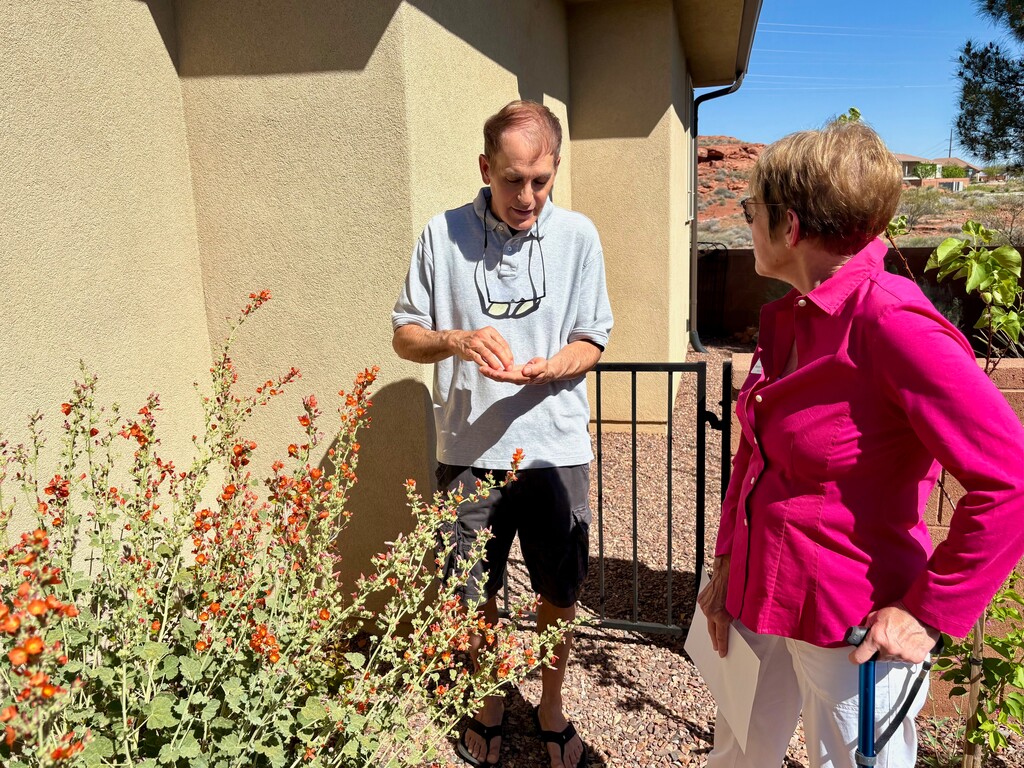
At the front of his house, he admires the Mexican evening primrose, chocolate flowers, prickly pear cacti and yucca. Around back, he picks fresh peas from pots hugged by globemallow shrubs. And he tends to the cherry, apricot, fig and peach trees he planted last year after his husband passed.
“Lose a loved one, plant a tree,” he says during presentations about his yard.
“I planted four,” he added with a soft laugh.
Soon, others can enjoy the pollinators flitting about Taggart’s St. George garden during the third annual Parade of Gardens Southern Utah on April 24-26.
(Brooke Larsen | The Salt Lake Tribune) Chocolate flowers grow in Trase Taggart's garden in St. George on Thursday, April 9, 2026.
“Parade of Gardens Southern Utah is organized to give our local residents ideas for their own outdoor spaces and gardens and yards, and how they can create those without using a lot of water,” said Karen Goodfellow, water program manager for Conserve Southwest Utah, which organizes the event.
Visitors to Taggart’s house will have the chance to learn about how he teamed up with his neighbors to remove all the grass from not only his front yard but all the front yards in his homeowners association.
At his home, just two small patches of lawn remain in his backyard so Dusty, his 14-year-old gray Shih Tzu, has a soft place to lie outside.
Desert landscaping is extra important this year, Goodfellow said, because the “water situation is really, really dire.”
Why the HOA ripped up its lawns
Taggart is the board president of his HOA, which includes 41 homes in the Red Cliffs Park subdivision that abuts the Red Cliffs National Conservation Area.
“This was a turtle habitat right here where we’re living,” he said, acknowledging the cost of development in the wildland urban interface.
Taggart’s side yard blends into the undeveloped land, though: Desert marigolds grow at the corner of his lot and spread in pops of yellow and calming sage-green along the neighboring open space.
(Brooke Larsen | The Salt Lake Tribune) Desert marigold plants grow at the edge of Trase Taggart's yard and a neighboring open space in St. George on Thursday, April 9, 2026.
Long before the HOA decided to ditch grass in its yard, Taggart and his neighbors helped the city maintain the open space by removing non-native plants like Junegrass and flammable tumble weeds.
“In the wash it was tumble weeds and dirt, and that’s all there was there,” he said. Now, when he and his neighbors walk back there, native grass fills the space.
After years of restoring the ecosystem behind their homes, Taggart and his neighbors took a closer look at their own yards.
The HOA owns the landscaping around the homes in the subdivision as “community property” and maintains the front and side yards, Taggart said.
A few years ago, Taggart looked critically at how much the HOA was spending on lawn care and found it was at least half of its monthly $1,500 landscaping bill.
“So there was talk at the time, is there a better alternative?” he said.
“The state legislature was talking about it,” he continued. “The community members were talking about it. … We even had a few homeowners come and say, ‘Hey, there’s going to be an incentive to take out lawns and put xeriscaping in. Have you heard about it?’”
(Brooke Larsen | The Salt Lake Tribune) Prickly pear cacti and ephedra grow near a small patch of lawn in Trase Taggart's backyard in St. George on Thursday, April 9, 2026.
Taggart and his fellow HOA board members weren’t aware of the new program. But Taggart looked into it and learned the Washington County Water Conservancy District would pay property owners to replace their grass with water-efficient landscaping.
Around a dozen of the 41 homeowners were eager to rip out their front and side lawns. Two already had. And others eventually jumped on board when Taggart put forward a plan to cover all the costs using the HOA reserves and the district’s rebate program.
“I am strongly in favor of this project since it conserves water, conserves money, and is borne equitably among all homeowners,” he wrote in a letter to HOA board members in December 2022.
In 2023, the HOA voted in support of ripping out the front lawns and replacing the thirsty turf with native and drought-tolerant plants.
Converting 39 of the lawns — a total of 7,318 square feet — to water-wise landscaping cost the HOA $25,571. A rebate from the water district covered $14,636 of the bill. Savings in landscaping maintenance then allowed the HOA to replenish its reserves by spring 2025 — just two years after the project started.
Lessons learned along the way
Not everyone was excited about the idea of ditching grass initially.
(Brooke Larsen | The Salt Lake Tribune) Desert plants fill the front yard of Trase Taggart's house in St. George on Thursday, April 9, 2026.
“I do remember sitting down with the folks at one of our homes that have the largest lawn,” Taggart said.
“They’re snowbirds. They’re only down here once in a while,” he added. But they were reluctant to say goodbye to their green grass.
They eventually understood, though, Taggart said, and didn’t want HOA fees to have to go up to maintain the lawns.
Taking care of the cacti and yucca has also posed some challenges, though.
The first year, they lost some plants after an “extremely hot summer,” Taggart said. They replaced them and adjusted watering schedules during the next scorching summer. But they overcompensated and some plants rotted out from too much water.
“So we’ve had a little bit of a bumpy ride that way,” Taggart said. “But over this winter and this last year, we’ve only lost three or four plants.”
Learning how to care for plants is exciting for Taggart, though. He’s been doing it his whole life.
“Both sets of grandparents had vegetable gardens and beautiful flower gardens, and so I was always hanging out with my grandparents and helping them in the yard and the garden,” Taggart said. “That’s where a lot of my love for botany and gardening came from.”
(Brooke Larsen | The Salt Lake Tribune) Globemallow plants reach across a pot of bush beans in Trase Taggart's St. George yard on Thursday, April 9, 2026.
Attendees of the Parade of Gardens will have the chance to learn more about Taggart’s story, his garden and his HOA this weekend. The tour includes nine other gardens, and tickets cost $20. More details are available on Conserve Southwest Utah’s website.