 Mark Eddington
Trading turf for desert landscaping just got a bit more lucrative. Water managers in Washington County are bumping their grass-removal rebate to push hesitant homeowners off the fence and into water-wise landscaping.
After several years of paying $2 per square foot to help residents rip out thirsty grass, the Washington County Water Conservancy District has increased the incentive to $3 per square foot on the first 1,000 square feet of lawn removed. That covers most residential yards.
“We’d been at $2 for three seasons,” said Doug Bennett, the district’s water conservation manager. “My research suggests that costs have gone up between 15 and 25%. Our rebate was actually seeming to shrink, so we wanted to make sure we gave a boost during drought conditions and encourage people to finish projects swiftly rather than sit on them.”
The extra dollar not only aims to save water, Bennett added, but also to buck the trend of local landscaping businesses experiencing their slowest season during St. George’s hot summers.
“It’s a good opportunity to give a boost to the local economy… at a time when it is most critical for us to conserve water,” he said. “The $3 rebate should give people on the fence a bit of a push to move in the right direction.”
‘Do this now’
Since the launch of the program in December 2022, Washington County residents have completed nearly 3,000 projects and removed nearly 4 million square feet of grass, according to district officials.
“You could push a lawn mower from here to Santa Barbara, California, across the amount of grass that the citizens of Washington County have replaced with desert-appropriate plants,” Bennett said.
The district expects the enhanced rebate to cost about $500,000 more than the previous program — though half will eventually be reimbursed by the state as part of the Water Efficient Landscape Program.
“We have to budget for the full cost of the program, and then we get reimbursed by the state,” Bennett said. “In terms of actual expense, we’re looking at about $250,000.”
The higher payout comes with a deadline. The district’s board has only authorized the extra dollar for projects completed by June 1 of next year. After that, unless the board takes new action, the rebate snaps back to $2. “So we’re encouraging people to do this now,” Bennett said.
This grass-reduction initiative is saving roughly 500 acre-feet —nearly 200 million gallons — of water annually, he said. Early data shows participating homeowners are cutting their usage by 80,000 to 100,000 gallons per year, in some cases slashing their previous water demand by nearly half.
Change of heart
When turf removal was first introduced, residents of Sun Country Meadows South — a 55-plus community in St. George — met the proposal with deep skepticism, according to resident Chris Green.
“Many residents simply could not picture a beautiful community without traditional grass,” said Green, who serves on the landscaping committee for the 17-acre property of 119 townhouses.
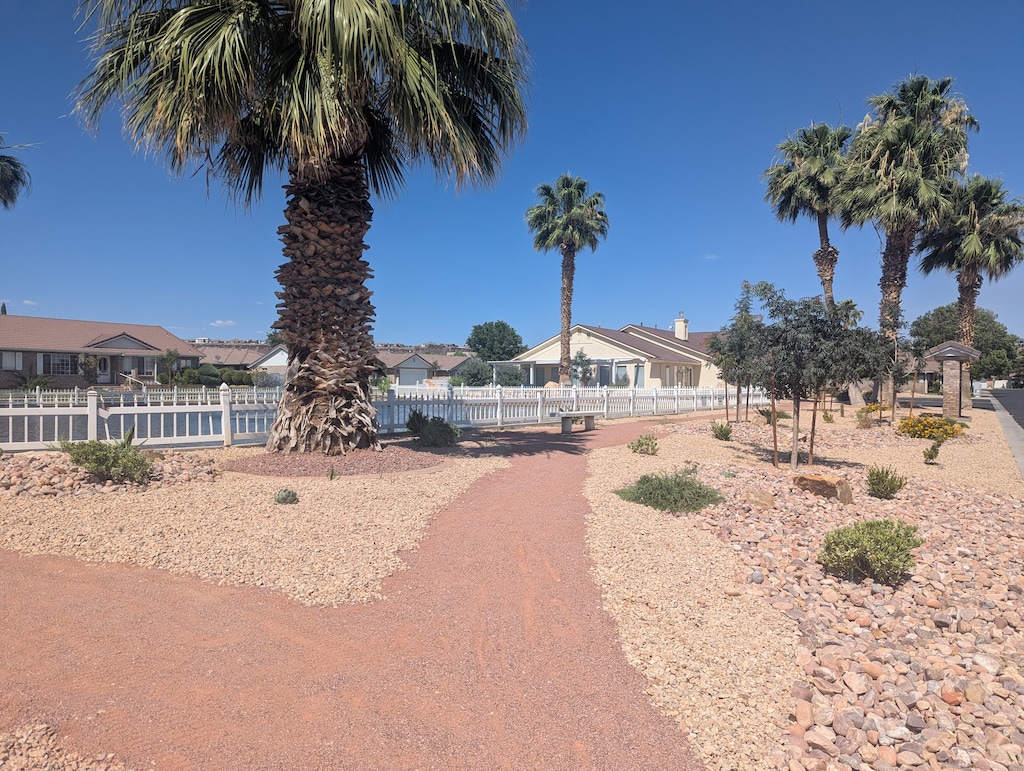
Now, she added, attitudes have changed. Residents have converted more than 20,500 square feet of grass adjacent to their homes into more drought-tolerant landscaping. In addition, the homeowners association has transformed 17,500 square feet of turf, previously unusable because it was in decorative patches around the clubhouse and pond.
“In its place, we now have beautiful walking paths and seating areas where everyone can now enjoy the pond and local wildlife,” Green said.
‘Treebates’ for shade trees
For Zach Renstrom, the district’s general manager, conservation is smart economics.
“When we conserve an acre-foot of water, it’s the cheapest water we can get,” he said. “We are not giving up anything. We are actually replacing it with something that’s very beautiful, very green, and makes our community a better place.”
Renstrom calls the program “a continuation” of Washington County’s long-running effort to stretch a limited resource. “We’ve always looked at how to be good stewards of our water,” he said.
Alongside the fatter turf rebate, the district is paying people to plant shade trees to fight urban heat islands. Participants in the budding “Treebate Program” can now get $100 per tree, with one tree allowed for every 700 square feet of project area. Approved species include desert-adapted or low to moderate-water trees such as desert willow, oaks and Mondale pine that can reach at least 15 feet tall.
On an extremely hot summer day, sitting beneath the shade of a tree makes a huge difference.
“When you have shade,” Bennett said, “those surfaces underneath [trees] can be 50 degrees Fahrenheit cooler than they would be if they were exposed to the sun.”