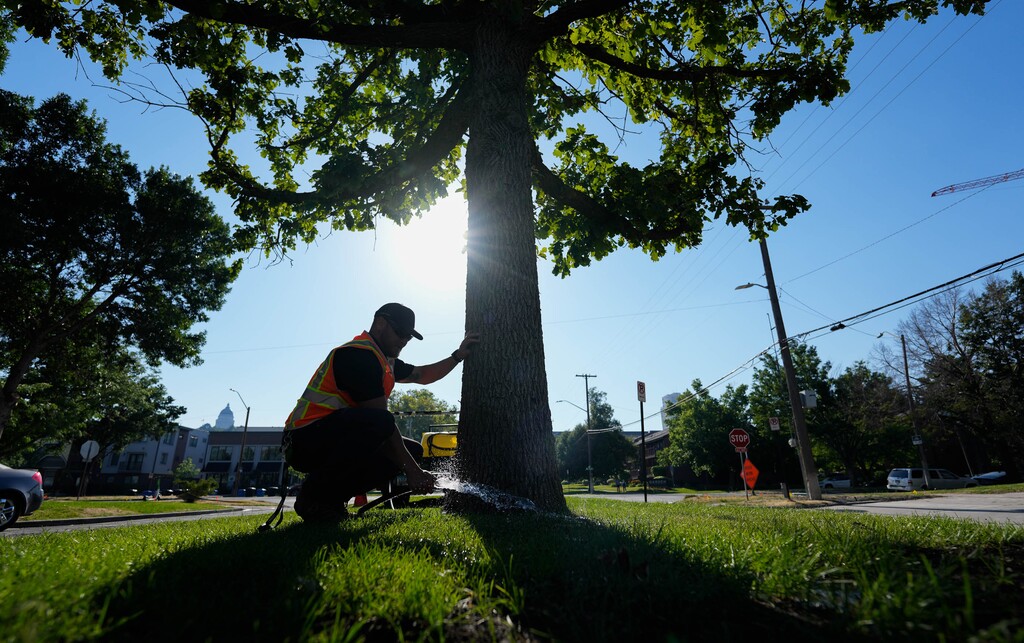
In Utah’s desert climate, urban trees rely heavily on the human touch to survive.
That, of course, means water.
With a dire worsening of drought conditions this season after a nearly six-year dry spell, replenishing the thousands of trees that nurture and offer refuge to residents all along the Wasatch Front has never been more important.
Trees bring shade and buffer the heat. They cleanse the air. They offer habitat to countless species, absorb noise and they catch and retain what scant moisture may fall.
You might be able to let your grass lawn go brown in summer months and see it later revive — but when trees dry out, they die and never bounce back.
A little more than decade ago, according to Salt Lake City Urban Forestry Division Director Tony Gliot, crews removed fewer than 500 dead or dying trees a year from the city’s rich urban forest of 90,000-plus trees and 250 species.
Now, that toll hovers around 1,200 annually, partly due to once heavily planted species reaching the end of their lives, but also from folks just watering less. Residents in Utah’s capital have faced recent hikes in their water bills, too, meant to encourage conservation.
“Yes, the trees are absolutely stressed,” Gliot said. “I can tell you unequivocally that we will lose trees this year. Right now, we’re losing them as a result of people not watering them.”
Added Miles Becker, an urban forestry extension specialist and assistant professor at Utah State University in Logan: “It’s going to be a tough, tough summer.”
As opposed to turf, the water your trees need will be well worth the cost. Distilled from tree experts up and down the Beehive State, here are tips for keeping your trees alive:
• Trees need infrequent but deep watering. In the state’s northern climes, you can go up to two weeks between waterings for a mature tree (trunk diameter of five inches or more) but give it a good soak each time. For younger, smaller or newly planted trees with smaller root systems, you might make that every week through the summer and into fall.
With southern Utah’s extended spates of 100-degree weather, experts suggest making that schedule a little more frequent. Residents in those areas are also advised to water their trees year-round, especially in dry, warm winters like the state saw this year.
(Francisco Kjolseth | The Salt Lake Tribune) Arborist Nick Bleckert, operations manager for the Salt Lake City Urban Forestry Division, waters a large bur oak tree in Utah's capital, on Wednesday, June 24, 2026.
• How much water? Gliot says the ground should be squishy after those decent dowsings, while Becker added that the moisture should penetrate down at least 12-to-18 inches by the time you’re done.
So you might buy a probe and stick it in the soil once you’re done to make sure.
• Don’t rely on your lawn sprinklers to do the job. Experts recommend soaker hoses or several encircling rounds of drip feeders, ideally with water going in along what’s called “the drip line” of a tree — in other words, the outer perimeter where rain flows off the tree’s branches and leaves.
Look up at that edge and then, at the ground: That’s where the roots absorb water best.
“Almost all species of trees have evolved to shed most rainwater at the edge of the tree. ... That’s also where you’re going to find the most roots,” said Doug Bennett, the conservation manager for the Washington County Water Conservancy District.
Thing is, for a mature backyard tree in an urban area, that drip line might easily fall in your neighbor’s yard — but not to worry. Gliot says watering closer to the trunk if needed will also help get the job done, again, as long as these are good and regular soaks.
And remember there’s a lag effect of drought on trees, Becker added, so keep watering into September and October.
(Trent Nelson | The Salt Lake Tribune) Warm Springs Park in Salt Lake City on Saturday, June 13, 2026.
• What else to watch for? Droopy leaves or brown, crispy edges are an immediate sign your tree needs some deep drinks. There are other slower responses to hotter conditions, as well.
“We think of trees as fixed,” said Becker, “but they change their behavior to adjust to low water.”
If you see leaves turn color or even dropping in late summer as opposed to further into the fall, “the tree’s probably already made its decision,” he said, “that it’s closing down shop” for the season.
Take that as a sign you might water it more generously the following season.
(Francisco Kjolseth | The Salt Lake Tribune) Arborist Nick Bleckert, operations manager for the Salt Lake City Urban Forestry Division, talks about the process of caring for a large bur oak tree that was transplanted in March.
• Maybe the most important tip of all? Get to know your trees.
“It’s having a relationship with your tree that’s going to keep it alive,” said Gliot, “not an amount of gallons, not a watering technique.”
If you’re familiar with it and it needs something, he said, “you will know in a very kind of natural subconscious way.”
St. George resident and garden consultant Bonnie Pendleton echoes that same sentiment.
“Water, fertilize, prune. Treat your tree like a human being,” she said. “It’s a living, breathing thing, so treat it well.”
(Bethany Baker | The Salt Lake Tribune) Fairmont Park on Saturday, June 13, 2026.