 Samantha Moilanen
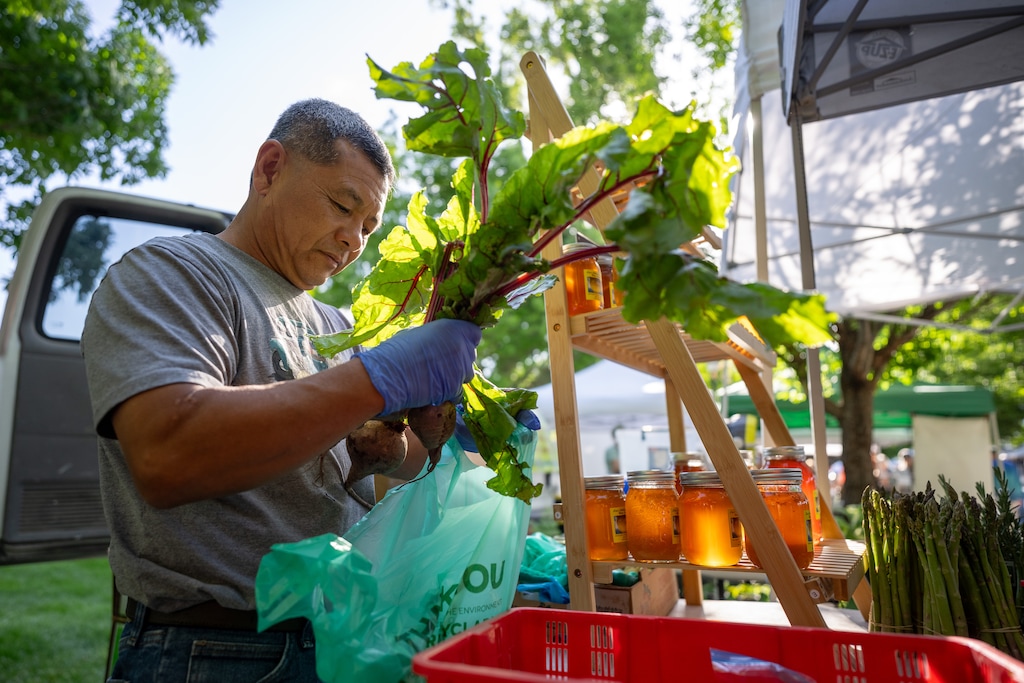
On the opening day of the Downtown Farmers Market, customers lined up at David Chen’s booth in Pioneer Park, filling bags with bok choy, broccolini, carrots, green onions and jars of honey.
But the peaches, plums, pears and Golden Delicious apples that typically help carry the Layton grower’s business through the summer were wiped out by frost this year, Chen said.
After an unusually warm winter prompted fruit trees to bud early, freezing temperatures in April swept across Utah, devastating orchards in the Beehive State. Chen said he lost his entire tree-fruit crop and saw many of his summer vegetables — including cucumbers, squash and hot peppers — pushed weeks behind schedule.
“It’s devastating,” Chen said Saturday, describing how fruit that appears healthy on the outside reveals freeze damage and rot once it’s split open.
While his booth drew a steady stream of customers Saturday, Chen is among Utah growers facing a much leaner summer season, with many tree fruit crops gone before the market began.
In May, Gov. Spencer Cox declared a 30-day state of emergency for Box Elder, Cache, Davis, Iron, Juab, Millard, Piute, Sanpete, Utah and Weber counties after freezing temperatures in April caused widespread agricultural losses.
Apricots, sweet and tart cherries, plums, peaches, pears and apples suffered losses ranging from 95% to 100%, according to the governor’s office.
(Trent Nelson | The Salt Lake Tribune) Cherries from Black Bear Orchards at the The Downtown Farmers Market in Salt Lake City on Saturday, June 6, 2026.
Utah-grown fruit scarce
Throughout the bustling farmers market on Saturday, the crop loss was visible as stands that would normally be preparing for the arrival of Utah-grown peaches, cherries and apricots instead leaned heavily on vegetables.
Aside from strawberries and cherries from a grower in Colorado, locally grown fruit was scarce.
The Colorado grower, Black Bear Peaches, had a stand full of cherries. Julia Grant, who sells for the grower at markets, said the orchard used wind machines and large water tanks to fight freezing temperatures and benefited from a nearby red rock formation that helped moderate nighttime lows, preserving much of the cherry and peach crop.
Growers adapt
At Tagge’s Famous Fruit & Veggie Farms, a longtime Box Elder County grower known for its summer peaches and other tree fruit, sugar snap and English peas filled the stand Saturday.
(Trent Nelson | The Salt Lake Tribune) Eleanor Greene helps customers at Tagge's Fruit & Vegetables, at the The Downtown Farmers Market in Salt Lake City on Saturday, June 6, 2026.
The farm survived the first freeze of the season, said owner Thayne Tagge, only to lose nearly all of its tree fruit during a second cold front. Peaches, apricots, cherries, plums and nectarines were among the crops nearly wiped out, he said.
“The last one was too long, too hard, and it got us, and it freaking got everybody,” Tagge said. “We have about 100 half bushel of peaches on the tree, handful of cherries, but for the most part it’s a total loss.”
Row crops, however, such as blackberries, raspberries, watermelon and cantaloupe were not damaged by the freeze, Tagge said.
(Trent Nelson | The Salt Lake Tribune) Jarrod Weeks, Weeks Berries of Paradise, sells strawberries at the Downtown Farmers Market in Salt Lake City on Saturday, June 6, 2026.
Still, Tagge said the losses are unlike anything he has seen in decades. The last freeze that caused a near-total loss of tree fruit in the area occurred in 1972, according to Tagge.
To help fill his stands this summer, Tagge said he plans to source fruit from growers in neighboring states. At the Downtown Farmers Market, however, he said customers won’t find fruit from his farm this year.
“We’ll see what happens the rest of the year,” Tagge said. “Can’t give up.”
Turning to cider and donuts
For Pyne Farms in Utah County, the spring freeze left the family-run operation that has been in business since 1903 with nothing to harvest, said owner Kent Pyne.
(Trent Nelson | The Salt Lake Tribune) Kent Pyne, Pyne Farms, at the The Downtown Farmers Market in Salt Lake City on Saturday, June 6, 2026.
Pyne said the farm lost its entire tree-fruit crop after the spring weather killed off tart cherries, apples and peaches across his 53 acres in Santaquin and Genola.
At the Downtown Farmers Market on Saturday, Pyne sold his usual apple cider slushies, cider and apple cider donuts. But typically by this point in the season, he would also have apriums, a plum-apricot hybrid, and early peaches for sale, he said.
Now, Pyne said, he is focused on getting through the year.
As shoppers passed the booth, a worker called out, “Fresh apple cider slushies — we crush ’em and slush ’em,” drawing customers to the stand.
The farm will have to stay lean and cut expenses to bridge the gap to next year’s harvest, Pyne said.
“Just support your local farmers however you can, whether they have agritourism or they have some sort of crop ...” Pyne said. “The farmers really appreciate it.”