 Palak Jayswal
For Lebanese American author and poet Moudi Sbeity, belonging is a fickle, fascinating thing.
It’s something that he’s struggled with throughout his life, but it’s also something that he’s learned to cultivate, to grow alongside.
Through these struggles to find belonging, Sbeity found himself tightly woven into Utah’s culture, and even its history books. He started the popular restaurant Laziz Kitchen, and was one of the plaintiffs in the lawsuit that legalized gay marriage in the Beehive State.
(Moudi Sbeity) Moudi Sbeity poses with his memoir, "Habibi Means Beloved," and his poetry book, "Alhamdulillah Anyway."
His journey is much of what he explores in his new memoir, “Habibi Means Beloved,” published by the University of Utah Press.
“Belonging, for me, is this kind of knowingness and intimacy with the ground of my own life,” Sbeity said in an interview. “Belonging is also an action of love. We create it. We show up in a way that makes room for others.”
Sbeity’s time in Utah — he came here as an evacuee from a small village in Lebanon at the age of 18 and has since moved — played a role in building that sense of belonging.
“For me in Utah, starting Laziz and then being part of the Kitchen vs. Herbert lawsuit was a way in which we expanded the circle and welcomed people in, and so created the conditions for belonging,” he said.
The Utah of it all
(Jeffery Packard) | Moudi Sbeity, the author of "Habibi Means Beloved."
The memoir features pockets of Utah where Sbeity found solace or created a community, like with the Utah Conservation Corps at Utah State University, where he fell in love with the state’s landscape.
“I did not grow up with access to the natural world,” Sbeity explains. In Lebanon, he couldn’t freely run through places, because of “the possibility of detonation by planted Israeli mines.”
“Joining the Utah Conservation Corps opened up my entire world and perspective on what else exists,” he said. “Now camping outside under the stars and working on a trail all day long brought me into a close contact with this world, and it taught me something about myself. It changed me completely.”
(Trent Nelson | The Salt Lake Tribune) Kitchen v. Herbert plaintiffs Derek Kitchen and Moudi Sbeity speak at a rally to celebrate the legalization of same-sex marriage, Monday, October 6, 2014, in Salt Lake City. Sbeity and Kitchen split in 2021.
Sbeity also writes extensively about his past marriage to Derek Kitchen, a former Salt Lake City Council member, and, later, state senator. The couple were two of six plaintiffs who famously took on Utah’s same-sex marriage ban in 2013 and won.
Their public relationship sparked wide admiration in Utah, but being on display also took a toll.
“Being in the public eye sort of sets you up to scrutiny, just as much as celebration and encouragement,” Sbeity said. “We now had to contend with what someone might say, how we might be perceived. Would this hurt the case or would it help the case? We were then thrown into circles that were affluent, and that is not where either of us came from.”
(Kim Raff | The New York Times) Moudi Sbeity, co-founder of Laziz Kitchen in Salt Lake City, on April 30, 2021. Sbeity moved on from the restaurant in 2022.
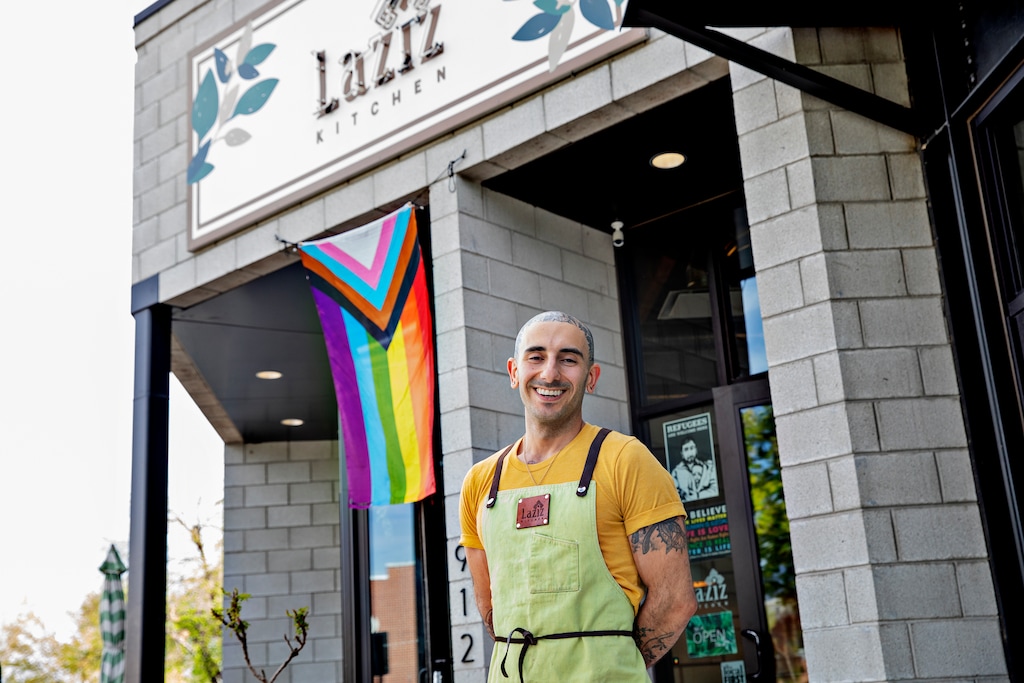
Sbeity and Kitchen separated in 2021. During their relationship, they opened and co-owned Laziz Kitchen. Sbeity moved on from the restaurant at the beginning of 2022, but the community the business brought together remains with him to this day.
“I loved creating it and investing my time and my heart in that and it did become such a community staple,” he said. “Shortly after we opened, Trump was elected for his first term, and people came in droves to find a safe space.”
Finding a path of spirituality
Another Utah note is Sbeity’s friendship with poet and writer Nan Seymour, whom he first met at the Downtown Farmers Market when she was the director of Local First Utah. The book is, in part, dedicated to Seymour, creator of the River Writing Collective, a community writing group.
“We have traveled together metaphorically on our path, when she invited me to write with her at the River Writing table,” Sbeity said. “Unknowingly at the time she was also giving me the gift of expression and unconditional belonging and love.”
The memoir also explores Sbeity’s relationship, especially as a queer person, with Sufism, a spiritual, inner dimension of Islam. He first discovered Sufism through poetry at Seymor’s writing table.
(Francisco Kjolseth | The Salt Lake Tribune) Moudi Sbeity at Laziz Kitchen. He moved on from the restaurant in 2022.
“It’s a way to reclaim the larger sum of us,” he said. “For me really the heart of the book are the places where I break off the narrative and discuss these concepts, whether they’re Islamic or Sufi or poetic or just generally an orientation towards what we are to each other and how else we could live.”
While writing this memoir, Sbeity said that he’s learned that finding belonging isn’t the end game.
“Belonging won’t resolve our existential condition, but we can continue to return and walk and work towards places that are inclusive,” he said.
“Habibi Means Beloved” is available for purchase now.