 Tony Semerad
If Salt Lake City can’t use zoning to directly block U.S. Immigration and Customs Enforcement from retrofitting a west-side warehouse into a sprawling detention center, its planners at least want to keep the facility from expanding its footprint in Utah’s capital with the help of the private prison industry.
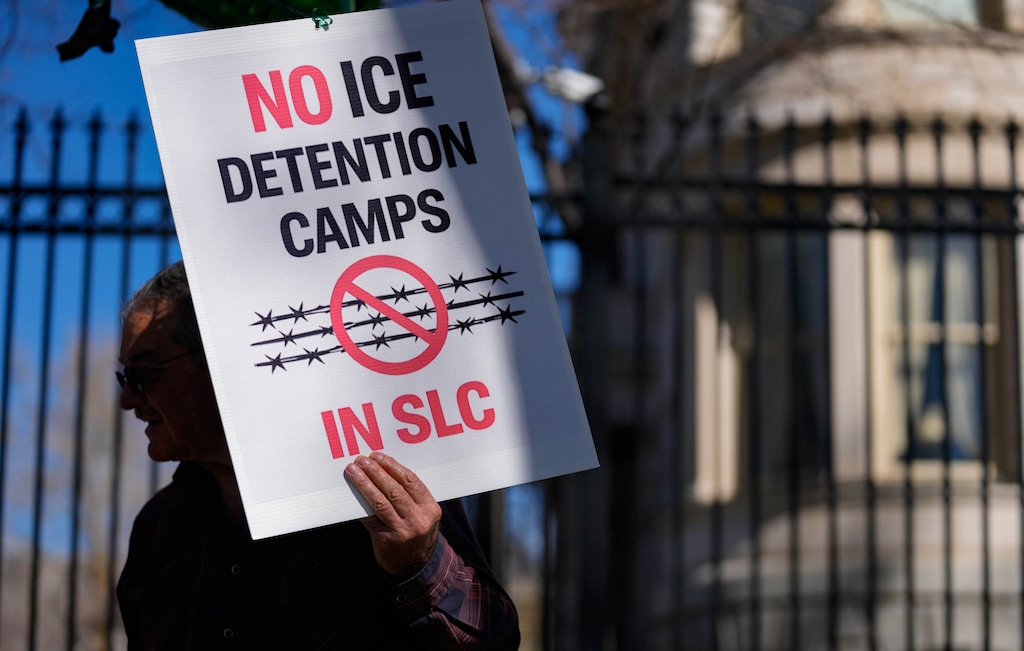
This month, the planning commission voted to start the process to ban privately operated prisons from constructing new facilities in the city. Though motivated by a desire to push back on the planned ICE holding facility, the move endorsed by the commission probably wouldn’t directly affect that 7,500- to 10,000-bed center now envisioned by the feds.
But it may, commissioners hope, prevent ICE from using its long-standing relationships with the private prison industry to expand beyond the detention center in future.
“We’re just closing a potential path that way,” City Planning Director Nick Norris told members of the planning commission.
(Christopher Cherrington | The Salt Lake Tribune)
Officials at the Department of Homeland Security have confirmed to Mayor Erin Mendenhall that the newly purchased warehouse at 6020 W. 300 South is to be converted into a “mega-center” for detained immigrants as ICE’s enforcement efforts expand nationwide, but officials have not shared more detailed plans for the site.
There’s no indication the agency wants to use private prison companies to expand detention efforts in Utah in the future. Still, planning commissioner Lilah Rosenfield said, carving such uses out of what is permitted under city zoning code could give elected leaders additional leverage down the road.
Specifically, Rosenfield told colleagues on April 8, the change could prevent some of the more controversial U.S. private prison operators working for ICE from buying land, building prisons and offering them to the U.S. government, the state or even the city under contract.
“Ultimately,” Rosenfield said, “private prison facilities do exist and ICE does contract with private prison facilities.”
Commissioners voted unanimously to initiate the petition to change the city’s zoning.
‘Closing a potential path’
Lands owned by the state of Utah or the federal government are not subject to city zoning rules, so the city’s option in curtailing detention facilities through its land use code is to target privately owned outfits.
Norris said community correctional facilities, as now defined under city code, are already prohibited within a half mile of residential areas, which pretty much limits where they are currently allowed to areas zoned for manufacturing.
The code change sought by the petition, Norris said, would forbid those facilities as a land use throughout the city when the land is owned by private companies.
At the same time, the change would be crafted to “grandfather” in several existing sites akin to halfway houses and rehabilitation centers for people transitioning out of incarceration, according to city documents.
Once the petition is drafted and launched, Norris said, it will go up for 45 days of public input. The measure would then have a hearing before the commission to decide its recommendation on passing or killing it, before forwarding that on to the City Council.
Norris said a timeline for starting the petition has yet to be established.
The planning commission is taking a rare foray into legislating city rules on its own behalf, a strategy that initially left at least one member cautious of the effort. Typically, the commission reviews project applications and new planning proposals and advises the City Council on zoning ordinances, land use and the city’s general plan.
“It’s legislating in a space we have no business in as a planning commission,” said member Richard Leverett. “But also it’s just ineffective as a piece of legislation.”
Leverett initially said the ban would be easy to bypass if the feds owned the land but allowed a private company to use it. Ultimately, though, he joined the rest of the commission to move forward with the petition, saying he supported removing private prisons as an allowable land use in the city.
Resistance from SLC
Mendenhall has vowed to use other city zoning and legal tools in hopes of blocking the 833,000-square-foot center from ever opening, calling such ICE facilities “inhumane.”
At the mayor’s urging, the City Council moved last month to cap water usage for nonresidential facilities at 200,000 gallons per day and closed a loophole on government-owned sites. An ICE detention center, Mendenhall said, is estimated to need 1-2 million gallons daily when fully operational.
The city has also sent up red flags about sewage capacity for the detention center located in the Utah Inland Port, near Interstate 80 and Salt Lake City International Airport.
Beyond overwhelming water and sewer capacity, Mendenhall has said the detention center could strain roads in the city’s warehouse district and affect economic development.
She has also warned of a financial burden on other governments, including the city, with the federal site exempt from local taxes.
Mendenhall has raised the potential that a detention center of that scale could stretch police, fire and emergency medical services, which she says are already operating at maximum capacity.
Tony covers growth and development issues for The Tribune. He is a former editor and politics reporter and has been with The Tribune since 1991.