 Jose Davila IV
 Tony Semerad
While key questions about U.S. Immigration and Customs Enforcement’s planned Salt Lake City detention center remain unanswered, an internal agency memo might offer some clues as to how the center could be used — and what that might portend for Utah’s immigrant community.
The building, currently an empty warehouse, sits at 6020 W. 300 South near Salt Lake City International Airport and Interstate 80. The federal government bought it for $145.4 million — a premium for the area — from a company affiliated with a German asset management firm called DWS Group.
Observers believe that ICE will step up immigration-related arrests across the region if and when the facility — the first of its kind in Utah — comes on line.
“There is a general sense of additional doom,” Utah immigration lawyer Kendall Moriarty said. “It’s hard to know, from a professional standpoint, does this mean more enforcement action in Utah, specifically, or does this mean maybe the same amount of enforcement action here, but just holding more people from Wyoming [and] Idaho? … So for me, it looks like they’re just creating a more centralized holding facility for all these states.”
(Christopher Cherrington | The Salt Lake Tribune)
ICE did not reply to emailed questions about the facility, including how many detainees it could hold and when the agency expected it to open. Instead, the agency sent a general statement about the project.
“The Salt Lake City, Utah, facility is part of ICE’s innovative approach to purchase and manage its own detention facilities across the country, instead of relying on third-party owned facilities scattered throughout the United States,” ICE wrote. “We are working with contractors to design, build and provide comprehensive services for the new detention centers.”
The warehouse could operate as a key cog in that new national network of detention centers, according to an internal memo issued by ICE and released in connection with a warehouse it acquired in New Hampshire.
The Utah facility’s sale and ICE’s lack of community engagement have generated backlash from residents and elected officials, including Republican U.S. Sen. John Curtis. Others, like Utah House Rep. Trevor Lee, R-Layton, have cheered the plan, while Gov. Spencer Cox has thrown his support behind it.
Building a deportation machine
(Chris Samuels | The Salt Lake Tribune) The Salt Lake City warehouse ICE purchased this month.
ICE’s strategy, according to the internal memo, includes buying and renovating eight new large-scale detention sites nationwide along with up to 16 smaller regional processing sites across the country.
“These facilities will ensure the safe and humane civil detention of aliens in ICE custody,” the agency wrote in the Feb. 12 document, “while helping ICE effectuate mass deportations.”
All of this has an ambitious timeline as well: ICE wants to have this expanded network of more than 92,000 new beds up and running by the end of November.
This will effectively eliminate, the agency said, a number of beds ICE contracts with other law enforcement to use, while dramatically boosting its own capacity and — according to the agency’s analysis — improve its management of detainees in custody and streamline removing them from the U.S.
The estimated cost of creating this new model through buying and converting existing warehouse facilities is $38.3 billion, set aside in President Donald Trump’s massive spending legislation last year.
ICE has hired nearly 12,000 additional agents since Trump assumed his second term. The agency, according to its own take, has sought to time its push to build out a new detention network in hopes of having bed capacity in place for an anticipated spike in arrests and enforcement activity from those new officers.
“Facilities will be built to handle the immediate surge capacity and sustained long-term operations,” ICE officials wrote, “providing a unified, scalable solution that delivers continuity, safety, compliance and control - built to scale, and committed to supporting our mission.”
Along with former jails, ICE has in mind remaking industrial and logistics buildings like the one in Salt Lake City into two new kinds of facilities:
• Regional processing centers, serving basically as staging locations for transferring detainees or removing them from the country. These are expected to have an average daily population of between 1,000 and 1,500 detainees, each with stays of between three days to a week.
• Large-scale detention facilities capable of holding 7,000 to 10,000 detainees for an average of 60 days or less. These sites, according to ICE, will serve as the agency’s primary locations for removing detainees from the country.
While ICE has not made clear exactly how the Salt Lake City warehouse will be deployed once it gets converted, the building’s scale — 833,000 square feet — seems to indicate it is more likely to be part of ICE’s network of processing centers, as opposed to a more large-scale and prison-like facility with longer inmate stays.
A like-size warehouse purchased by ICE in Williamsport, Maryland — at 830,000 square feet — appears expected to yield about 1,500 beds, according to the Washington Post. Another bought in the Phoenix metro area, at 418,400 square feet, will reportedly be part of the same network of future processing centers able to hold 1,000 to 1,500 people.
Worries about detention push
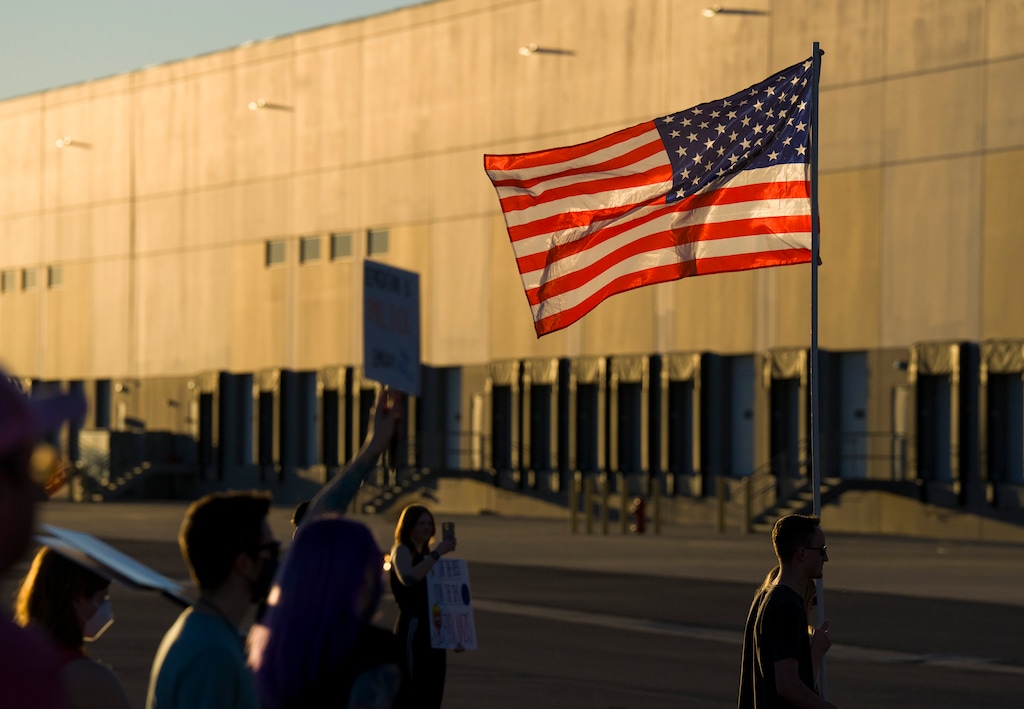
(Francisco Kjolseth | The Salt Lake Tribune) Protesters gather outside the Governor’s Mansion in response the recent purchase of a Salt Lake City warehouse by ICE, Tuesday, March 17, 2026.
West-siders and Utah immigration observers are deeply unsettled by ICE’s plan to retrofit the warehouse.
“People are scared,” said Isaac Atencio, co-owner of the Fairpark neighborhood’s Culture Coffee and The Salt Lake Barber Co. “The overwhelming sentiment is just kind of horrified. It is a big detriment to the community. It’s a huge detriment to the west side.”
Atencio urged residents to take ICE’s plan for a detention center seriously and mobilize to stop it.
Ellie Menlove, the director of policy for the American Civil Liberties Union of Utah, said the relative lack of information from ICE on its plans was worrying.
“No one has any idea what their plans are, or what the timeline is, or what they plan to do, or when they plan to start construction,” Menlove said. “No one has any idea, any answer to any of those questions. And that seems to me to be a very odd posture coming from the federal government with such a major project.”
Menlove, citing a 2022 report from the Immigrant Legal Resource Center, said immigrants lacking permanent legal status who live in counties with more detention space are more likely to be arrested. That, she fears, is evidence that Utah could see stepped-up enforcement.
(Bethany Baker | The Salt Lake Tribune) Sebastian Stewart-Johnson, a founding member of BYU student group the Black Menaces, speaks at a protest in front of the Salt Lake City warehouse ICE bought, Wednesday, March 18, 2026.
Voices for Utah Children Executive Director Moe Hickey shares the same concern.
“What I’ll be looking for is if we start establishing quotas, then I think we’re going down a really bad path, because I think that was the challenge in a place like Minnesota,” he said. “Once you start establishing quotas and a certain number of people have to be arrested every day — and with unreasonable numbers as well — then you start just rounding people up.”
Menlove, like others interviewed, remains worried about conditions inside ICE detention facilities, too. Thirty-two people died in ICE custody last year, The Guardian reported, while those held by the federal agency often complain of inadequate food and sleeping arrangements.
“How are we debating whether or not people should be kept in a warehouse?” west-side Salt Lake City Council member Victoria Petro said. “In the year of our Lord 2026, we’re honestly debating the possibility of warehousing humans in Utah.”
Petro, for her part, doesn’t believe the facility will ever hold detainees because it could run afoul of the city’s fire and health codes, she said.
Mayor Erin Mendenhall, meanwhile, has vowed to use “every tool at the city’s disposal” to stop it.
(Chris Samuels | The Salt Lake Tribune) The ICE warehouse in Salt Lake City.
Jose Davila IV covers west-side communities and is a Report for America corps member. He previously worked for KUNR Public Radio in Reno, The Toledo Blade and the Yale Daily News. He appreciates tips on the west side's best food, great hikes across the state and pickup volleyball games. Es bilingüe y ama los tostones de su padre más que nada.
Tony covers growth and development issues for The Tribune. He is a former editor and politics reporter and has been with The Tribune since 1991.