 Tony Semerad
Along with the water, there’s the waste.
Now that the U.S. Department of Homeland Security has confirmed its newly purchased warehouse on Salt Lake City’s west side will be turned into a “mega-center” housing up to 10,000 detained immigrants, major questions are percolating over how much water it will use and and how much sewage capacity it could eat up.
City officials moved swiftly last month — in a response to historically dry weather conditions — to cap water consumption on large nonresidential users across Utah’s capital, including the U.S. Immigration and Customs Enforcement warehouse at 6020 W. 300 South, at no more than 200,000 gallons daily.
The City Council also pointedly eliminated a key loophole to those caps for government buildings in a bid to ensure consumption limits fully apply to the 833,000-square-foot warehouse the agency quietly purchased in early March for $145.4 million.
Nearly a month later, City Hall still has only scant details from DHS on the detention center’s overall demand for utilities such as water, sewer or electrical service. But its own internal estimates project water usage at a 7,500-bed center at between 1-2 million gallons per day, compared to about 5,600 gallons daily the site uses now.
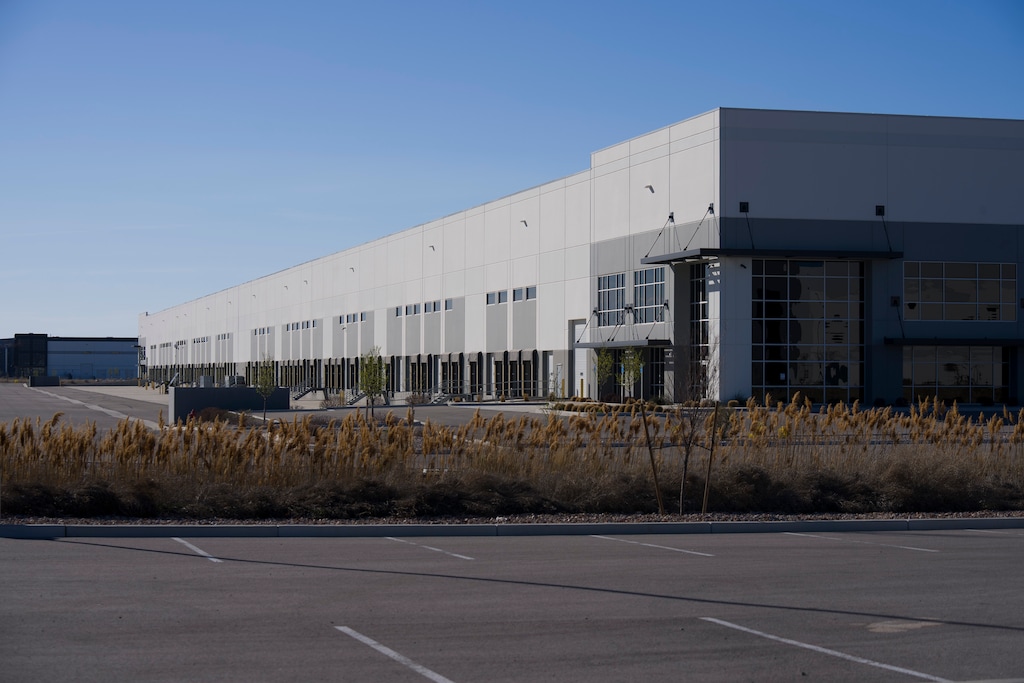
(Chris Samuels | The Salt Lake Tribune) A warehouse in Salt Lake City recently purchased by the U.S. Department of Homeland Security, for use as a "hub" in stepped-up enforcement efforts by U.S. Immigrations and Customs Enforcement, on March 13, 2026, two days after the facility was purchased — for $145.4 million.
The city has even less of an idea about the volume of wastewater that would need to be pumped away and treated from such a high-occupancy ICE center, which the agency has said will be a “hub” in a new network of centers it is building. What Salt Lake City does know: those boosted sewage flows are all but guaranteed to exceed the capacity of existing system lines, lift stations and pumping units that serve the area today.
ICE has not given the city any of the information it has sought about the facility’s impact, according to Andrew Wittenberg, spokesperson for Mayor Erin Mendenhall.
“We do not know their water demand, their average sewer flows or their peak sewer flows,” Wittenberg said. “We do not know all of the ancillary activities that will be conducted at the facility, such as food preparation, laundry, medical, or maintenance, which would have an impact on demand as well as water quality.”
Even without direct information, Wittenberg added, “what we can say with near certainty is that there are substantial constraints in the wastewater collection system.”
SLC, Inland Port won’t chip in
(Photo courtesy of Kevin Perry) City and state officials say water quality and flows to the Great Salt Lake are at stake with a new detention facility proposed on the west side Salt Lake City by U.S. Immigration and Customs Enforcement.
DHS has informed leaders in the Georgia town of Social Circle — where ICE hopes to convert another warehouse to a similarly sized facility — that the proposed center’s sewage outflows there will top one million gallons daily.
Town officials are saying that is way more than the town’s treatment plant can currently support. They also pressing for more from DHS, which has not responded to several requests from The Salt Lake Tribune for comment.
In a March 18th statement, DHS spokesperson said the facility in Salt Lake City would be “very well-structured” to meet its own detention standards. Such sites “will undergo community impact studies and a rigorous due diligence process,” the statement said, “to make sure there is no hardship on local utilities or infrastructure prior to purchase.”
Six days later, the agency told The Tribune in an emailed statement that its “plans include a variety of engineering solutions that will maximize on-site containment and generation for utilities.”
“ICE contractors,” the agency continued, “will coordinate with the service providers and necessary government entities regarding any capacity infrastructure developments needed to safely and efficiently operate the detention centers.”
‘No gray area’
(Google) A warehouse in Salt Lake City that was recently purchased by the U.S. Department of Homeland Security.
Another piece of the puzzle, though, is more clear.
Leaders with Salt Lake City and the top official at the Utah Inland Port Authority, a state economic development agency which spans the warehouse location and much of the city’s northwest quadrant, say they won’t pay for new sewage capacity or other infrastructure improvements required to service an ICE facility.
The port authority says it has a legal mandate to use its limited financial tools to entice high-wage jobs in key economically desirable industries such as advanced manufacturing, aerospace and defense and life sciences.
That picture doesn’t include a detention center, even though ICE has promised to create more than 9,800 area jobs and boost Utah’s economy by $1.1 billion.
“There’s no gray area here,” the port authority’s executive director, Ben Hart, told The Tribune in an interview. “The Inland Port will not be using any of its resources to support this facility.”
Limited resources in city’s northwest quadrant
(Rick Egan | The Salt Lake Tribune) Ben Hart, executive director of the Utah Inland Port Authority, in 2024. Hart said the port won't chip in to help the ICE facility come on line.
Port officials also issued a statement about a week after the ICE purchase first surfaced, saying they were not informed nor consulted prior to the sale going down. That’s also reportedly been the case with city and state officials and members of Utah’s congressional delegation.
Water, sewer and road capacity for additional traffic are all already in limited supply in the city’s northwest quadrant, Hart said, “and ultimately, how we use those is going to be incredibly important.”
Port officials, he said, are hearing from businesses already established in the area seeking details about the ICE facility’s potential impact on port resources available to feed existing and future development.
“We’re always paying attention when someone comes in as a really heavy user of any resources, and that includes water, sewer and traffic,” Hart said.
With the port’s proximity upstream from the ailing Great Salt Lake, he added, water consumption ranks high among those concerns.
“There are a lot of people watching,” Hart said. And while many unknowns remain in light of limited details from ICE, he added, “we know we would not use Inland Port funding to help support this operation in any way, shape or form.”
Millions in sewer system overhauls could be ahead
(Rick Egan | The Salt Lake Tribune) City officials believe major sewer upgrades and water-quality studies will be needed before a new U.S. Immigrations and Customs Enforcement facility could connect to the city's system.
From the city’s view, the U.S. government would be required to fund and build any additional sewer capacity it needs, according to Wittenberg. It will also have construct those additional utilities to the city’s own health and water-quality standards, he said, before a detention center would be allowed to connect to its water and sewer systems.
An initial review of the Salt Lake City ICE facility’s impact by the city’s Department of Public Utilities indicates that, “at a minimum,” substantial sewer upgrades will be required to:
• Upsize about 1,900 feet of an adjacent 18-inch sewer line and another 2,400 feet of similar lines downstream to 24-inches in diameter.
• Upgrade a lift station that moves sewage through the system and extend a pressurized main line by roughly 9,500 feet.
• Boost capacity on two sewer pump stations.
Even if those upgrades are feasible for the city’s sewer collection system, their costs are likely to reach into the millions. Before that, though, there’s the open question of whether DHS’s plans would be deemed environmentally safe, city officials say.
Protecting the Great Salt Lake
“First and foremost,” the mayor’s spokesperson said, “Salt Lake City itself is not viable without the Great Salt Lake, which is where our high-quality, treated wastewater ends up.”
Wastewater discharges into the city’s collection and treatment systems are heavily regulated by the federal Clean Water Act and the state’s Water Quality Act, Wittenberg noted. Those laws are, in turn, regulated by the city. “We take that responsibility very seriously,” he said, “in order to protect public health, city infrastructure, and our environment.”
In the face of sewage capacity limitations posed by an ICE facility in Social Circle, a town of 5,600 people 45 miles east of Atlanta, DHS has floated the idea of building its own on-site treatment plant. It’s also suggested a system of storage tanks might work at that 180-acre site to bypass capacity issues and allow for off-peak discharge of waste into the town’s network.
Those approaches at the Salt Lake City warehouse, which spans 25 acres, could pose a direct risk to the city’s sewage system, Wittenberg said. Storing wastewater on-site, for one thing, can lead to buildups of corrosive gases that can then damage collection pipes.
“We would not allow that effluent into the city’s system without a permit,” Wittenberg said. And that would have to come only after a substantial review — with more information than the city currently has — to assess all the risks.
Examining ICE’s stance in Social Circle, Wittenberg said, the Public Utility Department in Utah’s capital “feels strongly that there is insufficient site-specific research, engineering, and expertise for such plans to be considered appropriate or best practice.”
ICE is still awaiting its “due diligence report” on the site — including an initial take on its water, sewer and other impacts, according to the mayor. ICE officials promised to share those findings with the city once they are complete.