 Courtney Tanner
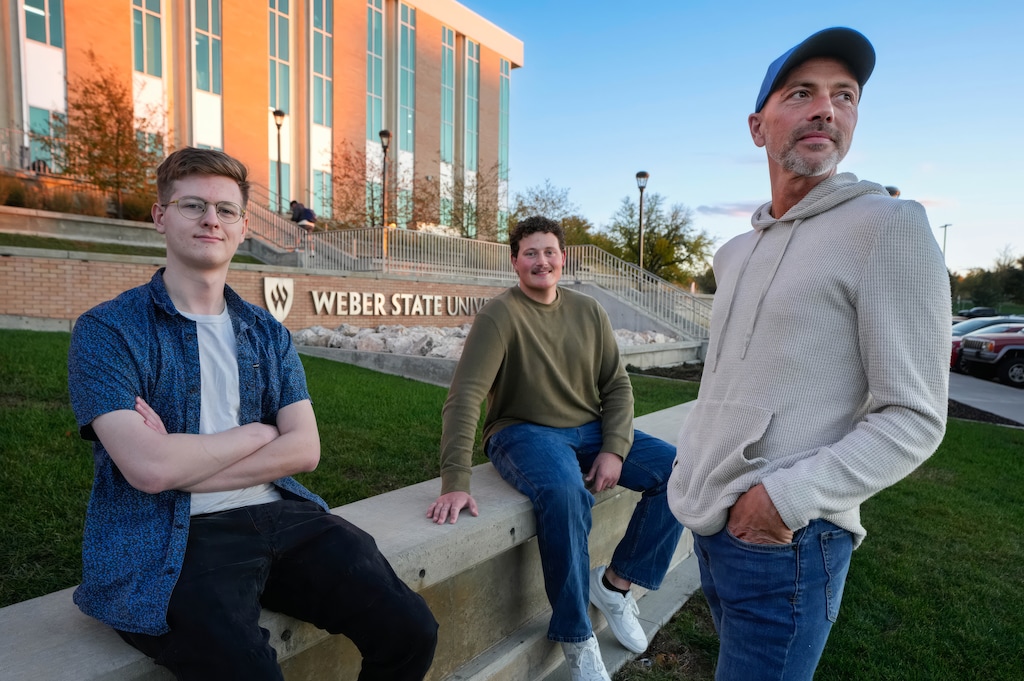
Three Weber State students are collecting signatures and stories as they try to persuade their university to reopen the identity centers the school previously shut down in response to the state’s anti-DEI law.
Their effort first started as an assignment in a shared social work class, said Nick Eckstrom. But it’s since shifted into a passion project.
At 48, Eckstrom is an older, gay student. When he was 18, he said, he didn’t see places like LGBTQ centers on campuses and didn’t feel like there was space for someone like him in higher education.
“If they had these things when I was younger, it would’ve changed everything for me,” said Eckstrom. “And now we’re going backward, back to that.”
He and his classmates, Evan Burnett and Kolby Ferrell, launched their campaign last month, calling on Weber State’s leadership to reverse course.
Weber State in particular had a sweeping response to Utah’s 2024 law banning diversity, equity and inclusion efforts — going further than nearly every other public university in the state, and later taking some heat for it.
The Ogden university shut down all eight of its identity centers that helped serve Black, female, LGBTQ+, Indigenous, Latino, Pan-Asian, Pasifika and undocumented students. At the time, then-Weber State President Brad Mortensen said he wanted to take “a little more aggressive” approach.
The commissioner over public higher education in the state and the bill’s sponsor have both said schools were not required to close those centers. Under the law, they could keep operating as long as they were open to all students, with no limitations based on identity (such as a scholarship only for women). The measure required all students to have equal access.
(Kennedy Camarena | The Signpost) Weber State University students hang out in the former site of the LGBT Resource Center and Women's Center, one of several identity-based campus centers that were shut down.
The three students fighting to restore the centers say the Weber State spaces previously welcomed anyone who walked in.
“They were always open to anyone,” said Burnett, who is 21 and bisexual.
When he got to Weber State as a freshman, the centers were still open. “It took being around other LGBTQ people to find my identity,” he said.
That lasted just a few months before they were closed. He wants other students to have the same opportunity to explore and find belonging with their identities and cultures.
Meeting with the president
The three students’ online petition has so far gained more than 500 signatures. They table each weekday on campus and talk to students and clubs to collect testimonials to present to school leaders.
They’ve also had an initial meeting with Weber’s State new president, Chris Mallet, which came after some creative persistence, Eckstrom said.
Initially, the three emailed Mallett to schedule a sit-down, but were instead directed to meet with an academic success official and the dean of students, they said. That discussion was helpful, Eckstrom said.
But he wanted the president to personally hear the stories they collected: the Pacific Islander students who’ve felt isolated and unwelcome; the Black students who’ve said they don’t feel like they’re wanted on campus anymore; the female students who’ve thought of dropping out.
So Eckstrom went to one of Mallet’s planned town halls, got there early — and chose a seat in the center of the front row.
When Mallet finished his remarks and asked for questions, Eckstrom’s hand shot up first.
The president had said that Weber State values belonging. Specifically, Mallett presented about the school’s new strategic plan, which states: “We value listening to and embracing individuals of all identities and backgrounds through the promotion of belonging, creativity, uniqueness, and self-expression.”
Eckstrom challenged that.
“The closure of the centers doesn’t align with that value, from my view,” the student recalls saying.
Mallett said they should talk more about it and scheduled a meeting with Eckstrom, Burnett and Ferrell for Oct. 29.
(Bethany Baker | The Salt Lake Tribune) Incoming Weber State University President Chris Mallett speaks as the Utah Board of Higher Education announces his appointment at Weber State University on Thursday, May 21, 2026.
The students said it went well and were “super impressed” Mallett took the time to meet. He made no promises, they said, but he listened and asked practical questions. They’re set to meet again in early December.
Ferrell, 24, said learning about other students’ experiences has made Ferrell more invested. He joked that he’s the “straight white guy in the group,” but wants to use his privilege to advocate.
“These amazing people who are a part of these groups need to feel welcome,” he said. “And without these centers, they don’t. People are feeling not represented and alienated. That’s unacceptable.”
He said the centers were a place for students like him to learn more about others’ identities. He grew up, he said, not learning about different groups and is working to change that for himself and his son.
In their presentation to the president, the three students also cited research that shows how closing such centers can affect marginalized groups — including research done by an academic at Weber State.
What research at Weber has found
That research came from Sarah Herrmann, an associate professor of psychological science, who’s been at Weber State since 2017. Her speciality is examining the educational performance of students from historically marginalized backgrounds.
When Utah’s anti-DEI law passed in 2024, her first inclination as a researcher, she said, was to study how students were impacted.
She’s done two studies so far at Weber State, surveying more than 600 students and taking a closer look at 18, who she interviewed.
Her biggest finding was that LGBTQ students, in particular, reported a far lower level of well-being and a less welcoming campus after the centers closed. They also reported higher rates of disengagement with their education.
It was a stronger response than Herrmann said she expected.
(Trent Nelson | The Salt Lake Tribune) Weber State University in Ogden on Wednesday, Feb. 25, 2026.
Meanwhile, students of color and female students were opposed to the law but more likely to use the general Student Success Center at Weber State. That center replaced the eight individualized ones that closed.
All students directly affected by the closures, though, reported campus felt more hostile, though Herrmann noted it’s too early to determine anything beyond a correlation with reported emotional responses.
She intends to continue tracking the issue over time, but so far, Herrmann said her results closely follow other studies across the country that have looked at schools post-DEI.
“Past research links cultural centers with improved retention and performance,” she said. “Belonging is an important predictor of success in college.”
Eckstrom said he’s heard from students who are upset with how abrupt the closures were in 2024 and felt they had little say. Others, he noted, have said they’re afraid to speak out.
“The conversation didn’t happen a few years ago like it should’ve,” Eckstrom said. “I think a lot of people got hurt from it.”
Now, he said, his hope is to make sure students are at least heard — and meeting with Mallett was a good step.
What’s next
In a statement, Weber State didn’t say whether it is weighing reopening the centers.
Spokesperson Rachel Badali said the school has seen student engagement increase by 30% with its new unified Student Success Center, and among those who sought out resources there, graduation rates are 10% higher.
“Creating a single space where every Wildcat can walk in, get help and share their culture has brought people together in ways we hadn’t seen before,” she added.
But the school finds it’s “helpful to hear from our students,” Badali said — “both those who miss the former model, as well as others who feel right at home in the new center.”
Eckstrom said he’ll continue fighting for those who miss the centers. His group will continue collecting signatures until Nov. 30, and he may lobby during the upcoming legislative session for other schools to do the same.
“The point of the centers was making community,” he said.
It’s something he said he didn’t have 30 years ago but is grateful to have today.
(Trent Nelson | The Salt Lake Tribune) The Stewart Bell Tower seen from the Stewart Library at Weber State University in Ogden on Wednesday, Feb. 25, 2026.