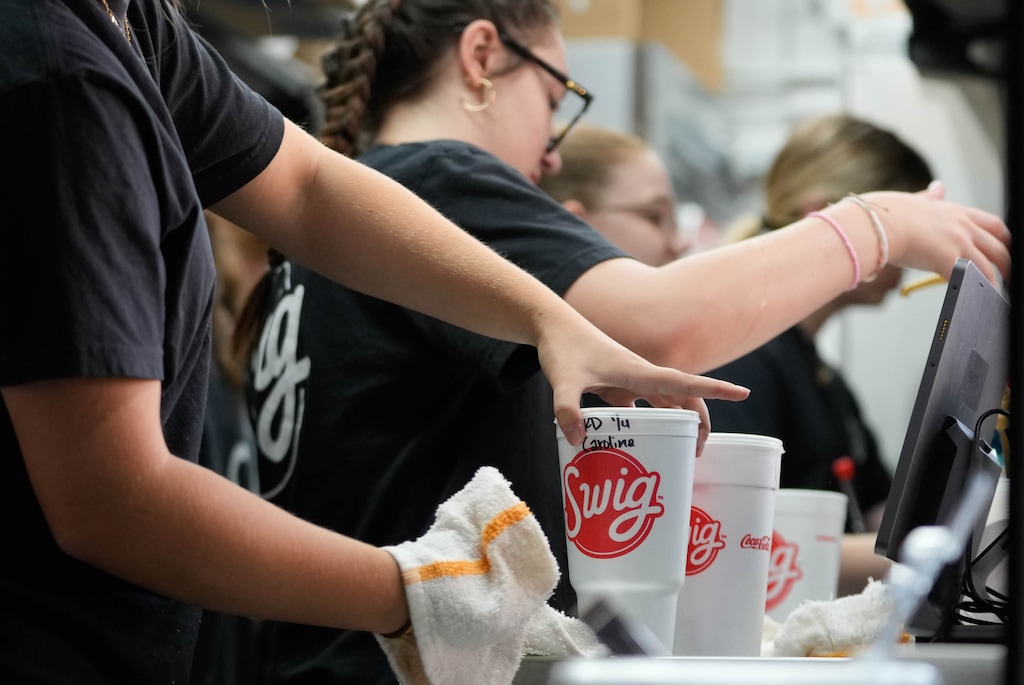
What’s a dirty soda, and why is it quintessentially Mormon?
To make a dirty soda, you take a large soda and adulterate it with cream, which makes it “dirty.” If you want it “extra dirty,” use twice the cream. Then, you or your professional sodarista — is that a word now? — add the flavor shots of your choosing. There’s coconut, mango, lime, butterbeer and on and on. It’s infinitely customizable.
True confession: I’m not a superfan. This is surprising because I live for the two chief ingredients in a dirty soda, which are sugar and cream.
I first encountered dirty soda on a trip to Utah five or six years ago. But now, thanks to its visibility on Instagram and on “The Secret Lives of Mormon Wives,” it’s gone viral.
The story of dirty soda is oddly wrapped up in religion, specifically in the Utah-based Church of Jesus Christ of Latter-day Saints. That’s the argument made in the entertaining new documentary “Saints + Sodas,” released this week by Trademark Films, an independent company based in Provo.
(Religion News Service) “Saints + Sodas” promotional poster.
The film’s director, Madison Pope, told me dirty soda was a Utah phenomenon throughout the 2010s, when soda shops like Swig and Sodalicious started popping up (sorry, no pun intended) all up and down the Wasatch Front. But with “Secret Lives,” which premiered in 2024, suddenly it was everywhere. The documentary features star Jen Affleck and her husband, from whom she reportedly filed for divorce this week, guzzling their preferred elixirs on camera, with Jen confessing herself to be a Diet Coke addict.
Addiction of any kind is verboten, according to the church’s Word of Wisdom, the dietary code that has animated Latter-day Saint life for nearly 200 years. But does soda get a pass? Whether it’s truly forbidden used to be the source of significant hand-wringing for church members.
On the one hand, soda has never been included in the list of things Latter-day Saints can’t drink if they want to pass a temple recommend interview. Coffee and tea have been on that list for nearly 100 years, even though earlier members drank them on the regular. And alcohol is definitely on that list, even though those early Saints imbibed sometimes on special occasions — including at some 19th-century temple dedications, ironically.
On the other hand, the late 20th century featured a lot of internal judgment, with church members informally surveilling one another about soda pop. It may not have been official doctrine, but in 1996, when Gordon B. Hinckley was church president, he declared on “60 Minutes” that members didn’t drink caffeine at all. When host Mike Wallace asked him, “No alcohol, no tobacco, no coffee, no tea, not even caffeinated soft drinks?” the ever-cheerful Hinckley answered, “Right!”
[Read this Salt Lake Tribune story, one of a number on the topic, about how caffeine isn’t against the church’s Word of Wisdom.]
That was enough for many members. A prophet of the Lord had seemingly put the kibosh on soda pop, placing it on the same naughty list as officially off-limits drinks like alcohol and coffee.
Yet many members continued to drink soda quietly, even guiltily.
Utah therapist Julie Hanks, who is interviewed in the film, said some Latter-day Saints have experienced a sense of disconnect about which beverages are OK to drink and which are not. Why is it not OK to drink a cup of tea, which may even have health-promoting properties, but a 70-ounce cup of sugary soda is fine?
“People find that — not drinking coffee, but you can drink caffeinated beverages — upsetting and contradictory,” Hanks said in the film. “Because it is. It doesn’t make any sense, right?”
In the past decade, soda has become far more accepted in church circles. In 2017, the Brigham Young University cafeteria began selling it. You can buy it in the church-owned Joseph Smith Memorial Building right on Temple Square.
But the documentary makes the point that some Latter-day Saints may have gone overboard in soda consumption. Viewers meet people with extreme caffeine habits, including an influencer who says he drinks 40 12-pack cases every week. And there’s a group of Utah teachers from Rock Canyon Elementary School in Provo who do a collective DoorDash order several times a week for their dirty sodas. The documentary shows how they use this as a teachable moment to help middle schoolers understand math. (Question: If five teachers order three times weekly as a group, sometimes in 44-ounce and sometimes in 32-ounce sizes, how many ounces of dirty soda do they consume each week? Answer: Eight gallons a week for the group. Gulp.)
One of Pope’s own kids is in that scene of the film because these are her teachers. “When I’d go to parent-teacher conferences, one of her teachers who is in the film explained to me the whole dirty soda ring that was going on at the school,” Pope said. “I wanted the film to show regular people who live and work here who are drinking dirty soda,” not just celebrities and influencers.
For her part, Pope said she admires the creativity that Latter-day Saints have put into their dirty sodas — and that dirty soda may be a direct outgrowth of there being so many drinks they can’t have.
“As a religious group, we’ve decided on the rules, and we’re like, ‘OK, we’re not going to drink coffee, but we still want caffeine, and we can get that from soda,’” she said. “But then we went a step further and were like, ‘how can we make it unique and fun and something we can become proud of?’” She argues the dirty soda phenomenon showcases members’ ingenuity and sense of ownership.
The “Saints + Sodas” film is now available for $10 to rent for your enjoyment. Make a watch party out of it. But BYODS.
(Francisco Kjolseth | The Salt Lake Tribune) Religion News Service columnist Jana Riess.
Note to readers • The views expressed in this opinion piece do not necessarily reflect those of Religion News Service.