I’m not sure whether children still do this, but we usually used raggedy pillow cases to collect candy on Halloween in the 1980s and ’90s. That is, once the plastic pumpkins attached to cheap black handles our parents splurged to buy broke after one season.
I had the good fortune of growing up in a town flush with families — where child millennials and Generation Xers outnumbered our boomer parents. On Halloween night, our neighborhood teemed with hundreds of suburban kids, beginning from anywhere as early as 5:30 and lasting until past 9 p.m., when the teens began their politely destructive shift.
Each year, I venture a little further into “back in my day” territory. My fist rises almost subconsciously and begins to shake in a generational scold as I reminisce and worry about what we’ve lost — the more carefree days of how I remember my childhood. I know the world is complicated, and change is often good. Still, I bemoan a lot of it anyway. I can’t help it.
There was just a general looseness back then, one that I think would feel so foreign to see now — an afforded autonomy that might prompt a welfare check today (and maybe for good reason).
I’m certain our parents loved us, but it may not have seemed so the way they ejected us from our homes after dark when we were, say, 8 years old, and told us to go beg strangers for candy until past our bedtimes. We were essentially dressed in flimsy pajamas after sunset on this holiday, basically on the cusp of a Mountain West winter. The Donner Party taught them nothing about a late October trek.
I’m as much of a culprit as any in what might be an over-coddling of today’s youth, but it does sometimes seem jarring to think back on how things used to be compared to now. I don’t recall any parental supervision on Halloween night, a time that preceded cellphones and tracking devices. It seems parenting in those days was mostly a let-go-and-let-God faith practice. “They’ll probably come back,” they seemed to think about us as we descended upon our neighborhood streets with other children our parents barely knew from families our parents also barely knew.
( Amanda Hall) This drawing by Amanda Hall depicts Eli McCann's family trick-or-treating.
A family affair
Each year for trick-or-treating, my two older sisters, one younger sister, and I stuck together like a proper family until, one by one, we aged out of the imagination and into the cynicism of the holiday. In the early days, our costumes would be themed, or at least matching in some way. This was not usually a choice on our part but rather a practicality made reality by our mother’s insistence that she personally handcraft the outfits to save money.
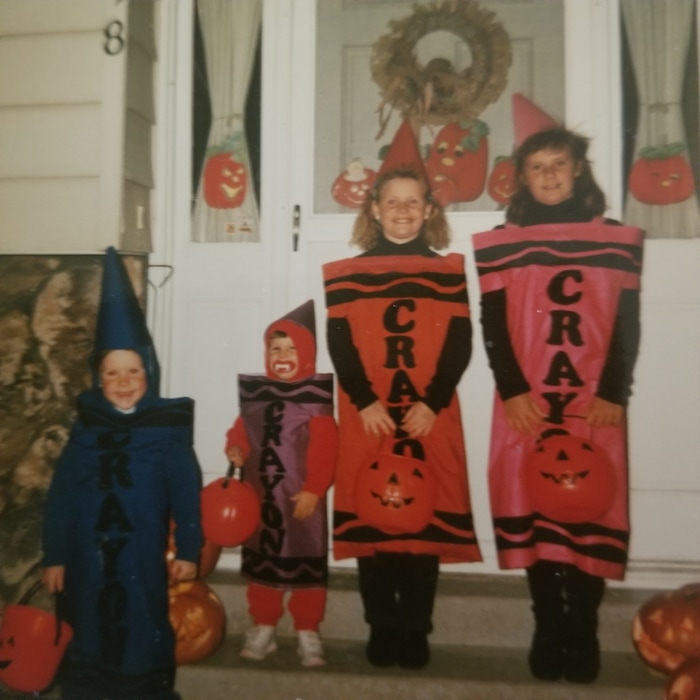
A family photo from Halloween 1990 depicts us four children (I was 6 at the time) standing on the front porch dressed as Crayola crayons, each a different color. Mom had pieced these costumes together without the help of the internet or any written pattern. After dad snapped the picture, we were sent off, a rainbowed party of four, to scour the neighborhood for treats. “You must be Cathie’s children,” a person would sometimes ask us. I don’t think I realized until much later this question was evidence both of a mother’s love and of her crafting prowess that had so preceded her that people just assumed the crayons came from her sewing machine.
I don’t know that I’ll ever again smell pumpkin seeds roasting without feeling like I’m 10. While we were out trick-or-treating, mom and dad stayed home, handing out candy and making pumpkin stew they’d then bake inside a pumpkin. They’d roast the seeds to sprinkle on top of our steaming bowls as soon as we returned home. While they dished up the meal, we’d scatter our candy across the floor for a great accounting, to then be followed by complex four-way trade negotiations not even the United Nations could have successfully mediated.
The age difference between my oldest sibling and the youngest is eight years — 1978 to 1986. It looks like something etched on a tragic tombstone when put that way. What those dates meant for mom and dad was that over the course of about eight years, they watched the trick-or-treating era of parenthood slowly slip away from them. In less than a decade, they went from sewing crayon costumes to wondering what happened to the time shivering children sprinted into the house to gobble up roasted pumpkin seeds.
(Robert F. Bukaty | AP) Halloween candy and decorations are displayed at a store in Maine in 2020.
We have to be here for the kids
I’ve now reached an age when I can appreciate and realize that I’m not sure our parents were ready for us to grow up. In the 2½ decades since I moved away from home, they’ve made sure to give me their annual report after every Halloween, calling me to tell me how many children came by that year.
“Not as many as we used to get,” mom says each time. She always sounds a tad sad.
For Halloween, my sisters will often invite them to their own homes in neighborhoods with a much higher per capita of children, but my parents always decline, feeling a sense of duty to hold down the fort for whoever shows up.
“We have to be here for the kids who live around us,” they’ll explain. We make it a point to bring our children to their house to kick off the night, before we have them wander our own streets, where our kids will make memories with the friends who are growing up alongside them.
Today, my three sisters and I live in different homes across the Salt Lake Valley, our parents essentially in the center of all of us. We have our own traditions now but also many of the same ones we used to observe.
Every Halloween, it makes me smile to think of us four now-grown-up crayons, coloring our own necks of the woods, each baking a stew inside a pumpkin to greet our children at the end of a chilly night in which they’re less underdressed than we once were. We help with the great candy accounting, and perhaps even broker some complex trade negotiations, before sending our kids to bed, wondering why on earth we often do all of this on a school night.
Off in the middle of the valley, mom and dad tally the night’s nonpaying patrons to our childhood home, wishing they had as many as they used to and no doubt longing for the days when their raggedy pillowcases returned with candy.
(Sarah Baltz) Tribune guest columnist Eli McCann.
Note to readers • Eli McCann is an attorney, writer and podcaster in Salt Lake City, where he lives with his husband, child and their two naughty (yet worshipped) dogs. He is the author of a recently released novel, “Stitched,” and a previous collection of his columns, “We’re Thankful for the Moisture: A Gay Guy’s Guide to Mormon Faith, Family, and Fruit Preservation.”