For just over nine months, I lived in a city in western Ukraine called Vinnytsia while serving as a missionary for The Church of Jesus Christ of Latter-day Saints. The early part of that stint covered my second Ukrainian winter, meaning large portions of my memories of Vinnytsia look like horror stories in my mind’s eye.
One day was so cold that a woman we had visited at the end of the evening refused to let us head home without calling a taxi. During the 10 or so steps from the door of the Soviet-era apartment complex to the cab, I felt so close to death I think I saw the face of God.
(Eli McCann) Then-missionary Eli McCann in wintry Vinnytsia, Ukraine, with its frozen river.
That following Sunday, my mission companion and I got stuck in a small elevator. We had just left our 10th-floor apartment to head to church services. This was during the height of Ukraine’s 2004 Orange Revolution, which had caused some utility disruptions, including the heat in our complex.
We had been sleeping in our winter coats and hadn’t showered in days. We were later told the building’s frigid temperatures had messed with the elevator equipment, which didn’t begin working again for three hours. We had stood, inches from one another, avoiding touching the walls that perpetually smelled like they had been doused in urine, for the entirety of that time. We didn’t have cellphones, and the church members worried about us when we didn’t show up.
The day before, I had baptized a young woman named Svetlana in our Latter-day Saint meetinghouse. When my companion and I arrived, we found there was no heat in the building, including hot water. We filled the font with liquid so cold I’m convinced it wasn’t H2O because otherwise it would have been ice.
When Svetlana arrived, I told her the situation, blowing fog into her face with each breath. I suggested we reschedule, but she refused because she had already invited family and friends.
As I dunked her in the water, I had a distinct thought: “I wonder if this is how it feels to slaughter someone.” I could hear her underwater screams, which then grew louder as she reemerged, causing something of a jump scare for the 30 or so spectators. She climbed out of the font so fast she left skid marks.
She did not continue attending church for long after this.
The ‘village people’
(Eli McCann) A Ukrainian villager fetches water at the beginning of winter in Medvezhe Vushko.
By spring, I felt like I had survived a tragedy. Eventually, we shed our coats for jackets and then shed the jackets for short sleeves — the same ones from “The Book of Mormon” musical, the uniform of my people.
There was a village just outside of Vinnytsia called Medvezhe Vushko that curiously had a critical mass of Latter-day Saints. The population of the town was only a thousand or so, but there were 15 to 20 church members among them — a lot per capita for this Eastern European country.
It was often difficult to visit Medvezhe Vushko during winter because the unruly snowbanks were difficult to navigate on foot. The walk from home to home, spread out by farmland, was also difficult when temperatures dropped below zero. But as the ground thawed, we found ourselves making our way to the village at least once a week.
The residents of Medveshe Vushko were largely similar to one another. They were relatively poor. One of the homes, housing a mom and her three teenage daughters, had dirt floors and although they had electricity, they didn’t turn on any lights because of the cost. They had an apple tree and some land where they grew onions, beets and potatoes. Every time we visited, they insisted we take a bag of produce with us. The beets were a deep red and purple that I had never seen before and haven’t seen since.
It sounds so trite and patronizing to talk about poor people and how happy they seem — especially when the speaker is rich, which, compared to these villagers, I certainly am. But it is just factually true that the villagers appeared to be among the most joyful people I’ve ever seen. There was something in the water in Medvezhe Vushko, and I wish it was a staple that could be exported.
Grandma Ludmilla
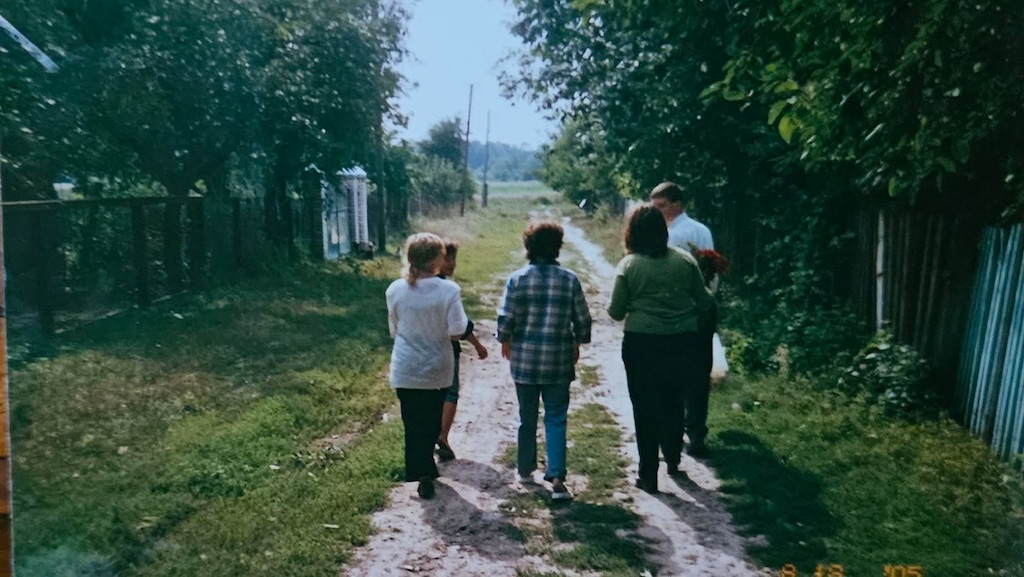
(Eli McCann) Then-missionary Eli McCann walks with "Grandma Ludmilla" in the Ukrainian village of Medvezhe Vushko.
We always started our visits with a stop at the home of a tiny fiery grandma named Ludmilla. I never left her house without devouring a bowl of borsch she had whipped up that morning. On our first several visits, I tried to decline the food because I didn’t want her to feel like she had to feed us, but I learned quickly any such effort was futile. I’ve now gone more than two decades wondering whether I’ll ever have a meal again as delicious as that borsch.
Ludmilla would pull a red flower-patterned silk scarf over her head and leave her home with us to visit the next house, occupied by a couple with a teenage son. They would join the caravan for our third visit to a widow who lived just on the edge of their farm and regularly tilled the land in nothing other than her temple garments.
(Eli McCann) Grandma Ludmilla's kitchen in the Ukrainian village of Medvezhe Vushko is full of the food she would feed the visiting missionaries.
It will forever be one of my most vivid memories: a dozen or more Ukrainians surrounding us as we hobbled our way through farmland, past endless rows of sunflowers, past silhouettes of women in the distance filling their dresses turned into makeshift bags and men pulling wagons ripe with the food the land had given them. The blue sky above the yellow fields of wheat, mimicking the country’s flag, never quite looked real to me, but like someone had increased the vibrancy settings on a camera.
(Rick Egan | The Salt Lake Tribune) A woman wakes the Ukrainian flag during a rally at Utah's Capitol in 2022.
We’d laugh — we were always laughing — as the people of Medvezhe Vushko engaged in harmless village gossip and teased us about our American accents.
We’d eventually notice the time, and the army of escorts would walk us back to the town’s bus stop for the only van that would be making a run to Vinnytsia that evening.
They would stand and watch us disappear, back to the city, away from this recently frigid tundra, now lush with deep black soil and the best people I’ve ever met.
(Sarah Baltz) Tribune guest columnist Eli McCann.
Note to readers • Eli McCann is an attorney, writer and podcaster in Salt Lake City, where he lives with his husband, child and their two naughty (yet worshipped) dogs. His new book is “We’re Thankful for the Moisture: A Gay Guy’s Guide to Mormon Faith, Family, and Fruit Preservation.”