 Robert Gehrke
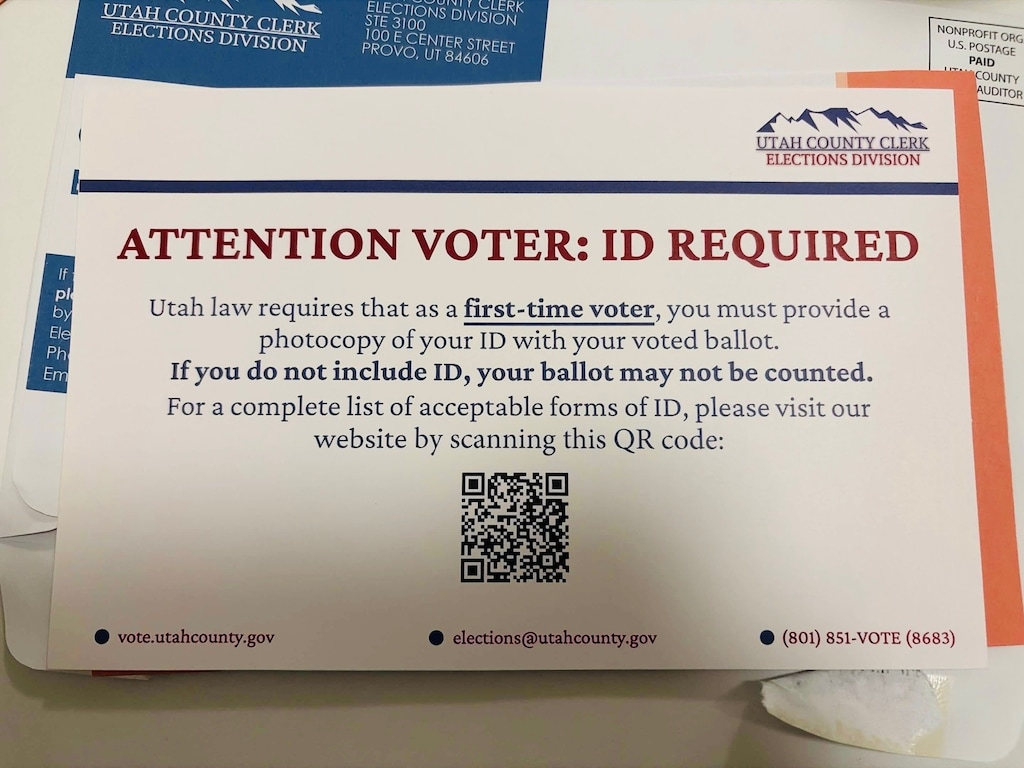
The Utah County Clerk’s Office sent notices in thousands of voters’ ballot packets that incorrectly tell first-time voters that they must provide a copy of their identification or their ballot may not be counted.
In an unknown number of instances, the message about identification being required was also sent to residents who had voted previously.
“It’s just a clerical mixup and some miscommunication and people got it who probably didn’t need to,” Utah County Clerk Aaron Davidson said in an interview. “It wasn’t anything mischievous, it wasn’t anything nefarious. It was just a misunderstanding.”
A flyer was supposed to be included in the ballot packet of certain first-time voters, informing them that, “as a first-time voter, you must provide a photocopy of your ID with your voted ballot.” Then, in bold text, it reads: “If you do not include ID, your ballot may not be counted.”
For some — those who registered to vote with a third party, such as groups gathering signatures on initiative petitions — that may be true. If they didn’t provide identification, they are required to do so in order to vote by mail, according to the Utah Elections Handbook from the lieutenant governor’s office, which oversees elections statewide.
(Trent Nelson | The Salt Lake Tribune) Utah County Clerk Aaron Davidson in the ballot counting center at Utah County's Administration Building in Provo on Tuesday, Nov. 5, 2024.
But it is not true for anyone who registered at the clerk’s office, for example, or when they got a drivers license. Those people had to prove their identity at the time. Clerks are instructed in the handbook to compare the voter registration against the drivers license database — done by punching one key — and, if they match, no other ID is required to vote by mail.
The Utah County notices went out to voters who had already provided identification. Davidson said he has also heard it went to residents who had previously voted. Neither should have received the message in their ballot packet, he acknowledged.
Davidson said there must have been a clerical error or miscommunication with the printer and the message was included with ballots mailed to people who have already provided their identity. He said he did not know how many received it in error.
“We are still trying to figure out how this even happened, because we had that number [of residents who should receive the ID requirement message] really low,” he said, “and then there was just some miscommunication and this kind of exploded.”
Carren Crossley, an organizer with the group Brave Utahns Rapid Response Network, said when the issue was brought to its attention, it couldn’t get an answer from Davidson’s office about how many of the notices were sent. But, she said, the lieutenant governor’s office contacted the Utah County office and reported back to BURRN that it had been sent to 7,000 voters.
The lieutenant governor’s office did not immediately respond to questions about the ballot message.
BURRN has four examples, Crossley said, of voters who received it in error: a person who provided three forms of ID while registering when she got her new drivers license; one who applied online; a longtime resident who had voted previously; and another resident who is politically active and had kept their voter registration active.
There is no common thread to explain why the four would be flagged, Crossley said, or why they each “couldn’t get a straight answer” from the clerk’s office when they called, as they later told BURRN.
“If the office responsible for elections doesn’t know why these people were singled out and there’s no unifying thread among any of them, why was it sent in the first place?” Crossley wondered.
Ultimately, Crossley said, her concern is that the notices will create confusion among voters, make them jump through hoops they don’t need to clear and potentially discourage some people from voting.
Davidson said he doesn’t “want to throw the lieutenant governor under the bus,” but added there was a “mixup in communication” with his staff and the direction from the lieutenant governor was unclear on whether first-time voters had to provide identification. The law says they are supposed to do so, Davidson said, and his office was given conflicting directions on how or whether to verify the IDs against the drivers license records.
Davidson has been an outspoken proponent of in-person voting and voter identification requirements, believing voting in person increases election security.
A study released this week by Utah Valley University found that there is no security advantage to in-person voting.
Davidson lost his Republican primary earlier this year to Corey Astill, who won the backing of Republican officeholders who said they were frustrated with Davidson’s crusading and mistakes made by his office.
Two years ago, some voters waited in line for close to three hours because voting locations ran out of ballots. The clerk attempted to print more and ran out of ink and then ballot paper, prompting the lieutenant governor to dispatch a state plane to Arizona, the closest location where the office was able to find the right type of paper.
Davidson said at the time that sending the plane wasn’t necessary and he found larger paper and was able to have it cut down so ballots could be printed.
Davidson also did not send out prepaid return envelopes with ballots last year — even though the county commission had budgeted for it — creating confusion among voters about whether they had to put a stamp on their ballot in order to return it.
Instead, in the postage field, the ballots said “POSTAGE REQUIRED IF MAILED.” That is not the case. The U.S. Postal Service delivers unstamped ballots and bills the county for the expense.
Davidson created a further issue when he told the Deseret News that he had tracked the ballots of certain elected officials he accused of politicizing the “stamp/no-stamp” issue. Ballots are supposed to be secret under Utah’s Constitution.
In 2025, Rep. Stephanie Gricius, one of the elected officials whose ballot Davidson had flagged, sponsored legislation — which passed overwhelmingly — classifying a ballot as a private record and making it a class B misdemeanor to track any individual ballot.