In the spring of 2021, I had just completed a triathlon and went to dinner with my parents and my husband, Skylar, to celebrate. We sat around a round table in St. George, where, during a lull in the conversation, my then nearly 70-year-old mother retrieved a lemon from her purse and began cutting it.
This was not a surprise. I was certainly used to my mom’s practice of bringing her own lemons to restaurants “because they don’t know how to pick out the good ones from the grocery store like I do.”
Mom began squeezing her lemon into the icy Diet Coke that had just been delivered to our table as she said, in a near mumble, “there is a lot of drama going on in the quilting community right now.”
Skylar, my dad and I looked at her, puzzled, as she continued, before taking a sip of her drink and without looking at any of us, “especially with the Australians.”
Though not a quilter myself, I was generally familiar with that world. I like to say I grew up under a quilting frame. Some of my most vivid childhood memories involve my younger sister and me playing with toys under pieced fabric acting as a fort above us, while my mom and half a dozen of her friends sat around the edges methodically and almost rhythmically dancing a needle up and down through the cotton in a group effort to get their communal work of art completed in time for a quilt show or competition they had spent months preparing to attend.
They would talk about whatever it was young Latter-day Saint moms talked about in the 1980s and ’90s. Recipes. Canning supplies. Harmless neighborhood gossip. Many of these quilting sessions took place in the women’s Relief Society room at the neighborhood church. The women would take turns checking on the gaggle of children they had brought and deposited to play in the cultural hall, where we dared one another to crawl into the demonic caves under the stage, where chairs were stored.
Common Threads
(Eli McCann) Tribune guest columnist Eli McCann with his mother, Cathie McCann.
A good chunk of my childhood included my family members spending weeks walking around a quilt on frames taking up a good portion of our family room, where mom and her friends slowly made meticulous progress on ornate decorative stitching of a pieced blanket they had spent weeks assembling.
All of this group quilting and crafting happened so passively and casually around me for decades that I don’t know it ever occurred to me any home anywhere was any different. An entire room in our house was completely dedicated to the hobby — ”mom’s sewing room,” we called it. There, one could wander in and step around a dozen or more projects in all stages of completion. Dresses needing mending. Baby blankets for the neighbors’ new grandchildren. Halloween costumes imagined from scratch and assembled from scrap. And, always, a quilt.
“Well, go on then,” Skylar told my mother in 2021 after the remark about the Australians.
For the next two hours, we sat around the table in that St. George restaurant asking follow-up question after follow-up question as mom dished about talented quilting groups who were territorial about their processes and didn’t like to share them with others. About the ruthlessness and cutthroat nature of large quilting competitions. About her own quilting group, Common Threads, that had been working together for decades and was harder to join than the Illuminati. About how anyone in Common Threads would take a bullet for any other member.
‘You have to write a book about this’
As we left the restaurant that night, Skylar told me, “that was genuinely riveting.” I agreed, and I was honestly surprised to agree. I had gotten to the point where I could admire my mom’s impressive work, but I don’t know I had ever stopped to think about how the construction of that work and those responsible for it might be so interesting.
We climbed into the car and the moment we shut the doors, Skylar turned to me and said, “Eli, you have to write a book about this.”
I laughed. I certainly was not equipped to write a book about quilting. But he clarified: “Not a book about quilting — a book about people who quilt. You need to write a novel about a group of older women who have quilted together for decades. I want to read that book.”
We stayed up late that night, mapping out the story of six older women recruiting two younger gay men to join their group and help them make a quilt for a competition against their bitter rivals — another group of older women who had bested them in every show for decades.
The first obstacle in preparing to write this was to persuade my mother to let me attend quilt night with Common Threads for research purposes. After consulting her friends, she came back to me with permission on one condition: “If you are going to come, you have to entertain us.”
(Francisco Kjolseth | The Salt Lake Tribune) Quilting fabrics at My Girlfriend’s Quilt Shoppe in Sandy in 2022. Tribune guest columnist Eli McCann has written a novel about a women's quilting club.
A group bound together by craft
I stood at the door that first night, ready to enter, my heart pounding, clutching a proverbial golden ticket to what felt like Willy Wonka’s deliciously secretive chocolate factory.
Over the next two hours my suspicions were confirmed: This was a group of people whose lives were worth examining, a group often ignored by the media, a group as interesting as they are hilarious, as talented as they are sarcastic, as thoughtful as they are supremely good at gossip.
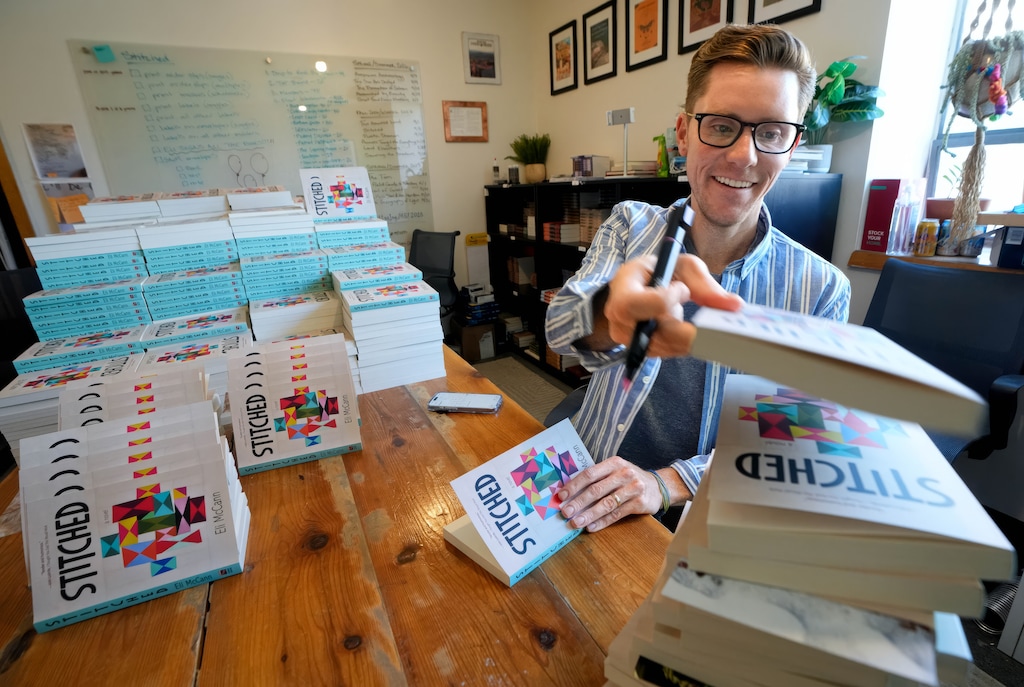
I finished the novel, and decided to call it “Stitched,” because that word encapsulated ultimately what I’ve observed of my mom and her friends, and of many groups of people who create art — that they are bound together.
In a way, researching and pouring myself into this felt a little like I was stitching myself to my mom, understanding her to a degree I don’t know I had before. (“Stitched” releases Sept. 8.)
When Skylar finished reading the final product, he said to me, “you know, more people should do this.”
“Do what?” I asked.
“Well, I wanted to read this story, but no one had yet written the book,” he replied. “So I simply commissioned it.”
Easy.
(Sarah Baltz) Tribune guest columnist Eli McCann.
Note to readers • Eli McCann is an attorney, writer and podcaster in Salt Lake City, where he lives with his husband, child and their two naughty (yet worshipped) dogs. His previous book, “We’re Thankful for the Moisture: A Gay Guy’s Guide to Mormon Faith, Family, and Fruit Preservation,” is available now. “Stitched” will be released Sept. 8.