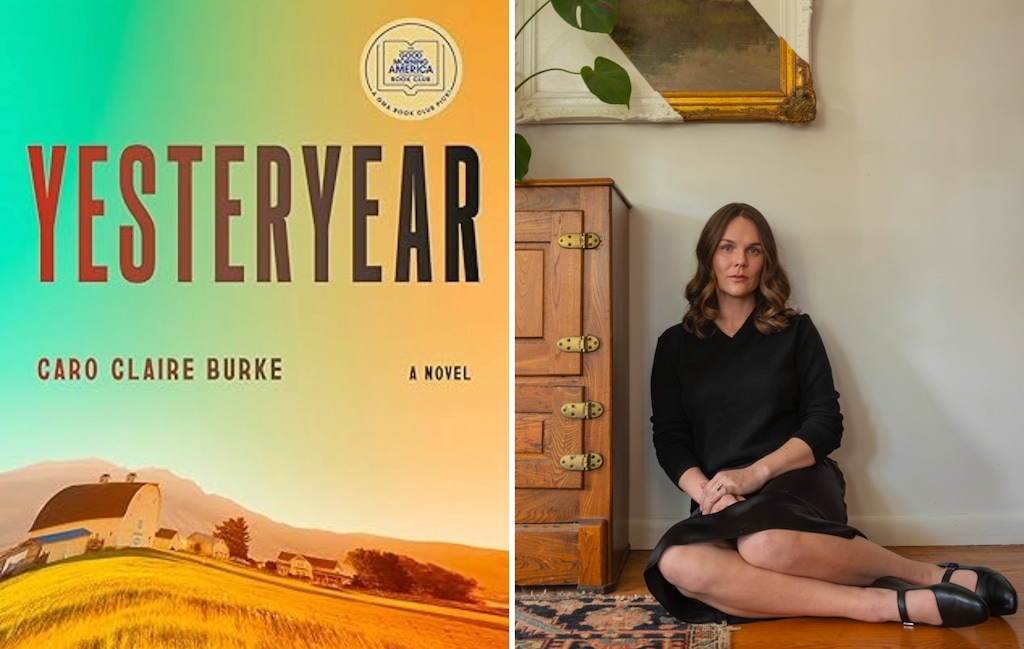
The novel “Yesteryear” by Caro Claire Burke is one of the buzziest books of the year. I read it because someone told me it was based on Hannah Neeleman, the Latter-day Saint tradwife influencer behind the Ballerina Farm social media empire with 10 million followers. The author herself has said she took inspiration from Latter-day Saint influencers, specifically calling out Neeleman and the cast of “The Secret Lives of Mormon Wives.”
I was surprised, then, to find that the book’s protagonist, Natalie, was not recognizable as a Latter-day Saint in any material way.
If you haven’t read the book and don’t want to wait the 75 weeks you’ll have to in order to get it from your library, allow me to catch you up on the premise.
Natalie is the world’s worst human, masquerading as the perfect mom rearing six children on a homestead called Yesteryear Ranch. She seems to have it all until one morning she wakes to find herself transported back to 1855 on an actual homestead, living the miserable life she’d previously romanticized on the internet.
Natalie is a zealot whose religion essentially boils down to gender roles. She does not like her husband but forces herself to have 10-plus of his children. We never see her go to church; there is no mention of a religious community. We see her clinging to religion out of sheer terror from the God who invades her thoughts, and yet we never learn what the stakes are if she chooses to live a different way. Despite spending many pages inside Natalie’s head, we get zero moments of genuine reflection or interiority; not a clue as to what she, at her core, wants.
Natalie can basically be boiled down to a religious-and-therefore-crazy-and-unreliable-narrator. And that’s where I got bugged.
Over the years I’ve been following Latter-day Saint representation in mainstream media, I’ve watched the mentions of my religion shift from throwaway references to Mormons’ (always off-screen) polygamy, sobriety, and big families, to church members being the center of attention. I had hoped that this centering might also result in some nuance or genuine curiosity. But even now, when we find ourselves in so much of the spotlight, we don’t control the story.
(Kim Raff | The New York Times) Hannah Neeleman, shown in 2024, rolls out dough to make noodles at her and her husband’s dairy farm, Ballerina Farm, in Kamas.
Of course, the biggest current (if messy) example is “The Secret Lives of Mormon Wives.” I can only laugh that this show posits itself as a platform to empower previously muzzled women; that Hulu has finally given them what they needed to smash the patriarchy. In reality, this show exists to exploit its cast members for a religion to which most of them no longer even subscribe. Yes, they are willing participants who’ve been made massively famous and wealthy, at least for now, but I’m interested in the story. And not one of the women on “Secret Lives” is in control of their onscreen narrative.
This is why “Yesteryear” was frustrating: I want it either to be about me or not be about me.
Is LDS scrupulosity different?
I’m aware this is a me problem and a petty one at that, but it feels as though putting a religion under a microscope but then not looking through the lens is another form of exploitation. At this point, I’d love for these creators to either stop looking at me, or look more closely.
I’ve seen some commentary that “Yesteryear” is in fact about Mormonism because of Natalie’s intense scrupulosity; specifically the way she edits her own thoughts because God is always watching. It was the strongest tie for me, and the most genuine argument I’ve heard for why Latter-day Saint women make up so many successful influencers. There’s a line about how “Jesus is the original audience member” — how Christians have been performing perfection long before their phones gave them access to an audience. It’s a fascinating argument and yet I found myself wondering how Latter-day Saints specifically experience scrupulosity. Is our version materially different from other Christian religions, and if so, how?
But Natalie’s scrupulosity is never examined. It’s just one aspect of her intense mental instability, which I feel strangely comfortable calling “crazy” because it’s the only word that belies the level of care or curiosity the author gives her main character’s mind — none.
It’s more than likely the author wanted to keep Natalie’s religion vague so as to be broadly relatable, and make it extreme so as to provoke discussion. It’s possible she wanted her main character to feel like part of the evangelical right because of the current political landscape. But to write a character so clearly drawn from a real Latter-day Saint woman and then not make her a Latter-day Saint woman seems like a missed opportunity.
If Burke was looking for ammo on how participation in religion can mess with a woman’s mind, she left a whole stockpile untouched.
What if?
Just imagine the “husband lists” we could have seen Natalie make in her Young Women class. Or the strong community she came from and the pressure she felt to mimic a lifestyle she was fed at church. Maybe the book could have highlighted the vast wealth that colors corners of Latter-day Saint populations and the complexities of marrying into “Mormon royalty.”
Or take gender roles. One of the major themes in “Yesteryear” is that Natalie and her husband, Caleb, seem to have been born with the opposite tendencies for their gender. I couldn’t help but be reminded of the massive reaction to a recent social media post in which we saw a Latter-day Saint man happily take a back seat to his wife’s medical career. How much more interesting could Natalie and Caleb have been if their gender role struggles were framed within the family proclamation?
Natalie’s father-in-law is essentially Mitt Romney, except for the part when he becomes completely corrupt and embraces extremism in an attempt to win his election. What if he had been as complicated as the real Mitt? Or what if he had been a church general authority instead of a politician, but also a total jerk? I’m guessing the response Burke’s publisher would give is “well, no one knows what a general authority is.” No one knew what a Minister of Magic was either.
I’m not asking the mainstream media to pump out positive propaganda for my religion. But what will it take for an artist to exert genuine curiosity about The Church of Jesus Christ of Latter-day Saints?
Mormonism strikes me as such a fertile world for art. It is complicated and beautiful and problematic and weird, and, from my apparently unreliable opinion, being part of it does not make you crazy.
For my part, I’ll continue to hope that someday Mormonism can be taken seriously; by which I mean be looked at with enough curiosity to do one Google search. For now, it seems we’ll remain peculiar. Being written about as though we’ll never enter the room. Being satirized, in the laziest way possible, in one of the biggest books of the year.
(Rebbie Brassfield) Tribune guest columnist Rebbie Brassfield.
Note to readers • Rebbie Brassfield is a writer and creative director in the advertising industry. In real life, she’s a mom of two boys living in the suburbs. Online, you can find her overanalyzing media representations of Latter-day Saints on her Instagram account or podcast, “Mormons in Media,” and as co-host of a monthly “Mormon Land” bonus podcast on Latter-day Saints in media.