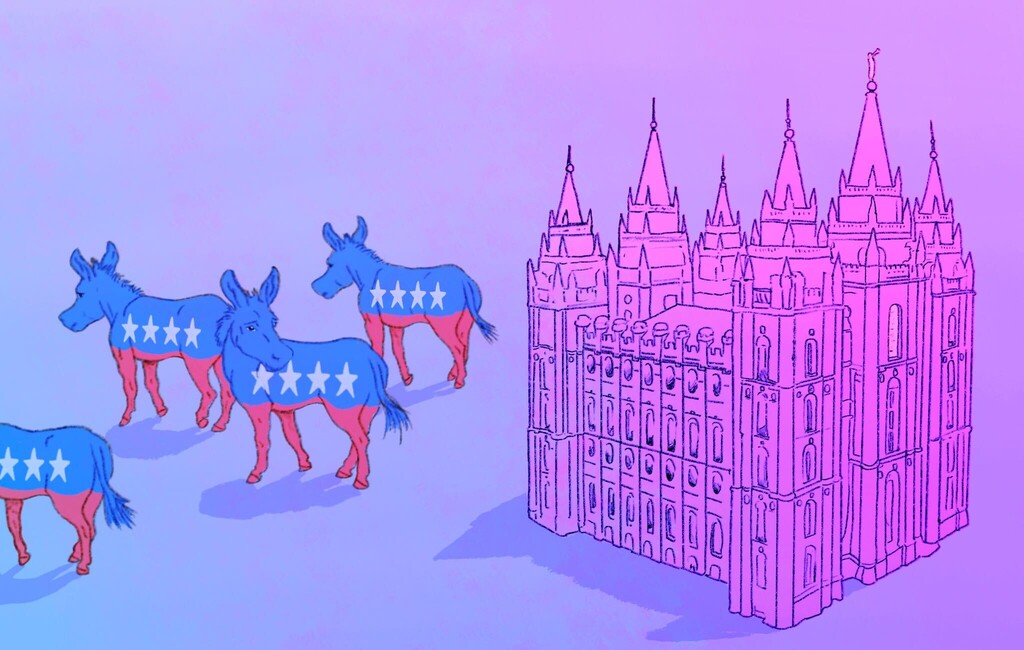
Scholars once believed that religion influenced political identity. They are now observing, however, the reverse phenomenon: political identity shaping religious identity. This is why liberal members of The Church of Jesus Christ of Latter-day Saints face a heightened risk of alienation from their faith and warrant special attention.
Latter-day Saint liberals have long been a minority, but the long-term risks of losing them completely have never been greater. Many of these liberals belong to younger generations, threatening to deplete the faith’s ranks for decades to come.
In this new era of political, ethical and informational polarization, it is becoming harder for liberals to share a faith with fellow believers who do not seem to share their basic values.
The “God Gap,” a significant aspect of a broader demographic shift in the American public, as discussed in Michele Margolis’s 2018 book, “From Politics to the Pews: How Partisanship and the Political Environment Shape Religious Identity,” reveals that Democrats are increasingly distancing themselves from religion. The religious right’s success in establishing a strong link between religion and conservative political identity is now backfiring on faith itself. Making religion more politically conservative doesn’t necessarily make religious people more conservative. It also makes less-conservative people less religious.
“I could no longer reconcile my personal values and priorities with those of the church.” In the 2016 Next Mormons Survey, nearly 40% of former Latter-day Saints ranked this as the top reason that they stopped affiliating with the church. Other top reasons included valuing such things as truth telling, the role of women and LGBTQ issues. More and more those who find themselves leaving the faith lack confidence in their religion’s basic goodness for themselves, for others and the world.
These concerns are not restricted to Latter-day Saints. Another recent survey shows, similarly, that 42% of people who left religion cite religious hypocrisy as the reason. Religious bigotry and prejudice against LGBTQ people were the reasons given by 31% and 24% of respondents, respectively.
A generation and gender gap
(Bethany Baker | The Salt Lake Tribune) Women in The Tabernacle Choir at Temple Square perform at General Conference. Surveys show women are becoming less likely to identify with conservative politics.
All of this adds up to a risky gamble for The Church of Jesus Christ of Latter-day Saints by being seen as too closely associated with conservative politics in its leadership and membership. Republicans and Republican-leaning individuals represent about 73% and Democrats and Democratic-leaning members represent about 23% of the U.S. Latter-day Saint community, but these overall numbers can hide significant generational shifts. While Generation Z represents an outlier in the overall trend, Gen X and millennial Latter-day Saints are about 50% Republican or Republican-leaning. These are also among the generations least likely to remain affiliated with the faith.
This generation gap is exacerbated by a gender gap, with younger Latter-day Saint women far less likely to identify with conservative politics. For the first time in history, we have also crossed a threshold with more Latter-day Saint women leaving the faith than men. This trend already has caused profound shifts in dating and marriage patterns, education and income levels, and has been a source of significant anxiety as women grow less and less devoted to patriarchy.
It isn’t just those who have left but those who are more marginal as well. In fact, 1 in 4 Latter-day Saints report that they have thought about leaving the faith. A 2009 Pew survey shows that Latter-day Saint Democrats are less likely to attend church services weekly, an indication of their ambivalence. It would hardly be surprising if these numbers have swelled since Donald Trump’s initial election in 2016.
There are several reasons why the decline in Latter-day Saint Democrats is particularly impactful for the faith tradition. While liberal Latter-day Saints never held significant power, the diminishing influence of their voices is noteworthy. It has been more than 50 years since apostle Hugh B. Brown, the last identifiably progressive senior church leader, died. Additionally, it has been nearly a decade since Nevada Sen. Harry Reid, who died in 2021, held the highest-ever elective office of a Latter-day Saint and was a key figure in the Democratic Party. Since 2021, there have been no Latter-day Saint Democrats in Congress. Consequently, the visible ideological diversity of Mormonism in ecclesiastical and national political representation has effectively vanished.
(John Locher |AP) Former U.S. Sen. Harry Reid, shown in 2019, became the highest-ranking U.S. Latter-day Saint ever to hold elective office.
Rise of the right
This lack of noticeable political diversity also corresponds to an increase of polarizing Republican Latter-day Saints. Utah Sen. Mike Lee’s inflammatory rhetoric and submission to the worst of Trump’s abuses can reflect poorly on Latter-day Saints’ sense and morality. We are also now known for dishonest media figures like Nick Shirley and dupes like Glenn Beck. Zealots such as Ammon Bundy fill out the high-profile far-right Latter-day Saint roster. The Utah GOP’s increasingly desperate attempts to overturn the will of the voters for fair representation — first by ignoring the redistricting law and then by packing the courts in its favor — tends to paint Latter-day Saint conservatives as lawless extremists.
Universities remain about the only prominent place where a liberal Latter-day Saint tradition can exist and sometimes thrive. But even in these spaces, more progressives are finding themselves on life support. The church’s university administrators have targeted faculty and prospective professors in order to mute and eliminate intellectual and faithful diversity. It would be hard to characterize Brigham Young University faculty in whole or in part as particularly liberal in the wider context of higher education, so the shrinking ground there is even more concerning.
There is no simple solution to these problems. The further polarization of the Latter-day Saint community and the resulting Democratic disaffiliation align with significant trends that need to be addressed. This isn’t just about asserting partisan neutrality or warning people against single-party voting — as the church’s governing First Presidency has done. That can do little to connect with those who cannot bring themselves to vote for any Republicans right now.
In an era characterized by Trump’s divisive rhetoric, dishonesty, corruption, authoritarianism and illegal acts, liberal Latter-day Saints might find solace in knowing that their political convictions align with their faith — even if many in their faith cannot readily discern this connection. Church leaders may need to adopt strategies to communicate shared values and even adopt a more liberal tone to secure the faith of liberal Latter-day Saints. This could involve inviting liberals to participate at all levels of the church and working to protect a pluralistic community of faith — not merely tolerating or paying lip service to it. Greater visibility and promotion of liberal Latter-day Saints might help more individuals “reconcile their personal values and priorities with those of the church.”
(Taylor Petrey) Taylor Petrey is a professor of religion at Kalamazoo College in Michigan.
Note to readers • Taylor G. Petrey is a professor of religion at Kalamazoo College. He is the author and editor of numerous books and articles, including “Tabernacles of Clay: Gender and Sexuality in Modern Mormonism.” This column is available to Salt Lake Tribune subscribers only. Thank you for supporting local journalism.