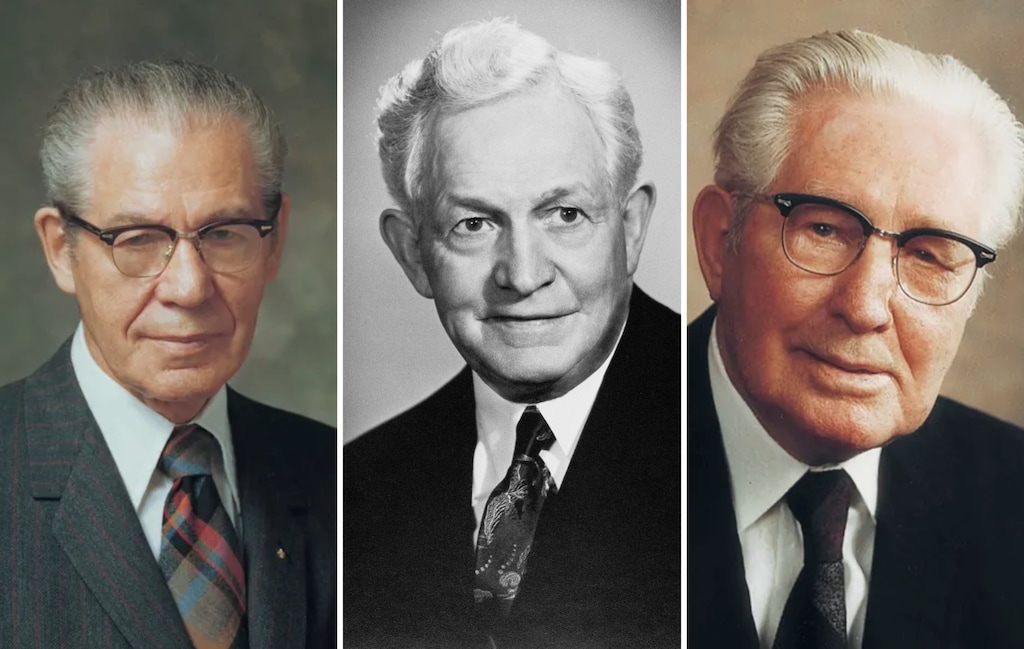
To many liberal members of The Church of Jesus Christ of Latter-day Saints, apostle Hugh B. Brown stood out as an ecclesiastical icon, a fierce warrior for social justice and a passionate proponent of ending the faith’s former temple/priesthood exclusion of Black members.
Still, Brown was not without his critics, including some strong opponents among the church’s highest leadership ranks.
As a member of the governing First Presidency from 1961 to 1970, for example, Brown wrangled with future church Presidents Harold B. Lee and Ezra Taft Benson, as well as other apostles.
For a generation of Latter-day Saints, Brown was a gifted orator who offered “understanding and counsel,” historian Richard D. Poll wrote in Dialogue: A Journal of Mormon Thought. “He was a multifaceted, magnificent human being.”
Yet Brown eventually was dropped from the First Presidency and spent his final years in some bitterness and sorrow.
Here are lightly edited excerpts from The Salt Lake Tribune’s “Mormon Land” podcast with Matthew Harris, history professor at Colorado State University Pueblo and author of “Second Class Saints: Black Mormons and the Struggle for Racial Equality,” who is currently working on a biography of Brown.
(Courtesy) Historian Matthew Harris, right, is the author of this new book about the former priesthood/temple ban against Black members of The Church of Jesus Christ of Latter-day Saints. He is writing a biography of Hugh B. Brown.
What stood out about Brown’s life before he entered church service?
He was born in the Utah Territory in the 1880s and when he was a teenager, his family moved to western Canada, which was what defined him. But the truth is that he had feet in both countries. He spent most of his adult life in the United States but went back to visit family periodically. He was a dabbler in a lot of things. He would be a lawyer. At one point in his life, he’d be a businessman. He was a cattle rancher. And he grew up in a large family. He was exposed to [Latter-day Saint] general authorities through the years. …When he was a young boy, apostle Heber J. Grant visited this Canadian ward of his and prophesied that one among them would be an apostle one day. Afterward his mother, Lydia Brown, told Hugh, “He’s talking about you.” Later, the bishop of the ward approached young Hugh and said, “He’s talking about you, and this honor and this privilege can be yours — if you live a righteous life.” Hugh B. always had that prophecy etched in the back of his mind.
Why then wasn’t Brown called as an apostle until he was in his 70s?
(The Church of Jesus Christ of Latter-day Saints) Church of Jesus Christ of Latter-day Saints apostle Hugh B. Brown.
In the early 1930s, after Prohibition was repealed, there was a liquor commission that the church wanted to have a pulse on. The three-man commission was to dole out liquor licenses after Prohibition’s repeal. So when businesses applied for a liquor license to sell liquor, that commission would review it. [Church] President [Heber J.] Grant asked [Hugh] to chair this commission, and so he did. It came back to bite him in the butt because several people started to accuse Hugh B. and his two fellow commissioners of taking bribes to the businesses that got the liquor licenses. [After] an investigation, they found that [the men] were innocent of the bribery charges, but perceptions often become reality. [Apostle] David O McKay was the first counselor in the First Presidency at the time. He showed up to the Granite Stake in Salt Lake, where Hugh B. was a beloved stake president and effective leader, and abruptly released him. Hugh B. had no idea it was coming. They also released him from the board of directors at the LDS Business College. He is crushed because he’s been told that he’ll be an apostle. He’s so upset that he …moved to Glendale, California, and the [church leaders] realized that, “We asked him to do this, and this is what happens, and this is how we treat him.” …In 1953, about 13 or 14 years after the liquor scandal, [apostle] Harold Lee and others convince President McKay to call Hugh B. Brown into the general authority ranks. But he’s called as an assistant to the apostles. I conclude that this is President McKay’s way of saying, “All right, let’s see if you can prove yourself.” Five years later, he gets elevated into the Quorum of the Twelve [Apostles].
Eventually, McKay chose Brown as a counselor, so why were their ties so often strained?
It’s a tragic story, because they started off on the wrong foot [with the liquor scandal]. As an assistant, he won President McKay’s favor by working very diligently on his high-profile assignment, which was to look at temple marriage cancellations in couples who are going to apply for a temple divorce… Hugh B. Brown demonstrated such prowess and thoughtfulness and exhaustiveness in his research that his son later bragged that President McKay never once overturned [Brown’s] recommendations. … By 1958, when he was called into the Twelve, he embarked on a second critical assignment to France, where some missionaries were practicing or teaching this idea of plural marriage. Imagine these 20-year-old young men telling their mission president, telling local bishops, telling the people that they’re teaching, our church got it wrong on polygamy? That there never should have been any Manifesto [which marked the beginning of the end of polygamy in the church]? They fell under the sway of an older missionary named William Tucker, who was 23 and a graduate of UCLA. These younger missionaries looked at this older, charming, eloquent, articulate missionary — the ringleader. Hugh B. interrogates Tucker much as a lawyer would a client:
“Do you believe that David McKay is a prophet?”
“Nope,” the missionary replies.
“Do you believe that the church erred in the Manifesto ending polygamy?”
“Yep.”
The guy was defiant to the bitter end.… They excommunicated nine of these missionaries. That experience brought both of these men together. Some 21/2 years later, President McKay called Hugh B. to be his counselor after only being in the Quorum of Twelve for three years. But from 1965 up until McKay died in January 1970, the president was on the outs with Brown and also [apostle] N. Eldon Tanner. They just had differences of leadership, differences about decision-making. Still, Brown spoke at McKay’s funeral and said, “I wouldn’t be the man that I am today without David O. McKay giving me a chance.”
What about his ups and downs with Harold B. Lee?
(The Salt Lake Tribune) Church President Harold B. Lee clashed with fellow apostle Hugh B. Brown over the faith's former priesthood/temple ban against Black members.
It goes back to when they were stake presidents together in the stake presidency. Harold B. Lee was this dashing, young, brilliant administrator. He’s the mastermind behind the church’s welfare program. It’s a pilot case for his stake that later gets adopted writ large for the church. … Hugh B. copied some of Lee’s ideas about church welfare during the Depression and also applied it to his Granite Stake. So they’re very close friends. … By the 1960s, though, a couple of things happened that really led them to fall out. One is that Hugh B. is actively pushing to end the temple/priesthood ban. And he’s talking to reporters and trying to put pressure on the [leaders] to lift the ban. Elder Lee is a very rock-ribbed institutionalist. This is not what one does. The other strain is that Elder Lee is the mastermind behind the “correlation” program, having the same doctrinal message around the world with the same manuals. But what that means is that the Young Women, Young Men, the Relief Society and all the different journals are now going to come under one head. They’re going to lose their autonomy and the independence that they had once enjoyed. Elder Lee’s really pushing for this, and Hugh B. pushes back, saying, “This is wrong. They need their independence.” Secondly, if there is going to be a controlled, coordinated effort from Salt Lake City, it’s going to come from us, the First Presidency, not from the Twelve. President Brown thought his old friend was on a power grab. In 1969, President Brown is pushing again to end the ban, and Elder Lee is just furious with him. Lee is the one who tells [apostle] Joseph Fielding Smith, when he’s put in as the next prophet, “You can’t retain him as the counselor. It’s got to be me.” Brown is furious that Lee pushes him out of the First Presidency.
Finally, what about Ezra Taft Benson?
(The Salt Lake Tribune) Apostle and eventual church President Ezra Taft Benson championed conservative politics. Apostle Hugh B. Brown touted liberal causes.
Benson was a strong-willed partisan, just like Brown was, but Benson felt the need to push his views on the church. His biographer Francis Gibbons said there was seldom a sermon in which he gave in the ’60s in which he didn’t talk about politics. And it wasn’t just that he was always talking about politics, but he was saying abrasive things like “if you believe in civil rights, you’re an apostate. If you’re a liberal, you’re really a Communist. You can’t be a Democrat and a good Latter-day Saint.” …Then Benson’s linkage with the John Birch Society — this extreme anti-Communist organization — really puts everything over the top. Brown would fight back, both in public and private.
A little-known fact: Brown’s daughter was married to polygamist Rulon Jeffs, the father of the infamous Warren Jeffs, who’s in prison for child sexual assault. What happened?
Hugh B. is in England as a mission president, and he receives word from his daughter Zola Jeffs — the mother of his two grandchildren who is married to a guy named Rulon Jeffs — that Rulon was going to take a plural wife. Rulon’s father, David Jeffs, was one of the ones who didn’t think the church ought to give up this divine law [of polygamy]. Rulon has a vision and sees this woman in Provo who’s to be a second wife. Zola, of course, is crushed and doesn’t want to share her husband, but he convinces her that this is what God wants. When word gets back to Hugh B. that this is going down, he flies home from England unannounced and shows up in his daughter and son-in-law’s house in Salt Lake. He basically tells Rulon, “If you want to stay married to my daughter, these are the things you have to do: You can’t go to any more polygamous meetings. You can’t give them any of your money. You can’t read their literature. If you see your father, you have to bring Zola.” Zola’s just crying in the corner, sobbing uncontrollably, because she knows her father’s right, but yet she loves her husband. A few years after that encounter, they finally petitioned for divorce.
How did Brown become a champion of liberals?
When he first comes to the United States in the 1930s, he’s asking everybody he knows, “Should I be a Republican or Democrat?” Heber J. Grant, who later changed but was a Democrat at the time, told him, “Be a Democrat.” Some of the Republicans said, “Be a Republican.” So he becomes a New Deal Democrat, which means that he’s a New Deal liberal…In the 1930s, it means that the government ought to intervene in the economy to level the playing field. … By the 1960s, the Democratic Party and its conception of liberalism will evolve, and Hugh will evolve, too. Liberalism is also the government intervening into the lives to bless racial minorities, and Hugh will be caught up in this.
The arc of Brown’s life is similar, in some ways, to that of apostle Dieter Uchtdorf — a man of several countries, a popular speaker, perceived as progressive, dropped from the First Presidency. What do you think of that comparison?
(The Church of Jesus Christ of Latter-day Saints) Apostle Dieter F. Uchtdorf, speaking at General Conference in April 2025, was removed from the First Presidency when Russell M. Nelson became church president.
With Uchtdorf, the public line [for being removed from the First Presidency], as I recall, was that we want to prepare President [Dallin H.] Oaks to be the next church president [after Russell M. Nelson]. And there is some truth to that. I mean, when David O. McKay put Joseph Fielding Smith into the First Presidency. That’s one of the things he said. … But with Uchtdorf, and I’m speculating, is that he was … too beloved, he was too liberal. That was too much for some of the brethren. … The last thing I’ll say on that is that President Nelson, this is how it works, is built on relationships. He was not close to Uchtdorf, and he recognized in Oaks, they came into the quorum roughly about the same time, back in 1984. and so they came up into leadership together. They were close. Obviously, Oaks has a legal mind and he felt the church needed those legal issues at the highest quorum, the highest level. Uchtdorf didn’t provide that.
Brown had a commanding presence at the pulpit. Two of his sermons, “Profile of a Prophet” and “God is the Gardener,” still circulate among members today. What were your impressions of him as a speaker?
I read a transcript of a talk [he gave to missionaries in Boston] and everything that makes him a powerful speaker is on full display — his humor, the depth of his thinking, his ability to connect with people. I read that, and I was moved by reading the transcript, and then later, at the church archives, I listened to an audio, an archived audio version, and it just gave me chills down my spine. … I would argue that Brown is probably one of the best, if not the best, orator in the church in the 20th century.
Note to readers • To hear the full podcast, go to sltrib.com/podcasts/mormonland. To receive full “Mormon Land” transcripts, along with our complete newsletter and access to all Tribune religion content, support us at Patreon.com/mormonland. This story is available to Salt Lake Tribune subscribers only. Thank you for supporting local journalism.