In southeastern Utah, two buttes stand over the mesa, visible from every direction. Tribes in the region call them by the same name in their own languages: Bears Ears. People have lived in the canyons below them for hundreds of generations. The proclamation that made the place a national monument says, “For thousands of years, humans have occupied and stewarded this land.”
The five tribes that asked for the monument say their people are “eternally obligated by their beliefs to serve as stewards of the land.” The Haudenosaunee Confederacy calls that duty the Seventh Generation: its chiefs weigh each decision by what it will do to descendants who are not born yet. Thomas Jefferson wrote to James Madison in 1789 that “the earth belongs in usufruct to the living.” Usufruct is a lawyer’s word for the right to use property that belongs to someone else without damaging it.
Our forefathers on both sides left the same instruction. We the people are stewards. Most of us learned the short version as children: Leave the campsite the way you found it, because someone is coming up the trail behind you.
I am a lawyer, and Utah law has the same rule. A person who holds land for the next owner and uses it up commits waste, and a court may award three times the damage. The trouble is that the next owners of Utah’s land and water are not born yet. Nobody speaks for them at the hearing.
In July, a presidential proclamation cut Bears Ears from about 1.36 million acres to about 121,000. It gave the uranium, copper and vanadium in the ground as one of its reasons.
The same trade is now being offered for Utah’s water, and the buyers are data centers.
Delta sits at the bottom of the Sevier River. The state closed that river to new water rights in 1946 and the groundwater under it in 1997. In June 2025, Millard County rezoned more than 1,100 acres of farmland for a data center campus that its developer, Creekstone Energy, has master planned for more than 10 gigawatts. A county commissioner said the projects would not exceed existing water rights. On a river that was fully divided 80 years ago, that means the water the campus uses will be water somebody else was using.
In Box Elder County, the Stratos project drew nearly 3,900 protests when it applied for water last spring. Its developer told KSL on Oct. 1 that a revised application was expected that week.
Using published figures from Lawrence Berkeley National Laboratory, Amazon and the National Renewable Energy Laboratory, I calculate that one gigawatt of data center in the interior West uses between about 600 and 5,300 acre-feet of water a year. That is the water of 1,800 to 16,000 homes. The difference is mostly how the power plant behind it is cooled. Creekstone’s answer, announced in September, is a patent application for capturing water from its gas exhaust. KSL reported that the technology is “conceptual only.”
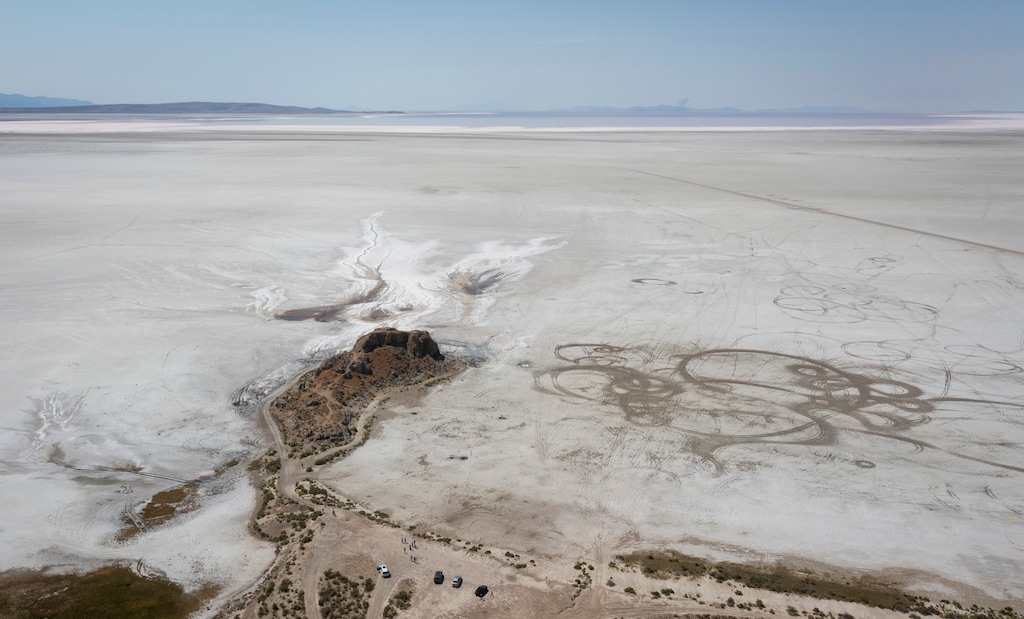
A tracker of announced projects counts 18.7 gigawatts of data centers planned for Utah. About 920 megawatts are operating today. In September the state’s reservoirs were half full and the upper Sevier was delivering about a tenth of what its oldest rights call for. The Great Salt Lake stands more than eight feet below the level the state calls healthy.
Some of this damage does not come back. The U.S. Geological Survey says most of the compaction that follows overpumping an aquifer is irreversible, and it calls the sinking ground “a legacy for all tomorrows.” Los Angeles began diverting the Owens River in 1913, and it has since spent more than $2.5 billion holding down the dust from the dry lakebed.
Utah can fix this with one rule: No water, no permit. Before a county rezones land or the state grants a tax credit, the developer should file, in public, the water rights it has actually bought and an engineer’s count of what its buildings and its power plant will use. Ask your county commissioners and your legislators to require it.
Bears Ears was still there for us because people we never met left it that way. This is not a partisan issue. The land we inhabit will be inhabited by others, as it has been for thousands of years. The work of keeping this state for them has fallen on its citizens, and the time to act is now. There is nothing left to squander.
(James H. Tily) James H. Tily is an attorney in Salt Lake City.
James H. Tily is an attorney in Salt Lake City. He represents a client in a pending Millard County matter involving water share accounting. This commentary does not draw on or discuss that matter. He used AI to research and fact-check this commentary.
The Salt Lake Tribune is committed to creating a space where Utahns can share ideas, perspectives and solutions that move our state forward. We rely on your insight to do this. Find out how to share your opinion here, and email us at voices@sltrib.com.