 Tamarra Kemsley
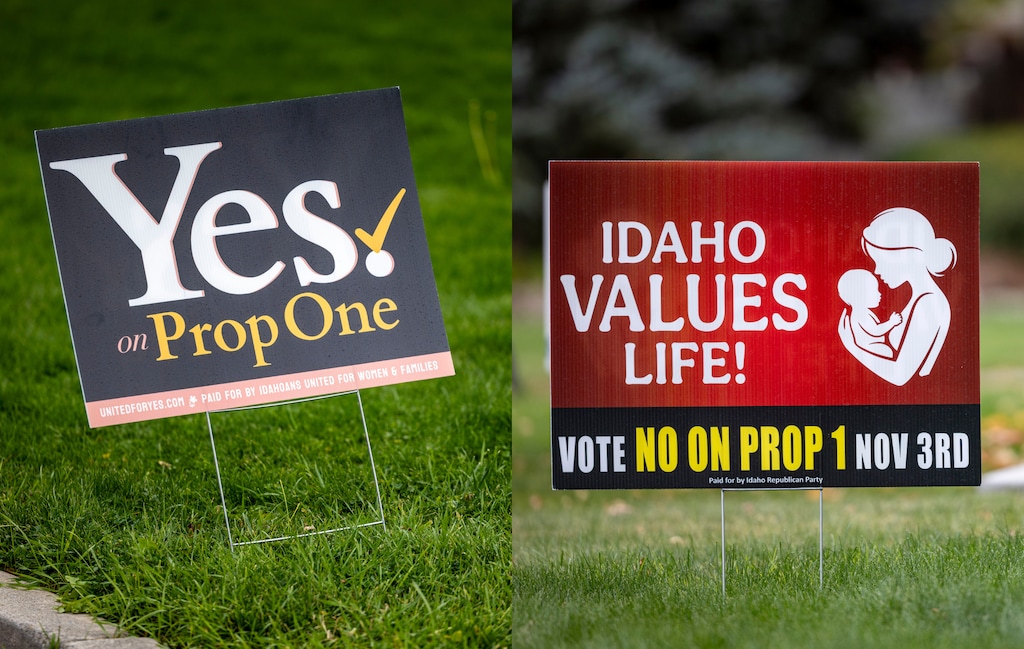
High-level Latter-day Saint leaders have taken a public stance against Idaho’s Proposition 1 and Nevada’s Question 6 expanding abortion access, even cracking open church coffers in hopes of defeating one of the measures.
Indeed, the Roman Catholic Diocese of Boise also kicked in money for the cause.
To which countless readers have responded: Wait, can they do that?
“Separation of church and state???” asked a commenter on The Salt Lake Tribune’s story about the $1 million donation The Church of Jesus Christ of Latter-day Saints made to the group opposing Idaho’s ballot measure.
Wrote another: “Explain to me how we allow this but don’t tax them like other businesses?!?”
Still another: “There are laws against nonprofits being involved in political issues. What’s the loophole here?”
So can churches wade into these waters and keep their tax-exempt status?
The short answer: Yes, they can. Here’s why:
The Constitution’s establishment clause — enshrined in the First Amendment — is brief and focused on limiting the government’s actions, not those of religious organizations. Meanwhile, the phrase “separation of church and state” originates in a letter written by Thomas Jefferson in 1802 and represents less a cut-and-dry directive than an ever-evolving, constantly contested legal principle.
The Johnson Amendment
Critical to the evolution of the courts’ and Americans’ conception of that principle is the 1954 Johnson Amendment, which sets specific parameters for how tax-exempt charities — houses of worship included — can engage in politics.
Say a church wants to put together a voter education guide or a get-out-the-vote drive. The Johnson Amendment has no qualms with either. The same is true of efforts around voter registration.
Where it draws the line is not in supporting or opposing specific public policy proposals — like those on the ballots in Idaho and Nevada — but rather backing or bucking specific candidates.
According to the IRS, 501(c)(3) organizations are “absolutely prohibited from directly or indirectly participating in, or intervening in, any political campaign on behalf of (or in opposition to) any candidate for elective public office.”
Break this rule, and an organization runs the risk of losing its tax-exempt status.
Even then, though, the odds of this occurring are arguably low.
As Loyola University Chicago tax professor Sam Brunson explained in an episode of The Salt Lake Tribune’s “Mormon Land” podcast, the IRS has exercised this punishment sparingly.
“In the [72-year] history of the Johnson Amendment,” he said, “I am aware of one church that lost its tax exemption.”
(Sam Brunson) Sam Brunson, tax law professor at Loyola University Chicago, says the IRS rarely goes after a religious group's tax status.
If a second were to follow, moreover, it is unlikely to occur under the Trump administration, which supported a recent and, so far, failed attempt to persuade the courts to declare the Johnson Amendment unconstitutional on the basis that it limits free speech.
A relevant IRS rule
In 2016, Latter-day Saint leaders inched close, in a way, to promoting an anti-Donald Trump position. The church’s Salt Lake City-based newspaper, the Deseret News, published a front-page editorial encouraging him to bow out of the presidential race after an “Access Hollywood” videotape from 2005 captured the GOP nominee bragging about groping women.
No IRS repercussions followed.
A decade later and more relevant to the church’s statements and donation on the abortion ballot measures, Brunson said, is the IRS rule stating that, in order to maintain its tax-exempt status, an organization “may not attempt to influence legislation as a substantial part of its activities.”
Key word: substantial.
It’s a term that remains somewhat elusive — despite attempts by courts to pin it down.
Regardless, Brunson told The Tribune this week, “a $1 million donation by the LDS Church does not rise to that level.”
All the same, the church, in its nearly identical statements in Idaho and Nevada, was emphatic that it remains neutral regarding political parties and candidates, a seeming nod to the Johnson Amendment. Nonetheless, it stated, it “addresses issues it believes have significant moral consequences” — including abortion.