The allegations emerging from Cornell University are horrifying. A former student reported that she was sexually assaulted by multiple men at a fraternity house after consuming alcohol and drugs. A fraternity Snapchat conversation reportedly described her in crude, transactional sexual terms and alerted other members to the possibility of sexual acts. Nearly two years later, prosecutors have reopened the criminal investigation, and questions remain about what happened that night and how the university and law enforcement responded. Those questions deserve a thorough investigation.
Yet, there is more we should be asking: What kind of environment creates conditions in which sexual violence occurs, and another human being is reduced to an object for others’ gratification?
That question matters in Ithaca. It also matters here in Utah.
For decades, I have cared for survivors of sexual assault as a forensic nurse and studied sexual violence as a researcher. One criminology framework I frequently teach is Routine Activity Theory. In its simplest form, the theory proposes that crime becomes possible when three domains converge: a likely offender, a vulnerable individual and an absence of protection.
There is danger, however, in looking only at those three domains. They do not exist in a vacuum. Surrounding them is culture: the attitudes, expectations, power structures and social norms that shape what we consider acceptable, whose boundaries matter, whose voices we believe and what behavior we are willing to ignore or excuse.
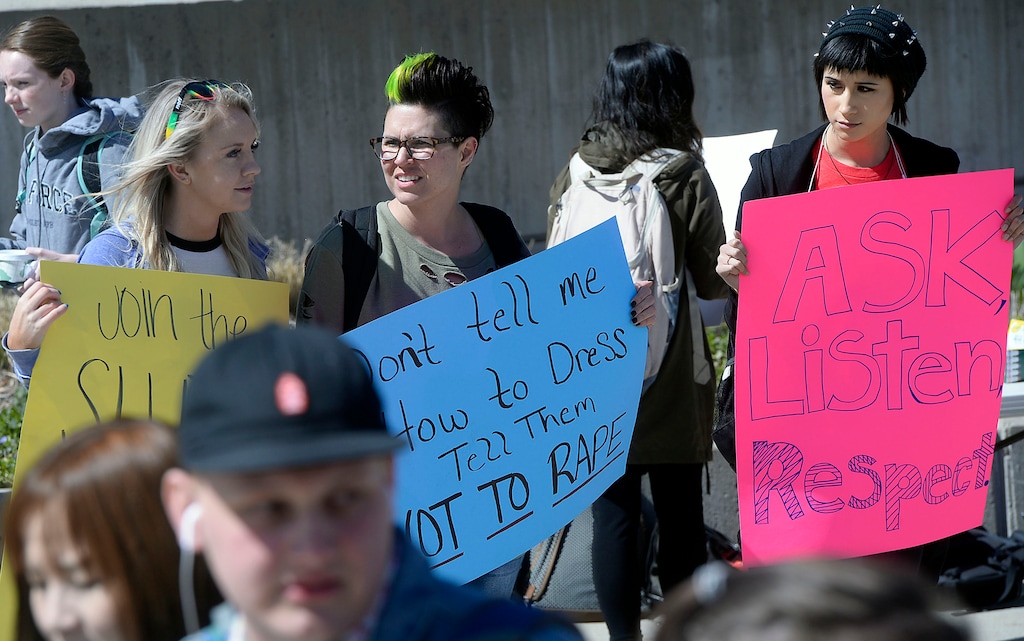
Last week, more than 400 people registered for a Utah Women & Leadership Project webinar, “The Roots of Sexual Violence in Utah: What Every Utahn Should Know.” The webinar grew from a white paper by my co-author, Dr. Susan Madsen, examining decades of research about the cultural roots of sexual violence. Some of those roots are uncomfortable to name. Gender inequality. Male entitlement. Sexual objectification. Rape myths. Victim blaming. Sexist jokes. Stereotypical gender roles. The tendency to question women’s credibility. Silence when someone crosses a boundary.
None of these things means that an individual will commit rape. But culture establishes boundaries around behavior. What we laugh at, excuse, minimize and ignore teaches people what those boundaries are.
That is why the reported messages surrounding the Cornell allegations should trouble us as deeply as the criminal case itself. When a woman is discussed as though access to her body can be advertised to a group, the problem is deeper than whether conduct ultimately meets the legal elements of a crime. The language itself tells us something about attitudes toward sex, women, consent and entitlement.
And before Utahns reassure ourselves that this is an Ivy League fraternity problem 2,000 miles away, we should look closer to home.
Utah has wrestled with high rates of sexual violence for decades. Our research team has examined thousands of sexual assault medical forensic examinations performed across this state. Behind every data point is a person whose life was forever changed by the actions of an offender in a particular environment and at a particular moment within our communities.
We cannot prevent sexual violence simply by teaching potential victims how to avoid those moments. Indeed, that approach merely reinforces victim blaming. Rather, we need to scrutinize the actions of perpetrators and question our cultural norms.
Why did someone believe another person’s intoxication created an opportunity? Why did peers remain silent? What messages have we given boys and young men about sex, masculinity and entitlement? Do we challenge sexist jokes when they are told by people we like? Do we believe that a person who initially agrees to sexual activity retains the right to say no later? Do our institutions protect their reputations more fiercely than they examine their cultures?
And perhaps most uncomfortably: What have each of us tolerated that helps keep those norms alive and well in Utah?
Changing culture does not require us to condemn Utah. It requires us to care enough about Utah to examine it honestly.
During our webinar, our colleague Liliana Olvera-Arbon issued a simple challenge: “We must be bold.” We must teach boys and young men that consent is not access to someone’s body but an ongoing agreement between people with equal autonomy. We must teach all young people to recognize coercion and intervene when boundaries are being crossed. We must stop laughing at comments that degrade women. We must challenge victim blaming when we hear it. We must expect schools, universities, workplaces, faith communities and other institutions to create environments in which dignity and accountability matter more than reputation.
Most importantly, we must stop treating rape as something that simply happens. Sexual violence grows within environments shaped by people. That means those environments can also be changed by people.
The Cornell allegations should deeply disturb us. But discomfort is useful only if it moves us to action.
Utah, let us be bold enough to examine our culture, brave enough to challenge what we have normalized and committed enough to change it.
Sexual violence does not happen in isolation. Neither does prevention.
The call to action is simple: Examine what we tolerate, challenge what we can and use our voices and actions to help build a Utah where respect, consent, safety and accountability are the norm.
If you or someone you know has been impacted by sexual violence, support is available. Call the Utah 24/7 Sexual Assault Helpline. English: 801-736-4356 and Español: 801-924-0860.
(Dr. Julie L. Valentine) Dr. Julie L. Valentine is a professor, researcher and forensic nurse. The views expressed do not necessarily reflect the position of the author’s employers.
Dr. Julie L. Valentine is a professor, researcher and forensic nurse. The views expressed do not necessarily reflect the position of the author’s employers.
(Dr. Susan Madsen) Dr. Susan Madsen is a professor, researcher and founder of the Utah Women’s Leadership Project.
Dr. Susan Madsen is a professor, researcher and founder of the Utah Women’s Leadership Project.
(Liliana Olvera-Arbon) Liliana Olvera-Arbon is Executive Director of Utah Coalition Against Sexual Assault.
Liliana Olvera-Arbon is executive director of Utah Coalition Against Sexual Assault.
The authors of this commentary used AI to edit their op-ed for length.
The Salt Lake Tribune is committed to creating a space where Utahns can share ideas, perspectives and solutions that move our state forward. We rely on your insight to do this. Find out how to share your opinion here, and email us at voices@sltrib.com.