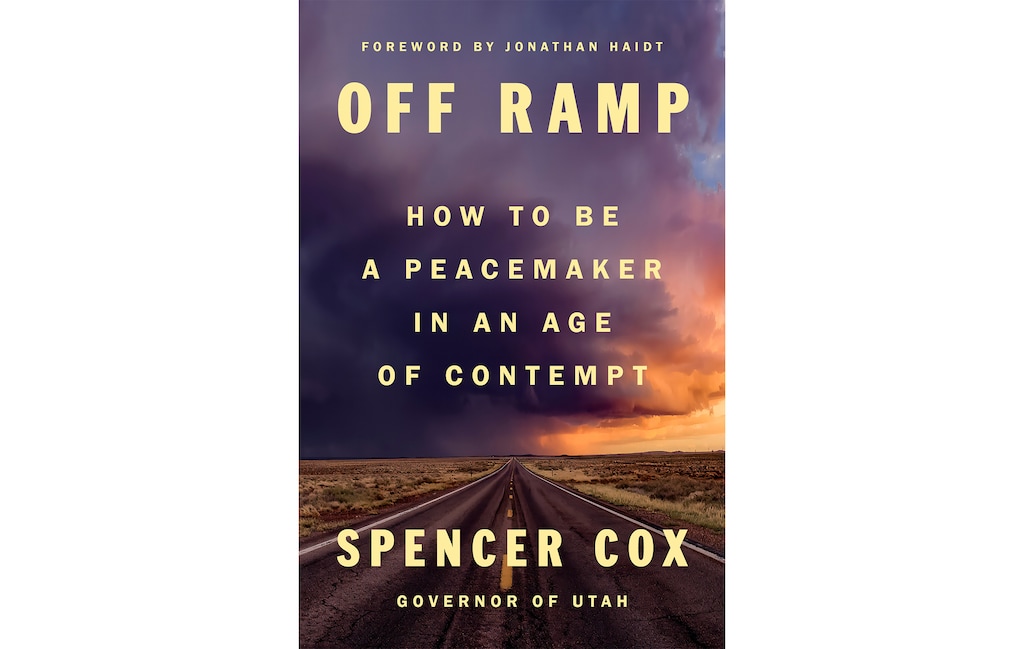
I was prepared to hate this book.
That I didn’t suggests that Spencer Cox not only makes a good argument, but that he has a good argument.
Cox, whose day job is governor of Utah, is out with an important and well-received book entitled “Off Ramp: How To Be a Peacemaker in an Age of Contempt.”
It builds on Cox’s “Disagree Better” campaign, launched back when he was chair of the National Governors Association. And it rises from his experiences following the murder of conservative activist Charlie Kirk a year ago while speaking at Utah Valley University in Orem.
It was an event that thrust Cox into the national spotlight and earned him much praise for keeping cool under pressure and calling for peace. He paints a compelling picture of how upset he was at the apparently politically motivated shooting in his own state, by, allegedly, one of his fellow Utahns.
The act demonstrated, Cox notes, just how much our political and social climate has moved beyond mere disagreement to ever-more-frequent acts of violence.
And it led him to wonder, in the words of a friend, just what he was going to do about it.
This book is a start.
It’s an argument with one all-but-fatal flaw. You can probably guess what it is. But it’s still an argument worthy of your consideration.
Listen. Be patient. Find out why people who disagree with you feel the way they do. If you do, others will often return the favor by listening to your point of view. Just taking the time to listen to the feelings of others, and to lay out your own, helps you not only see the strengths of the other point of view but may also force you to face the flaws in yours. It is a way to find points of common ground without compromising principles or morals.
“Off Ramp” is peppered with pop culture references, extensive research and a healthy dose of Cox’s self-deprecating humor. I polished off its 250 pages in one sitting (with a lunch break), which means Cox made it easy for me to do all that he asked of me, of us. Hear him out.
He makes a strong case that the fire in modern political divisions is largely due to the outrage-generating properties of social media. Platforms such as Facebook and X live and die by the share of your attention span they consume, and the best way to raise that is to funnel you stuff that makes you mad. Even if it isn’t true.
Cox tells the story of the Utah Compromise, a process that led to a law that protects LGBTQ people against discrimination in housing and employment yet protects the right of religious institutions to hold to their beliefs. He gives an extended shout-out to Troy Williams, then the director of Equality Utah, and his patient, listening outreach to political rivals.
Williams stopped trying to wear his opponents down, and successfully worked to win them over. It worked. And Cox was among the many who was really happy about it.
What the book doesn’t detail is how Cox has backslid on the issue of LGBTQ rights since then. He has turned his back on the rights of transgender students and athletes he once championed and stopped issuing what had become the normal governor’s proclamation honoring Pride Month.
Those are minor points compared to the one thing that has all but destroyed Cox’s credibility — trying to see the good in Donald Trump, a man whose whole essence is racism and xenophobia, hatred and division, the very antithesis of peacemaking.
He tells a story about meeting with Trump in the Oval Office and, among other things, making the case for federal assistance in preserving the Great Salt Lake. After 45 minutes of todeying up to the commander in chief, Cox extracted a promise — committed to a social media post — to devote $1 billion to that cause.
The fact that Cox thinks Trump will make good on that promise, or even remember it, betrays a strain of thinking that crosses the line between hopefulness and dangerous gullibility.
Cox argues, rightly, that automatically assuming the worst in those who disagree with you is neither ethical nor efficient. But there is evil in the world, and the fact that Cox surrendered his past opposition to Trump to become a supporter indicates that he can be horrifyingly blind to it.
Maybe facing the truth about some people and their actions is more than disagreeing better can handle.
Disappointing. Read the book anyway.
George Pyle, reading The New York Times at The Rose Establishment.
George Pyle, who admires anyone who can write a book and get it published, is the editorial writer for The Salt Lake Tribune.
The Salt Lake Tribune is committed to creating a space where Utahns can share ideas, perspectives and solutions that move our state forward. We rely on your insight to do this. Find out how to share your opinion here, and email us at voices@sltrib.com.