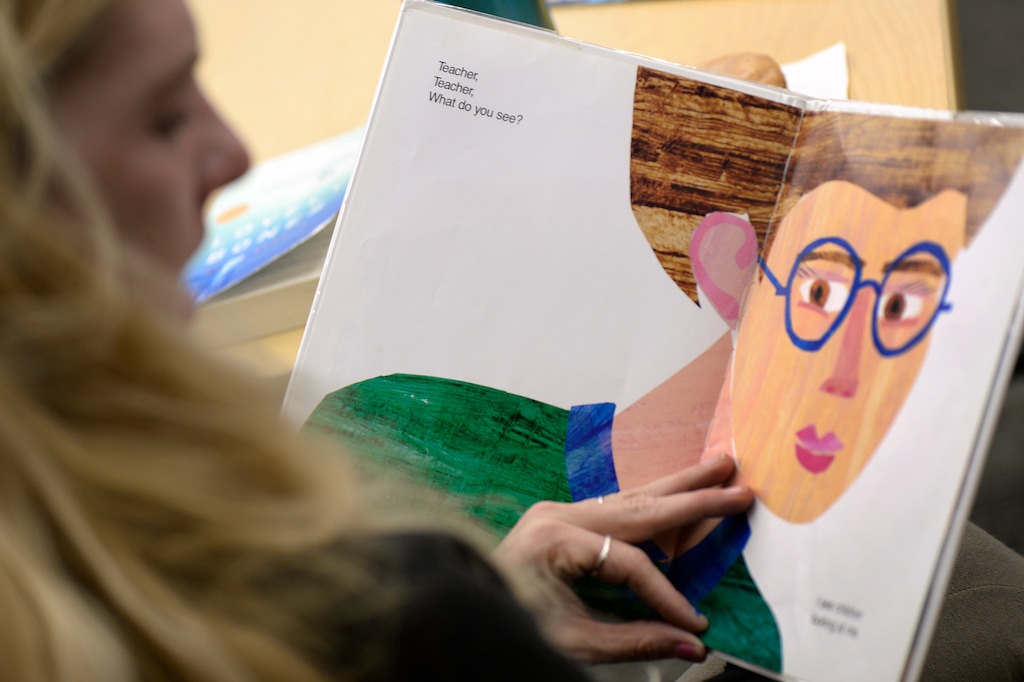
Every August, I stand at my classroom door and greet twenty-some small strangers as they become my kindergarten class. They arrive in new sneakers with backpacks too big for their shoulders, clutching the hands of parents who sneakily wipe away tears. Some of these children have fallen asleep to bedtime stories every night of their lives. Others may have never held a book at all. And yet, here in my bright classroom with its rainbow rug and jar of newly sharpened pencils, all of them are about to begin the same remarkable journey: learning that the strange little marks on a page can hold stories, ideas and possibilities.
You’ve seen the headlines. Utah’s third graders struggle in reading and have had little improvement over the last decade on the end of year benchmark test. However, by the time a child sits down to take that test we aren’t measuring a single year of school. We’re measuring a lifetime of accumulated opportunity. My job, every single year, is to send my students off to summer break reading. Sounding out sentences with their fingers tracking each word, grinning like they’ve cracked a code. Because that’s what it is, really. A code. And once they’ve cracked it, nothing is ever quite the same.
Early literacy was never just about alphabet drills and sight words, though we do plenty of both. It’s about handing a child the belief that they can be a reader. That belief doesn’t arrive fully formed in third grade. It’s built, brick by brick, years before any test is administered.
If we want those scores to climb, I don’t think the answer lives in more testing, more intervention, more catching up in upper elementary. I think it lives in living rooms and library story-times and kindergarten classrooms, in all the small places where reading first takes root.
This can be achieved by investing in our chronically underfunded schools (Utah consistently ranks close to last in per-pupil spending), but also by increasing community support and awareness of what work happens in early childhood literacy.
Supporting our youngest readers and pre-readers might be one of the most quietly powerful investments we can make, because the habits of mind a child builds at 5 years old can last a lifetime.
People still imagine kindergarten as it used to be, a gentle half-day between home and “real school” filled with finger paint and snacks and naptime. That kindergarten doesn’t exist anymore. We still leave space for play (thank goodness!) but the day is shaped now by benchmarks, structured literacy lessons based on the latest research and carefully monitoring progress towards academic goals. And yet the 5-year-olds themselves haven’t changed one bit. They still hum and wriggle while they work, their joyful energy barely contained by a desk and chair. My job is to balance the rigor of explicitly taught phonics and the joy of childhood. So we drill letter formation, read a story, then put on puppet shows to prove they’ve remembered the plot. We sound out word lists letter-by-letter, then break into song and dance over a new spelling pattern like it’s the best thing in the world. Somewhere in that mix, if I get it right twenty-some children learn to read and to love it.
But that balancing act isn’t mine to manage alone, and it never should be. The biggest obstacle my students face isn’t ability. It’s opportunity. Literacy doesn’t begin on the first day of kindergarten in my classroom. It begins at a kitchen table over a dinner conversation that slowly expands a child’s vocabulary, in a daycare singing silly rhyming songs, in a library story time on a rainy afternoon, in the patient pause of an adult who stops to answer a child’s hundredth question of the day.
The conversation about literacy so often lives in numbers and test scores. I wish everyone would see what I see everyday. Like how a little boy beams the first time he writes the whole alphabet without help. I wish they could hear the genuine and unprompted cheer that goes up when a classmate finally sounds out a stubborn word, the whole rug erupting like she’s scored a goal. I wish they could watch the way I get to watch as a child’s world quietly widens with every book from this room here and now out into oceans and castles places both real and imagined. I wish they could see the reading confidence arrive, not all at once but page by page.
When we invest in a kindergartner’s reading, we aren’t just teaching a skill. We’re handing over a key. And what a child does with that key, the doors it opens and the worlds it leads too, that’s the part worth paying attention to.
(Sarah Parker) Sarah Parker is a kindergarten teacher in Sandy.
Sarah Parker is a kindergarten teacher in Sandy. The views expressed here are her own.
The Salt Lake Tribune is committed to creating a space where Utahns can share ideas, perspectives and solutions that move our state forward. We rely on your insight to do this. Find out how to share your opinion here, and email us at voices@sltrib.com.