I do not know anyone of my generation who anticipated that the America of 2026 would be more polarized than the America of 1976.
In the course of this year — a year in which we commemorate the 250th anniversary of our nation’s birth — we must renew our commitment to America’s foundational principles. We must demand that our democratic institutions be more effective and that our elected representatives better safeguard America’s constitutional order and the rule of law.
Those of us who were in our 20s and 30s during America’s bicentennial year commemorated the rich legacy our nation’s founders had bequeathed to us. We also celebrated the integrity and resilience of our democratic institutions.
Those who are now in their 20s and 30s have experienced a decade of dysfunctional government and extreme political polarization. Both Utah and national studies and public opinion polls indicate many voters are now politically disengaged.
In 1976, after a decade that had thoroughly tested our democratic institutions, those institutions reasserted themselves. A very troubled decade had come to an end. Commitment to America’s promise was restored.
During the 1960s, our elected representatives had established a much more equitable balance between individual liberty and equality of opportunity.
The Civil Rights Act and Voting Rights Act of the mid-1960s had officially terminated the legalized racism of the Jim Crow era. Racism remained a fact of American life, but our nation was well on its way to becoming a multi-racial, authentically representative democracy.
The Fall of Saigon on April 30, 1975, effectively ended America’s participation in the Vietnam War. Many of my generation, including myself, had opposed that divisive war. Many had marched in protest against it. Many were outraged when members of the Ohio National Guard, with no warning shot, opened fire on student protesters at Kent State University, killing four and wounding nine. Many believed the end of that war was the prelude to a brighter future.
President Richard M. Nixon and Vice President Spiro Agnew were reelected on November 7, 1972. Agnew, when notified that federal prosecutors had compiled evidence of his political corruption and tax evasion, resigned on October 10, 1973. Nixon’s nominee to replace Agnew, House Minority Leader Gerald Ford, was promptly confirmed by majorities in the House and Senate.
The investigation of the Watergate break-in revealed that President Nixon had not only authorized a third-rate burglary. In addition he had weaponized the FBI, CIA and IRS to target his political rivals. After public revelations of Nixon’s misdeeds, Republican leaders urged the president to resign. He did so on August 9, 1974. Two members of Nixon’s cabinet and two high ranking members of his White House staff were indicted, tried, convicted and sentenced to prison for Watergate related crimes. Five weeks later, President Gerald Ford pardoned Nixon, a move that proved highly controversial at the time.
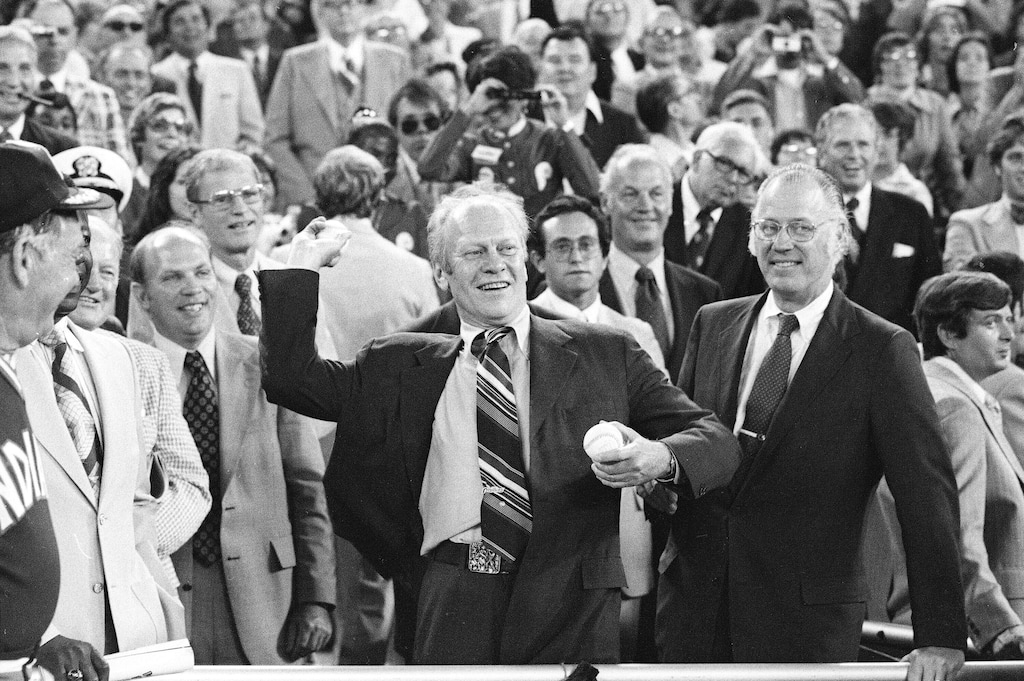
President Ford, however, rose to the occasion. He provided steady, unpretentious and inclusive leadership throughout our bicentennial year. He urged us to celebrate the 200th anniversary of our nation’s birth in a spirit of reunification, healing and renewal. He invited us to join in an ongoing adventure: our nation’s experiment in democracy. He did all within his power to restore institutional integrity to the presidency.
During the years leading up to our bicentennial celebration, institutional order was restored. President Ford proved to be a uniter, not a divider. Members of the legislative branch abided by their oaths of office and checked the criminal excesses of our nation’s former chief executive. The Department of Justice and the judiciary fulfilled their responsibilities without fear or favor.
During this 250th commemoration of our nation’s founding, we must hope and pray that institutional integrity ensures our democratic experiment prevails. We have inherited much to commemorate. By the end of this year, I hope the resilience of America’s democratic institutions and the sovereignty of the voting public will provide great cause for celebration.
Perhaps America in 2028 will be blessed with a president in the mold of Gerald Ford — blessed with a president who is an institutionalist known for his honesty and human decency — blessed with a president who is solidly committed to lawful order and to traditional political norms.
Perhaps in 2028 America will be blessed with a chief executive officer who prioritizes national stability and healing over personal ambition and the exercise of brute power — blessed with a president who asks first and foremost: What can I do for my country?
Andrew Bjelland
Andrew Bjelland is professor emeritus in Seattle University’s philosophy department, where he held the Pigott-McCone Chair in Humanities and taught political philosophy, jurisprudence, medical ethics and logic. He resides in Salt Lake City.
The Salt Lake Tribune is committed to creating a space where Utahns can share ideas, perspectives and solutions that move our state forward. We rely on your insight to do this. Find out how to share your opinion here, and email us at voices@sltrib.com.