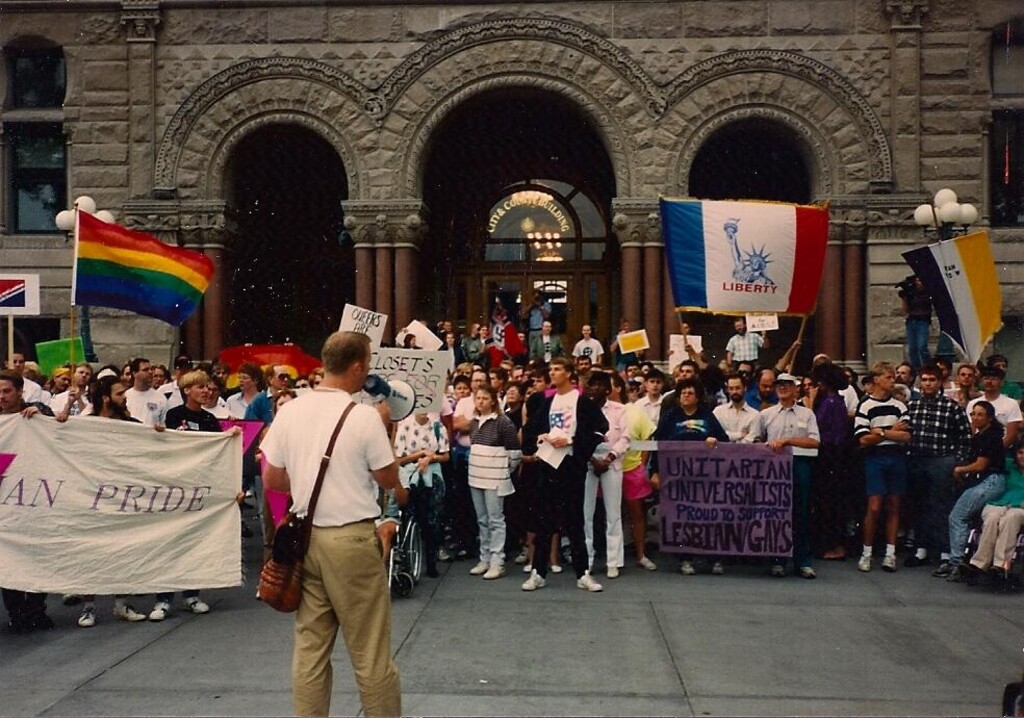
Every June, thousands of Utahns gather for Pride celebrations filled with rainbow flags, music and community. To some observers, it may look like a giant party. But reducing Pride to a parade misses its deeper significance. Utah Pride is one of our state’s most important civic traditions because it tells a story of resilience, belonging and the ongoing struggle for equality.
And many of its first organizers are still with us today.
I am a Queer historian who wanted to know more about this monumental civic celebration — where did it start? Who exactly was behind it? When I first began researching Utah Pride in earnest, I found a wealth of material at the University of Utah, where the Utah Pride Center archive is kept. Boxes full of pamphlets, forms, posters and old Pride programs. In these seemingly mundane documents, Queer activists preserved precious history, including the origins of Utah pride.
Pride’s roots stretch back to the national Gay Liberation Movement sparked by the 1969 Stonewall uprising in New York City. Inspired by activists across the country, Utah’s LGBTQ+ community began organizing celebrations as early as 1974 with parties on the shore of Great Salt Lake and eventually a “Gays of ’47” picnic up Millcreek Canyon. By intentionally drawing on Utah’s pioneer heritage, these party organizers made a powerful statement: Queer people were not outsiders to Utah history — they were part of it.
At the heart of these early celebrations were remarkable individuals, some of whom are still alive today. Local organizations like Seniors Out and Proud and the Mildred Berryman Institute for LGBTIQ2S+ Utah History are fostering intergenerational connections to help Queer people feel more rooted in community and get to know these pioneering activists, like Joe Redburn and the group Queer Nation Utah.
Queer Utahns are starting to realize that we do have a history – we just need to learn it.
When I’m deep in the archives, I am always reminded that history is fundamentally about people. It’s not just dates, places and events. It’s the choices we make and our different competing motivations. But finding that information can be hard, especially when it involves Queer people.
When looking for Queer people in Utah history, you have to find written documents, grainy photos or census records that confirm someone’s residence, age and race. All the while newspapers, family letters or even self-conscious journal entries are clouded with hate or concern. Queer history involves genealogical work that goes against the strong wind of homophobia at every step.
In the Queer community, it is also a common lament that we do not have elders to look to for guidance as we continue to fight for equality. During the 1980s-90s, AIDS was the top cause of death in the nation for people ages 25 to 44. Its prevalence in the Queer community led to the tragic loss of, essentially, an entire generation. This has resulted in a sort of historical amnesia, where we march forward feeling that we do not have a history and must create community anew.
And yet, Queer Utah history is resilient and sometimes even easy to find. It is found in the obituary that mentions the loving friend of a lifetime. It is found in the 2001 Utah Pride Guide that traces the development of the Utah Stonewall Center, the Gay & Lesbian Community Council and Utah’s first Pride Parade of 1990. And it is found in every conversation we have today with a Queer elder who led the way.
When I first started researching Utah Pride history, someone named Connell “Rocky” O’Donovan kept popping up. He is this red-headed, hippie-punk rabble-rouser who organized the second Utah Pride march in 1991 with a bullhorn in one hand and a fairy wand in the other. As part of the group Queer Nation Utah, Connell led the march to the Salt Lake City and County Building where they posed for photos while neo-Nazi counter-protestors loomed on the steps in the back.
Now, two years later, Connell has become one of my closest friends and has taught me how to keep marching. After living in Moab and Santa Cruz, California, Connell is now a historian based in Salt Lake City. We were connected through work at the Utah Historical Society, and I was a little starstruck when I first met him three years ago. Connell has taught me a lifetime’s worth of Queer Utah history in our many coffee shop dates and meetings. From nineteenth-century poets to Two Spirit Shoshone activists from the Red Power movement, he has introduced me to a large cast of Queer Utahns from history who have laid the groundwork so our community can be where it is today.
Connell often likes to downplay his own role in helping make Utah’s first Pride marches happen. He is a modest queen, seeing history in others rather than himself. But I will always carry the legacy of his work — and that of every Queer activist — with me.
This Pride, strike up a conversation with your Queer elders. You just might learn some history.
(Megan Weiss) Megan Weiss is a public historian based in Salt Lake City.
Megan Weiss is a recent graduate of the University of Utah history doctoral program. She is a public historian based in Salt Lake City.
The Salt Lake Tribune is committed to creating a space where Utahns can share ideas, perspectives and solutions that move our state forward. We rely on your insight to do this. Find out how to share your opinion here, and email us at voices@sltrib.com.