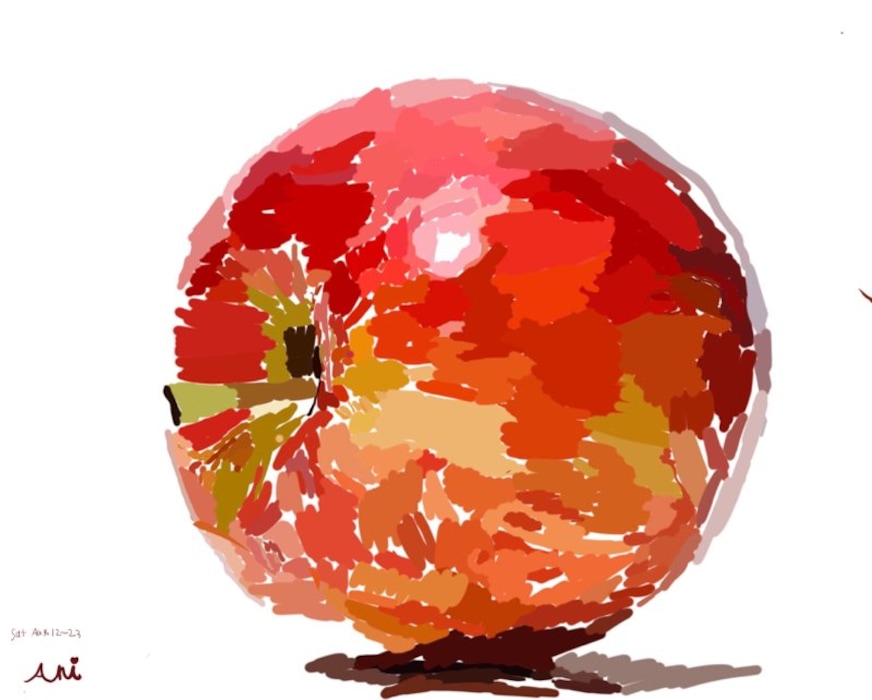
“Look what I just drew.”
My daughter walked into my room holding her iPad. She was 10. Until that afternoon, her drawings hadn’t been particularly remarkable. Rectangle houses with triangle roofs and stick-figure families standing beside them, that kind of thing. What she turned toward me now was an apple. Rendered in loose, confident brushwork, light catching the curve of it, a shadow pooling beneath, it was the kind of drawing I’d have expected from someone who had been studying for years.
“You drew that?” I said. I didn’t mean it to come out as disbelief, but it did.
Her style arrived that day, seemingly fully formed, out of nowhere. She has been drawing like that ever since.
I was in bed when she showed me, as I usually am. A medical retirement from a tenured professorship at Brigham Young University a few years ago ended one version of my life and began another, one measured in conserved spoons and careful hours. A handful of overlapping chronic illnesses (ME/CFS, POTS, fibromyalgia and MCAS) keep me horizontal most of the day. From that bed, I’ve watched my daughter fill pages with animals and fruit and flowers of her own design. For a while after the apple, I kept asking the same question, just in different words.
Where did this come from?
It took me longer than it should have to understand that I was asking the wrong question.
My daughter is autistic. In Utah, she’s one of many. Roughly 1 in 37 children here has been identified on the spectrum, representing tens of thousands of Utah families navigating schools, waitlists, therapies and the daily, grinding work of raising a child in a world that wasn’t built for them.
What doesn’t make the statistic is what I’ve come to think of as the quiet work: the part where you stop trying to translate your autistic kid into a neurotypical kid and start paying attention to who is actually in front of you.
The apple didn’t come from nowhere. It came from a kid who had been watching the world very carefully for 10 years, building up something inside her that I hadn’t known to look for. When I finally stopped asking her to explain her pictures in the language I understood and started sitting with them in hers, something shifted. I stopped being a parent trying to pull a child toward me and started being a parent meeting a child where she already was.
I think a lot of Utah parents are standing at that same door.
For years, the rallying cry was autism awareness. Increasingly, it’s autism acceptance. That shift matters more than people realize. Awareness is certainly important; early identification saves kids. But acceptance is harder. It means your autistic kid doesn’t have to perform neurotypicality to be loved, included or taken seriously. Their hyperfocus on special interests, their unique gifts and even their direct communication style should be understood as information about who they are, not viewed as a problem to be fixed.
Utah talks a lot about family values. We ought to be leading on this.
We have some of the pieces. Organizations like the Utah Parent Center and the Autism Council of Utah do meaningful work for autistic kids and their families. AANE, the Association for Autism and Neurodiversity, serves families across the country, including ours. And I’d be remiss not to mention that I’m able to write this because of the Bateman Horne Center in Salt Lake City, one of the leading centers in the world for ME/CFS and related conditions. They’re why I get four to six hours out of bed most days instead of zero. Utah quietly houses some extraordinary resources for people living with conditions the rest of the medical world still barely understands, and the state that nurtures that kind of specialized care can lead on autism acceptance too.
For any Utah parent with a newly diagnosed kid, or a kid you’re starting to wonder about: The work that matters most, in my experience, is quieter than the brochures suggest. It’s the work of watching. Of noticing what your kid loves and taking it seriously. Of building a family life that fits the child you have.
My daughter’s art has reached people I’ll never meet by going viral repeatedly on social media. That’s been its own surprise. But the gift her drawings gave me first was the gift of seeing her. From a bed in Utah, with most of my old life gone and a new, quieter one taking shape, I got to learn something I’m not sure I would have learned if I’d stayed healthy and busy: The people you love are always telling you who they are, and the only real job is to listen.
I hope more Utah families get to hear what their autistic kids are saying.
Sometimes they’re saying it out loud. Sometimes they’re drawing it.
Either way, it’s worth the quiet.
(Mark Wright) Mark Wright is a former BYU professor and the creator of $ANI, a Solana-based project built around his daughter’s artwork.
Mark Wright is a former BYU professor and the creator of $ANI, a Solana-based project built around his daughter’s artwork that donates weekly to the Association for Autism and Neurodiversity. He holds a Ph.D. and writes occasionally from bed.
The Salt Lake Tribune is committed to creating a space where Utahns can share ideas, perspectives and solutions that move our state forward. We rely on your insight to do this. Find out how to share your opinion here, and email us at voices@sltrib.com.