 Zak Podmore
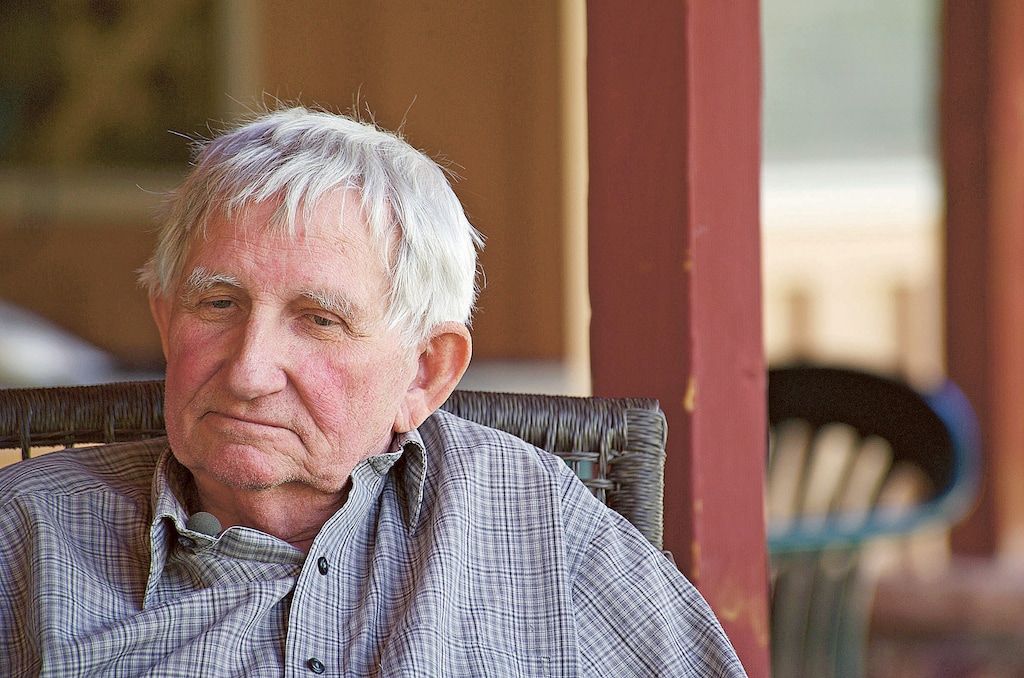
Ken Sleight may be most well known for something that he probably never did: kneeling on the bridge in front of the Glen Canyon Dam, his hands clasped and eyes closed, praying to the Almighty to produce a “precision-type earthquake” that would free the Colorado River from its imprisonment in Lake Powell.
The Sleight-inspired character Seldom Seen Smith acted out the scene in “The Monkey Wrench Gang,” Edward Abbey’s 1975 cult classic of ecosabotage. But although the character was fictional, Sleight’s lifelong hatred of the dam was very real, as was his love of Glen Canyon, the area drowned by Lake Powell.
“It was Glen Canyon that changed my whole life,” Sleight told The Salt Lake Tribune in 2018. “It made an environmentalist out of me.”
Sleight died Friday, Spanish Valley Mortuary in Moab confirmed. He was 97.
(Photo by H. Bennett. Courtesy of Ken Sleight.) Ken Sleight making breakfast along the river in Glen Canyon before the dam, circa June 1960.
Sleight was born in Paris, Idaho, in 1929, and took his first river trip through the Gates of Lodore on the Green River in 1951 as a student at the University of Utah. Later that year, he was drafted into the Korean War, where he served in the U.S. Army’s 48th Field Artillery Battalion, 7th Infantry Division, from June 1952 until September 1953.
When he returned to the United States, Sleight completed a business degree at the University of Utah. Soon after, he landed a job at Firestone as a tire salesman, but his passion lay in the canyons of southern Utah.
In 1957, Sleight purchased eight Army surplus rafts, quit the tire business, and opened a river guiding company that would soon take the name Ken Sleight Expeditions.
(Christopher Smart | The Salt Lake Tribune) Environmentalist Ken Sleight works on an irrigation line at his ranch near Moab in 2007.
For the next six years, Sleight led river trips through Glen Canyon on the Colorado River where he showed artists, environmentalists, reporters and curious members of the public the labyrinthine sandstone canyon country that would soon be flooded by Lake Powell.
Sleight and fellow river guides waged an unsuccessful battle to stop the reservoir from filling behind the Glen Canyon Dam. But when its gates closed in 1963, Sleight — a lapsed member of The Church of Jesus Christ of Latter-Day Saints — began praying for it to come down.
He found common cause with the writer Edward Abbey when the two met in 1967 at the Lees Ferry boat ramp. Sleight was launching on a Grand Canyon trip, and Abbey, who was working as a ranger for the National Park Service, helped Sleight rig his boats.
“[We] sat on the edge of the raft talking and thinking, eating and drinking until the wee hours of the morning,” Sleight would later write, “making creative commentary on how best to eliminate the Glen Canyon Dam.”
(Courtesy of Ken Sleight Collection) Ken Sleight speaks at a protest, circa 1983.
The friendship lasted through Abbey’s death in 1989, and Sleight never seemed to mind being immortalized as the anarchist “jack Mormon” Seldom Seen Smith. Sleight often said that Abbey was able to put into words his anger and sorrow over seeing Glen Canyon flooded and so many other wild places transformed by development.
But Sleight was, of course, a very different figure than the cartoonish saboteur portrayed in “The Monkey Wrench Gang.” In his youth, he briefly attended meetings of the John Birch Society, though he never joined the organization, and he later campaigned for conservative Republican Barry Goldwater’s 1964 campaign for president, in part because Goldwater was a river runner who floated Glen Canyon in 1939.
(Courtesy of the Ken Sleight Collection) Sleight Expeditions truck when Ken Sleight was just starting out as an outfitter, circa early 1960s.
Sleight’s son, Mark, took over his Grand Canyon river permit in 1979, but Sleight continued to run river trips in Utah with the help of his other sons, Jeff and Steve.
He married his second wife, Jane, in 1983 and the couple moved to Pack Creek south of Moab, where they ran a backcountry outfitting and guide service until 1990. Jane Sleight died in February at 82.
Ken Sleight fought in the successful campaign to block a nuclear waste dump from being established near Canyonlands National Park in the 1980s, and around that same time protested the construction of the White Mesa uranium mill.
He served as chair of the San Juan County Democrats in the 1990s, working with Mark Maryboy, the county’s first Native American commissioner, to run a slate of Navajo and Ute Mountain Ute candidates for every public office in the county.
(Courtesy of the Ken Sleight Collection) Ken Sleight smiles while scouting a rapid before rowing through the whitewater, circa 1980.
Perhaps Sleight’s most famous action from that period came when he rode his horse in front of a bulldozer that was chaining old-growth pinyon-juniper forest on Bureau of Land Management land to clear pastures near his home.
Sleight later served as a mentor to environmental activist Tim DeChristopher, who, as a University of Utah student in 2008, protested an oil and gas lease sale in southeast Utah by bidding on parcels of Bureau of Land Management land that he didn’t intend to pay for. DeChristopher spent two years in prison for the action.
(Courtesy of Sageland Media) Ken Sleight at his home outside of Moab in 2015 while shooting "The Unfinished Fight of Seldom Seen Sleight."
But Sleight never forgot about Glen Canyon, which he often used religious terms to describe.
“I’d still like to see the water from the reservoir — what I call Lake Foul — I think it all ought to be drained and the water be flushed downstream to be stored in Lake Mead,” Sleight told The Tribune in 2021. “One thing is for sure: We’re still trying to resurrect Glen Canyon.”
— Tribune reporter Brooke Larsen contributed to this story.
Zak is the southeast Utah reporter for The Tribune. He has been writing from Bluff, Utah, since 2015 and is the author of Confluence: Navigating the Personal & Political On Rivers of the New West. His second book, which will cover the decline of Lake Powell, is forthcoming from Torrey House Press in 2024.