As I reported last month, the Pew Research Center recently released a detailed study about Latter-day Saints in America, chock-full of data showing various changes over time.
Sociologists rejoiced. Pew’s standards are excellent, and their researchers always make the data publicly available at no cost.
The church did not rejoice. Instead, it issued a news release that same day, not naming Pew in particular but clearly pushing back against some of the study’s main findings. It seemed to take special issue with the conclusion that the church in the U.S. is retaining fewer of its childhood members — and that the religiosity of remaining members, while high, is not what it used to be.
Called “Measuring What Matters: The People Behind the Numbers,” the release reads:
“We appreciate whenever reputable organizations seek to truly understand our faith and commitment to Jesus Christ. Across the globe, The Church of Jesus Christ of Latter-day Saints is experiencing a season of spiritual vitality and growth.
“Official church records show consistent worldwide increases in both membership and participation. We are encouraged by increased participation among our children, youth and young adults in the United States over the past decade. Further evidence of this growth also includes the historic announcement that 90,000 full-time missionaries are currently serving around the world.
“We invite people who are curious to know more about our church not only to consult official data concerning the entire church membership, but also to come and see for themselves. The truest measure of the church’s growth is found in the increased joy and purpose reflected in the daily lives of its members.”
To me, this sounds like church leaders don’t think it matters what external researchers find and publish about our faith. So what if we’re only keeping just over half of our childhood adherents in the United States? We have 90,000 missionaries! And just look at all our new converts! Jazz hands, people!
I have to wonder: Why does the church feel the need to officially respond to external research data in the first place? I’m not aware of other religions that are this obsessed with their public image.
(Trent Nelson | The Salt Lake Tribune) Latter-day Saint missionaries march in a Provo parade in July 2025.
Back in 2012
How we love the validation when outside survey results confirm our high opinion of ourselves. By way of comparison, let’s look at the last time Pew issued a report about Mormons in America (and “Mormons” was the word the church used at the time). That was in 2012, when Latter-day Saint Mitt Romney was running for president. The church’s newsroom was all over that Pew report, gleefully touting the many ways we’re winning.
The weird thing is that much of that is still true in the 2026 Pew study: It’s a very balanced report. Yes, retention has fallen, but religious engagement for those who stay in the church is still markedly higher than it is for other Americans. More prayer, more church attendance, more family unity, more certainty about God.
But instead of extolling Pew’s newest data — or stating that the church is doing well in a challenging environment for religion — the church’s news release instructs people to consult “official data concerning our entire church membership.”
Emphasis on official, as in internal, as in “we are circling the wagons.”
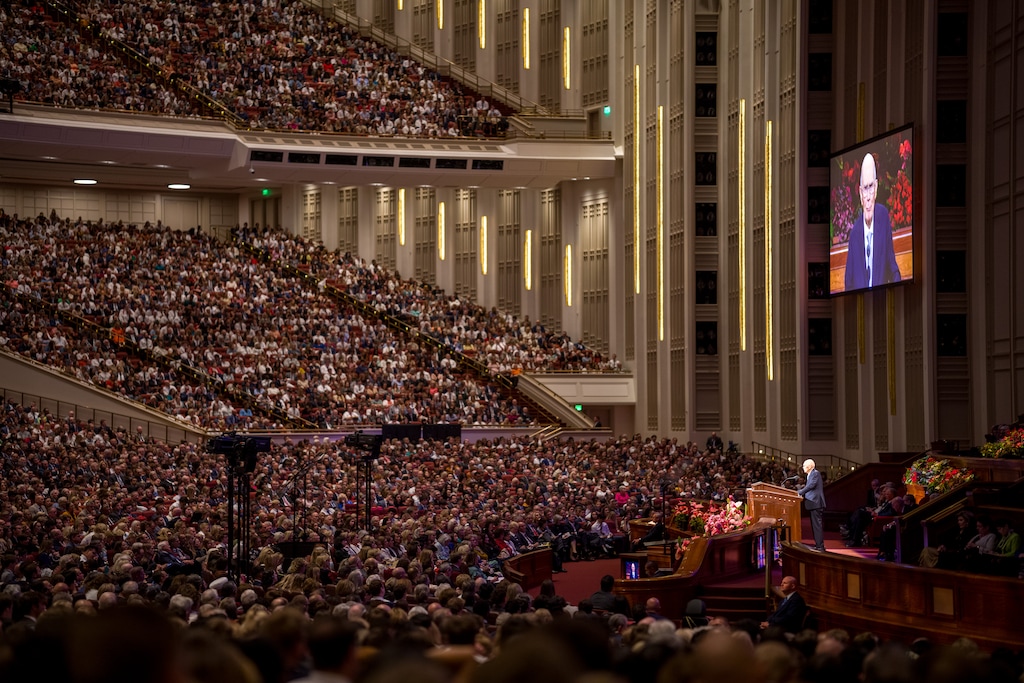
This deflect-and-deny approach seems to be coming straight from the top, and I imagine we’ll hear it at this weekend’s General Conference. I recently heard from a reader who just had a general authority Seventy visit her stake in the Southwest. She recalled how the Seventy related what he said an apostle of the Lord had just taught to him — that it “isn’t true” the church is losing members in any substantive way. Instead, she said he claimed the church has never been on more solid footing. He touted not only the record-level missionary force, she said, but also a greater percentage of members holding temple recommends, as evidence that the church is firing on all cylinders.
For the record, Pew is hardly alone in chronicling declines in Latter-day Saint retention and religious behavior. To varying degrees, we see drops from other long-standing and reputable research organizations as well. The General Social Survey shows younger generations are more likely to leave than older ones. The Cooperative Election Study shows the share of U.S. adults who say they are Latter-day Saints is now under half of what’s claimed by the church’s official U.S. statistics.
But none of this can be acknowledged. The faith’s insatiable need for public approval means we are supposed to emphasize how the church’s internal records show our metrics going up, up, up.
Troubling approach
So, the first reason this approach bugs me is that it’s only half the truth. Two things can be true at the same time: The church can be losing members and replacing them simultaneously.
Which brings me to the second troubling aspect. By failing to acknowledge the reality that more people are indeed leaving, while stubbornly clinging only to the positive parts of the story that make the church look 100% awesome, the church is teaching us that former members are expendable commodities. With 90,000 missionaries, why, we can replace members faster than they can leave!
Don’t let the door hit you on the way out, former Saints. Your presence, and your stories of pain, are not required.
It’s not just former members themselves who feel damaged by the church’s willful determination to ignore them. It’s also parents, spouses, siblings and friends. It’s the 69-year-old active member I interviewed for “Leaving Mormonism” whose four adult children are all out of the church now. Rosmait and her husband raised those kids to be devout. They held Family Home Evening, prayed and regularly studied the scriptures together. Both sons went on missions, and three of the four kids married in the temple. Then, one by one, they all left the church, all for different reasons.
Rosmait initially met the news with denial, which is an individual version of the church’s preferred institutional response. “I just threw up the blinders,” she said. “I think for most women who were dyed-in-the-wool Mormon growing up, when your children start leaving, you deny a lot. You look for little signs that they didn’t really mean it, and they’ll be back. It takes years to believe it, and then more years to accept it.”
But Rosmait did eventually accept it. She’s no longer in denial. She loves the church and being active in it, but she loves and includes her kids regardless of their religious status.
Maybe the church can learn a thing or two from her.
(Francisco Kjolseth | The Salt Lake Tribune) Religion News Service columnist Jana Riess.
Note to readers • The views expressed in this opinion piece do not necessarily reflect those of Religion News Service.