 Brooke Larsen
A federal appeals court has revived Utah’s lawsuit against the federal government that seeks to shrink two national monuments in the state’s red rock country.
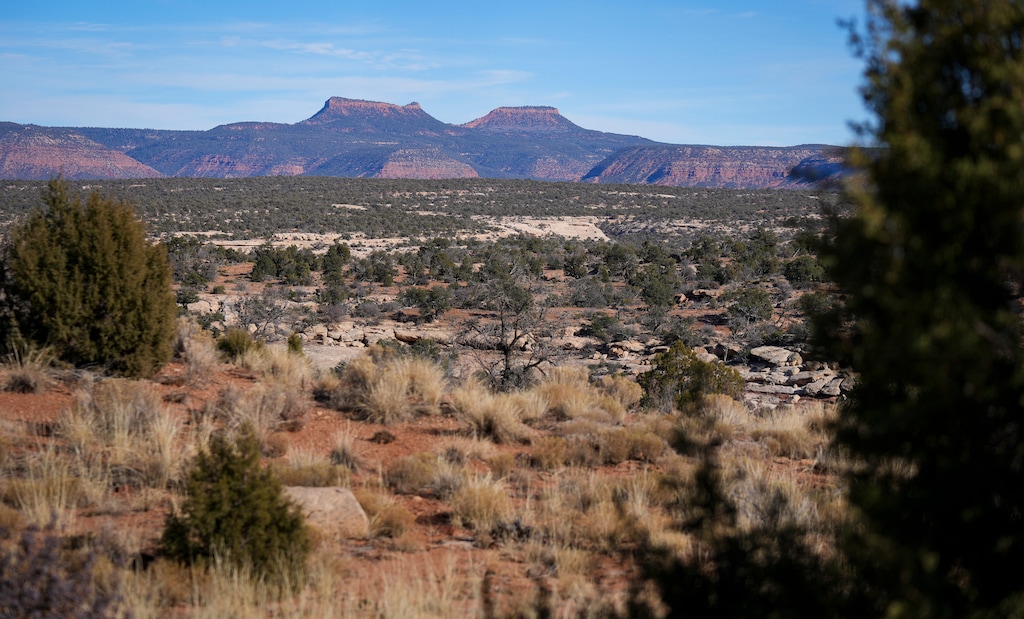
The 10th Circuit Court of Appeals reversed a district court’s dismissal of a lawsuit brought by Utah, Kane and Garfield counties, the Blue Ribbon Coalition and others that claimed President Joe Biden exceeded his authority under the Antiquities Act when he restored the boundaries of Grand Staircase-Escalante and Bears Ears national monuments in 2021.
The circuit court sent the case back to the district court and affirmed the district’s court decision to dismiss Blue Ribbon Coalition, a group that advocates on behalf of recreation access for motorized users, and other individual plaintiffs due to lack of standing.
The lawsuit is part of an ongoing conflict over the management of millions of acres of land in southern Utah. President Donald Trump previously shrunk the boundaries of the two monuments during his first term in 2017. President Bill Clinton initially designated Grand Staircase-Escalante National Monument in 1996, and President Barack Obama designated Bears Ears National Monument in 2016.
The circuit court’s decision does not affect the monument’s status or its boundaries, said Steve Bloch, legal director at the Southern Utah Wilderness Alliance. Rather, it returns the case to the district court, which had previously said it didn’t have jurisdiction to review the case.
The state and other plaintiffs argue that Biden designated areas other than “historic landmarks, historic and prehistoric structures, and other objects of historic or scientific interest” as required under the Antiquities Act. They also claim that the former president failed to protect the “smallest area compatible,” another requirement of the act.
“Today’s ruling is a win for Utah, and for every Western state that has watched federal administrations treat the Antiquities Act like a blank check to lock up millions of acres,” Utah Attorney General Derek Brown said in a statement. “For years, the federal government has insisted that a president’s monument proclamation is unlimited and can’t be reviewed.”
(Bethany Baker | The Salt Lake Tribune) Grand Staircase-Escalante National Monument, seen from Utah Scenic Byway 12 near Boulder on Tuesday, Dec. 17, 2024.
Both the state and environmental groups that joined the lawsuit on behalf of the defendants — the U.S. president and federal agencies — seemed to agree on one thing, though: federal courts have the authority to hear challenges to a president’s use of the Antiquities Act.
“Court after court has affirmed the president’s authority under the Antiquities Act to create monuments on federal lands,” said Heidi McIntosh, managing attorney for Earthjustice’s Rocky Mountain office.
While courts have heard such cases for 100 years, no court has overturned a president’s use of authority under the Antiquities Act, Bloch said.
“We’re confident that President Biden’s establishment of Grand Staircase-Escalante and Bears Ears National Monuments will be upheld,” he added. “President Biden hewed very closely to Congress’s intent in passing the Antiquities Act to protect irreplaceable resources, many found nowhere else in the world, when he established these monuments. And he specifically concluded that these monuments were the smallest size.”
Following the appeals court’s orders, the case will be sent back to the lower court to consider whether or not Biden’s monument designations were lawful. However, the federal government could ask all active judges of the 10th Circuit Court to rehear its argument that the monument designation is unreviewable, Bloch said, or ask the Supreme Court to review the issue.
The state plans to “keep fighting for Utah’s land, its rural communities, and the principle that no president, of either party, stands above the law Congress wrote,” Brown said. “We intend to win.”