The most interesting environmental story in America right now may be unfolding in a classic red state.
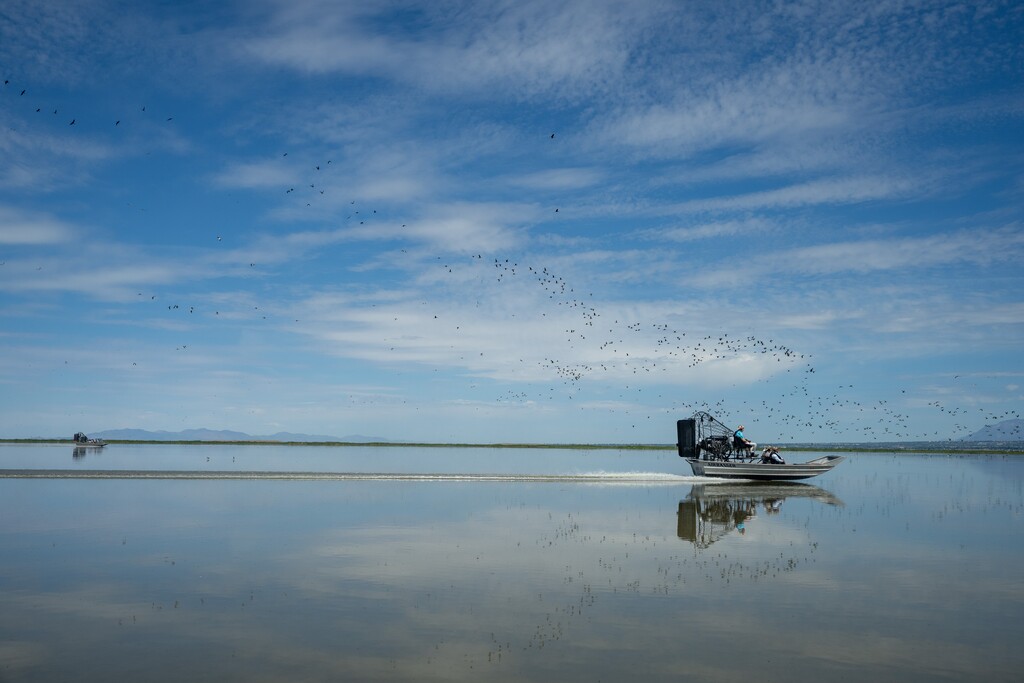
In northern Utah, Great Salt Lake is slowly collapsing. Its exposed lakebed sends toxic dust into nearby communities, its drying wetlands are losing their ability to sustain migratory birds, its food web is stressed and its mineral extraction industries are struggling. Its water level — which has not been in the healthy range of 4,198 to 4,205 feet since 2012 — reflects nearly every hard choice the West now faces: farming, cities, growth, drought, climate and the limits of old water law.
For years, Utah leaders have tried to save the lake while preserving the state’s conservative identity. Then came an unlikely development: President Trump pledged support for a $1 billion federal investment to “Make the Lake Great Again.”
Since the 1970s, environmental politics have followed a familiar partisan script in which Democrats argued for regulation while Republicans warned against federal overreach. But the script is breaking down.
A Republican environmental agenda is gaining momentum, not because the party has adopted the language of progressive climate politics, but because Republicans are discovering that environmental policy can serve conservative ends: affordability, economic growth, energy reliability and local control.
Great Salt Lake’s decline is a public health problem, an ecological problem, an economic problem and a water management problem. It can’t be dismissed as a coastal preoccupation or a symbolic climate cause. The lake sits in a red state whose leaders prize sovereignty and small government, yet those same leaders have acknowledged the scale of the crisis and invited federal help. Supporting Great Salt Lake allows Republicans to frame environmental action not as surrender to Democratic ideology but as protection of place, economy and public welfare.
A proposed hyperscale data center near Great Salt Lake, led by celebrity investor Kevin O’Leary, has received surprisingly strong opposition from Utahns. The 40,000-acre “Stratos Project” — the same size as Washington, D.C. — would double the state’s electricity demand and potentially alter the area’s climate with its heat output, water use and emissions. Social media lit up with questions, thousands formally protested a water right application and state leaders have cooled their support. And O’Leary is making concessions.
The debate has become less about the data center and more about governance. Utahns, while unquestionably pro-business, won’t entertain a corporation that appears to hide their potential impacts to land, air, water and energy, and they don’t like government agencies that fast-track an enormous project without the necessary public participation. And all this in a Republican stronghold.
Utah Sen. John Curtis has given the trend its clearest vocabulary. As founder of the Conservative Climate Caucus and host of the annual Conservative Climate Summit, he has argued for innovation, markets, American energy and emissions reduction without dismissing economic growth. Last year, when many Republicans wanted to kill clean-energy credits, Mr. Curtis was a mediating voice.
His approach won’t satisfy every climate advocate, and it shouldn’t be romanticized. The Trump administration dislikes wind and solar subsidies, and many Republican lawmakers still resist renewable energy, climate science and environmental regulation. The old reflexes remain powerful.
But Mr. Curtis’s work gives conservatives permission to speak up without borrowing progressive language. No environmental majority will persist if half the country believes that action requires a change of cultural identity.
The emerging Republican agenda has three strengths.
First, it localizes environmental action. A lake, a grid, a farm, a ranch, a factory or a watershed is more tangible than a global atmospheric target. People protect what they love.
Second, it links conservation to prosperity. Water security, farm viability, mineral production, rural income, manufacturing and affordable power are not side effects. They are the argument.
Third, it adopts innovation as a governing principle. Instead of asking what government should prohibit, it asks what markets, technologies and standards can make possible.
The weakness is just as clear.
A Republican environmental agenda may understate the scale and speed of climate risk, leading to partial solutions that come too late. It may use the language of innovation as cover for deregulation. It may fold whenever environmental protection requires investment rather than immediate return.
If Republicans want credibility on the environment, they need measurable outcomes like more water for local rivers, cleaner air, lower power costs and stronger rural economies.
If Democrats want durable environmental policy, they should recognize that not every solution will arrive in progressive language.
The country needs bipartisan environmental action. Each party can find its own reason to get there. For Republicans, the reason may be simple: Sometimes a policy is about saving home.
(Robert B. Sowby) Robert B. Sowby is a professor of civil and construction engineering at BYU.
Robert B. Sowby is a professor of civil and construction engineering at Brigham Young University in Provo, a licensed professional engineer and the author of “Terminus: A Hydrobiographic Journey of Water Management in the Great Salt Lake Basin.”
The Salt Lake Tribune is committed to creating a space where Utahns can share ideas, perspectives and solutions that move our state forward. We rely on your insight to do this. Find out how to share your opinion here, and email us at voices@sltrib.com.