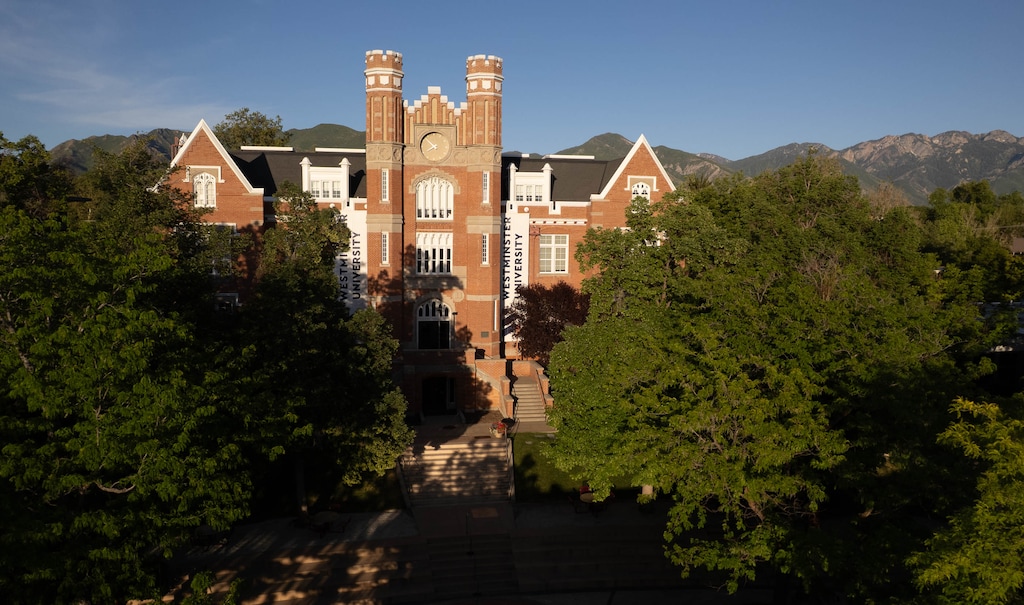
I give to causes across Utah, and I come from a family that has spent generations doing the same. So let me start with an uncomfortable truth: You cannot fundraise your way out of a broken business model.
Westminster University just received a D in Forbes’ annual ranking of private college financial health, the lowest grade the magazine gives. Enrollment has fallen 57% in a decade. The school has not operated in the black since 2018.
When the news broke, Westminster’s response leaned heavily on philanthropy, pointing out that it has raised $100 million over 10 years and that giving “has never been stronger.”
I believe them. But that is not the problem, and more giving is not the fix.
Two people shaped how I understand this. My father, Steve Denkers, has spent his adult life in Utah philanthropy, and few people have thought harder about how giving actually strengthens a community rather than just funding it. He taught me young that philanthropy is strategic, not only generous, and he brought his kids into the work early, which is part of why I came to it younger than most. My stepfather, Michael Young, who served as president of the University of Utah, the University of Washington and Texas A&M, taught me how university finance works from the inside. The views in this piece are mine alone, and both of them can speak far better for themselves than I can for them. But I would be dishonest not to credit where my education came from.
Here is what that adds up to: Donors do not rescue sinking ships. We fund momentum. Restricted gifts cannot cover payroll, and no serious donor wants their money plugging an operating hole at a school that has not yet fixed why the hole exists. A credible turnaround is what unlocks philanthropy. Not the other way around.
None of this should surprise anyone who has watched higher education over the past decade. Harvard’s Clayton Christensen predicted this exact squeeze back in 2013, arguing that tuition-dependent schools with thin endowments and no clear identity would be the first to fall. He was off on his timing, and his headline numbers were too aggressive. But he was not wrong about the mechanism. We are watching it play out in real time, in our own backyard.
Here is what gives me hope, though.
Westminster is not a small college in rural Vermont. It sits in one of the fastest-growing states in the country, on valuable real estate in one of Salt Lake City’s best neighborhoods, with a loyal donor base and an 86% first-year retention rate that even beats the University of Utah and sits well above the national average of 68%. The students who come, stay. That is one of the hardest things in higher education to build, and Westminster already has it.
What it needs now is leadership willing to move fast and make hard decisions.
Rethink the tuition model so it actually reaches Utah’s growing and increasingly diverse population. Tuition and fees run about $46,000 a year, and once you add housing, food and books, the full cost of attendance climbs to nearly $60,000. Westminster does work hard to offset that. Nearly all of its undergraduates receive grants or scholarships, bringing the average net price closer to $28,000, according to the U.S. Department of Education. But even at that level, and even before a single student sees an aid package, a $60,000 sticker price is too big a pill for most families to swallow. The number alone scares people off before they ever learn what they would actually pay.
Scale back programs with low enrollment and weak career outcomes. Build new ones that employers actually want, on models like Northeastern University’s co-op program, which alternates semesters of study with paid work, lowering instructional cost and improving job placement at the same time. Put the campus real estate to work.
And above all, stop trying to be a generic liberal arts school and decide what Westminster actually is. The small liberal arts model is fading. A sharp, well-run, well-located university with a clear identity and a real value proposition is not.
I hope Westminster’s board hired a president who came to shake things up, and I hope the board will support that president in doing it. Because the schools that survive this moment will not be the ones that fundraised the hardest. They will be the ones that were honest about the math and moved before the clock ran out.
I want Westminster to be one of them. It is a 150-year-old institution in a city I love, and it belongs here.
(Mike Denkers) Mike Denkers is a philanthropist and entrepreneur based in Salt Lake City, affiliated with the Eccles and Denkers Family Foundations. A member of the Eccles family, he has spent the past decade advising nonprofits on fundraising, growth, and education-focused giving.
Mike Denkers is a philanthropist and entrepreneur based in Salt Lake City, affiliated with the Eccles and Denkers Family Foundations. A member of the Eccles family, he has spent the past decade advising nonprofits on fundraising, growth and education-focused giving.
The Salt Lake Tribune is committed to creating a space where Utahns can share ideas, perspectives and solutions that move our state forward. We rely on your insight to do this. Find out how to share your opinion here, and email us at voices@sltrib.com.