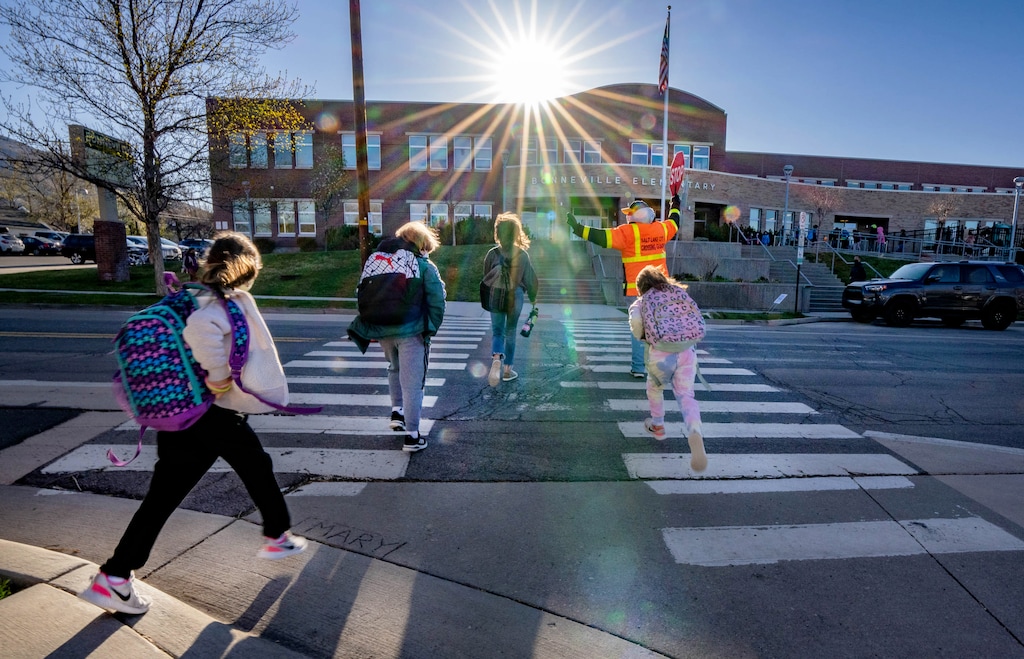
My nephew did everything right. He wore his helmet. He followed the crossing guard’s instructions. He rode his scooter through a marked crosswalk after school on a bright afternoon.
Still, he was hit by a car.
The driver was rushing to leave the school parking lot, speeding through the school zone and into the crosswalk. The helmet helped limit my nephew’s injuries, but the crash should never have happened.
Anyone who has spent time around a school during dismissal knows how chaotic it can get. Children move unpredictably. Parents rush. Staff try to leave at the same time.
School zones are where our laws should be clearest and strongest because the consequences of mistakes can be catastrophic.
But Utah is moving in the opposite direction.
During the 2026 legislative session, lawmakers passed HB0178 and HB0024 — two bills that reduce penalties for dangerous driving in school zones. One makes it optional for offenders to observe crossing guards as part of their sentence, and the other downgrades some speeding violations from a misdemeanor to an infraction. Some supporters argue these are small adjustments. But laws do more than punish behavior — they shape behavior.
As a personal injury attorney who has handled pedestrian injury cases across multiple states — including in Utah — I’ve seen the aftermath when drivers treat crosswalks as mere inconveniences. The result is measured not just in legal claims but in broken bones, lifelong trauma and families forever altered by preventable tragedies.
The question now isn’t whether these bills were intended to help, but whether they inadvertently send the wrong message: that convenience is more important than safety. We’re already seeing a troubling rise in pedestrian fatalities in Utah, particularly near intersections and crosswalks — exactly where school-zone laws are supposed to provide protection. Recently, an $81 million verdict was handed down in Utah in a case involving a child killed in a crosswalk. This is a tragic reminder of what’s at stake when we fail to prioritize safety over convenience.
Strong penalties aren’t just about punishing offenders. They’re about deterring reckless behavior before it causes harm. When lawmakers weaken consequences in school zones, they risk weakening the deterrent that keeps drivers vigilant.
Take HB0178, for instance. This bill removes the requirement for offenders to spend time observing crossing guards — a consequence designed to help drivers appreciate how school zones work and why they require heightened awareness. The justification for this change is that some drivers have treated crossing guards poorly during these observations. But harassment should never be a reason to reduce accountability. The solution isn’t to make laws more lenient but to address the harassment directly and ensure stronger protections for crossing guards.
Similarly, HB0024 sends the wrong message by downgrading speeding violations in school zones. While supporters argue that some speeding offenses are minor, research shows that even small increases in speed significantly raise the risk of severe injury. Whether a driver exceeds the speed limit by 5 mph or 15 mph, the danger remains the same.
The real question is this: How do we prioritize children’s safety over driver convenience? When convenience wins, crosswalks are ignored, speed limits rise and enforcement becomes inconsistent.
Impatience meets the unpredictability of children, and tragedy is often the result.
Utah needs to move in the opposite direction. We should be strengthening school-zone protections, not weakening them. That means clearer signage, consistent enforcement and infrastructure that forces drivers to slow down near schools.
We need to protect and respect crossing guards, and it should be unmistakably clear that speeding in a school zone — no matter how slight — is unacceptable.
There is still time for lawmakers and the governor to reflect on these changes as they take effect. Future legislative sessions should consider whether these laws are truly protecting children, or whether they’re inadvertently encouraging dangerous behavior.
Accountability isn’t just about punishment; it’s about prevention.
Utah prides itself on being a state that values families and children. Our laws should reflect that commitment where children are most vulnerable.
My nephew was fortunate; his injuries were limited. But the next child in that crosswalk might not be. When that moment comes, no one will be thinking about convenience. And by then, it will be too late.
(Thaddeus Wendt) Thaddeus Wendt is a partner & CEO at Feller & Wendt.
Thaddeus Wendt is a partner & CEO at Feller & Wendt and recently secured a $4.6 million unanimous jury verdict. His personal injury firm and its car accident attorneys handle all types of motor vehicle collisions, pedestrian cases, bicycle cases, dog bites and catastrophic injuries.
The Salt Lake Tribune is committed to creating a space where Utahns can share ideas, perspectives and solutions that move our state forward. We rely on your insight to do this. Find out how to share your opinion here, and email us at voices@sltrib.com.