 Mark Eddington
Hurricane • The muddy water surging into Elizabeth Lucas’ Hurricane home felt like a recurring nightmare.
Two months earlier, an Aug. 14 flood devastated the house on 850 West where she and her husband have lived for over two decades. They had just poured thousands of dollars into repairs when the second deluge struck, sending water rushing through her doorway.
“I was scared because the water came in so fast,” recalled Lucas, who was home alone when the flash flood from Gould Wash struck her neighborhood for the second time in as many months.
Weeks after the second flood hit on Oct. 22, she and her husband Jared, are living in an Airbnb in Colorado City, Ariz., working through insurance claims and taking stock of everything that is damaged or lost. Repairs take time and reams of paperwork Lucas said, and it could be months before they are able to move back into their home.
(Courtesy Elizabeth Lucas) Water and damage are seen inside of Elizabeth Lucas’ home after flash flooding in Hurricane on Thursday, Oct. 22, 2026.
(Courtesy Elizabeth Lucas) Water and damage are seen inside of Elizabeth Lucas’ home after flash flooding in Hurricane on Thursday, Oct. 22, 2026.
Juana Puga, who lives in the same neighborhood, recalled returning from an errand with three of her five sons in the car and seeing waist-deep floodwater engulfing their home. The family is now living in a rental as they sort out repairs.
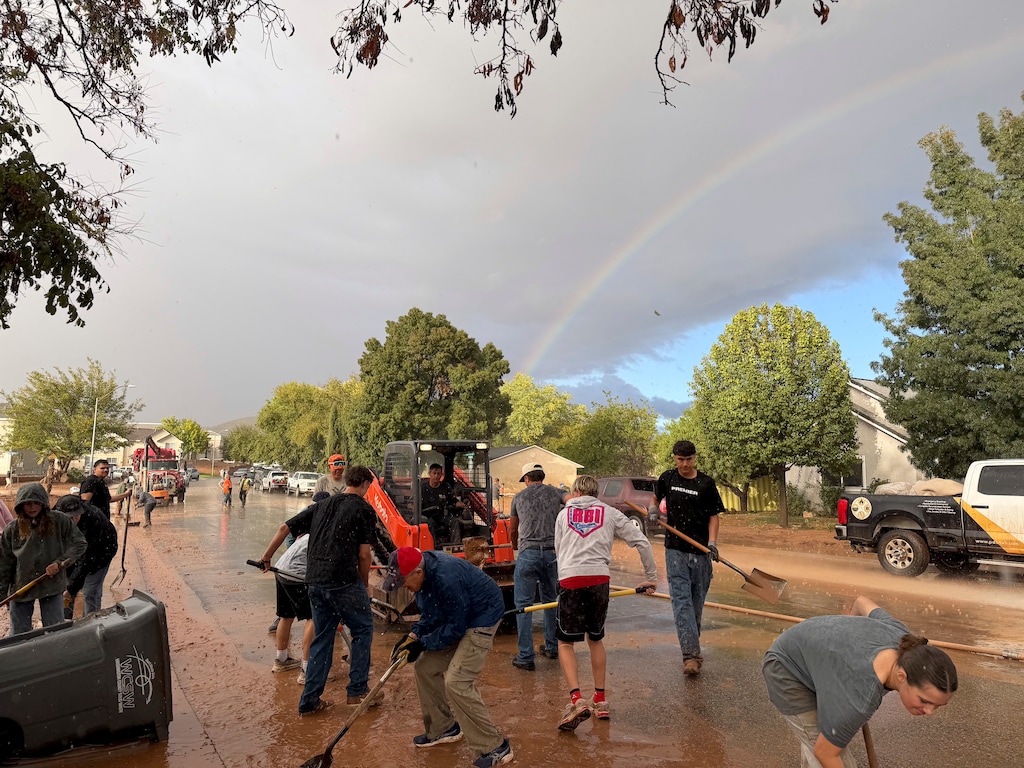
City officials estimate that the powerful storm and subsequent flooding left behind several millions of dollars in damages, impacting at least 80 homes near Gould Wash, west of the city center.
For many residents swamped by floodwaters for the second time, the pressing question is why the city failed to dredge the wash and clear debris between the two storms.
Sean Carey, whose home emerged with only minor damage, said city officials didn’t make enough of an effort after the first flood. He said residents raised the issue of dredging the wash at a city council meeting, but “it seemed like they didn’t know what to do yet” and “they didn’t want to throw a lot of money at it either.”
Puga also faulted the city for failing to clear the wash between the August and October floods.
“From August to October there was literally nothing done to the wash” she said. “If measures had been taken, this flood in October might not have happened or been so devastating to so many families,” she said.
Why the city didn’t dredge
Mayor Clark Fawcett said the city did not dredge the wash because the likelihood of experiencing two major storms and flood events in such a short timeframe was statistically near zero. He noted that he would have had a better chance of winning the lottery.
The city followed standard maintenance schedules by waiting to dredge until after the irrigation season, he said. Irrigation runoff had left the channel saturated, creating a high risk that heavy equipment would sink or damage underground utilities, he added.
“It’s kind of hard to get in and out [of the wash] and do anything with it,” Fawcett said.
After the second flood, the mayor said he told city crews to tackle the wash despite the tough conditions. He noted that workers exceeded expectations by using smaller equipment and clearing brush to avoid getting stuck, and even resorting to hand tools in some areas to protect a crossing sewer line.
Fawcett insisted the city is exhausting all options to prevent future floods. Officials plan to apply for federal funds from the Natural Resources Conservation Service to hire a consultant to design an upstream retention basin. If approved, the city would acquire Bureau of Land Management land east of the flood zone for the basin, which would slowly release stormwater during heavy downpours.
To address these vulnerabilities, the mayor said, city engineers are evaluating a potential replacement for the 700 West bridge while exploring options to raise the banks and expand capacity along the wash from 850 West to 1040 West.
However, the mayor cautioned that any major structural upgrades face steep hurdles, including the need for an Army Corps of Engineers permit, high project costs, private property boundaries, utility line constraints, and the critical risk of inadvertently diverting floodwaters into other neighborhoods.
Utah Rep. Celeste Maloy said her office is stepping up to help.
“I’ve been out with Mayor Fawcett to see the damage, and my office has been in regular contact with Hurricane city officials and state and federal partners throughout the process,” she said in a text to The Tribune. “We’re also engaging with the Natural Resources Conservation Service, the Small Business Administration and congressional committees to make sure Hurricane is getting the resources that can help the city and residents recover.”
While flood victims might get some relief from the U.S. Small Business Administration, which offers low-interest disaster loans to homeowners and business owners, Fawcett doesn’t foresee the Federal Emergency Management Agency stepping in to help individuals with home repairs. He said the scope of the disaster was not large enough to meet the agency’s threshold for assistance.
Whatever federal help the city might receive, he added, would likely be for infrastructure rather than individuals. And building a retention basin to forestall future floods could be “four or five years away.”
Longing — and dreading — to return home
(Mark Eddington | The Salt Lake Tribune) Elizabeth Lucas points out aspects of the repair work being done on her home after two flash floods in Hurricane, seen here on Monday, Nov. 2, 2026.
That timeline fills Lucas with dread. Her memory of escaping the second flood remains visceral: alone in the home with her husband at work, she watched the water rapidly rise.
Within minutes, the pressure from the rising tide prevented her from exiting through the front door, forcing her to crawl through a window into a chest-deep torrent. She survived by clinging to parked cars before they floated away, fighting the current until rescuers could reach her and haul her to safety.
What made the trauma worse, she said, was the timing.
Having just replaced the flooring and moved back home after the August flood, she watched history repeat itself. This time, the water took everything — not just six vehicles and a trailer, but irreplaceable journals, photos, and family keepsakes. Fortunately, the Lucases were able to obtain flood insurance before the second event.
While the support she and her husband have received from neighbors and the community make her want to return home, they are still apprehensive about rebuilding without a lasting solution and worry about their safety.
“I want to come back to my home,” Lucas said. “I just don’t want to do this all over again.”
(Mark Eddington | The Salt Lake Tribune) Elizabeth Lucas stands the kitchen of her home after surviving two flash floods, seen here in Hurricane on Monday, Nov. 2, 2026.