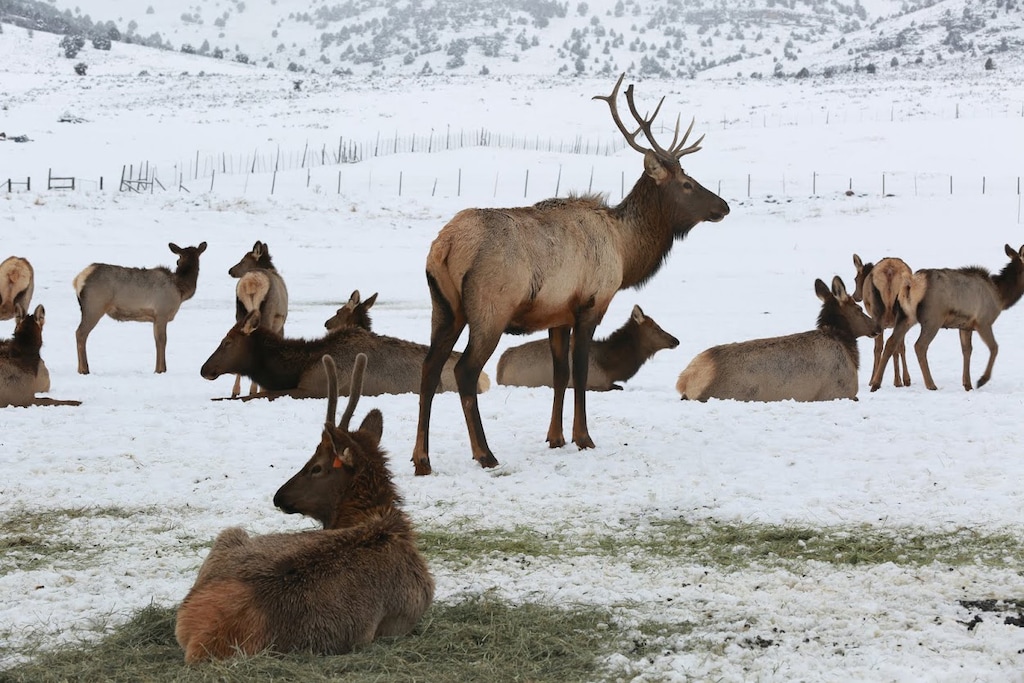
Rocky Mountain elk, Utah’s state animal, are impressive — but they can pose financial and management challenges to farmers and ranchers.
I encountered these challenges frequently myself during two decades as wildlife manager for Deseret Land & Livestock. As the health of the rangelands we managed improved, and our livestock productivity with it, so did the abundance of wildlife.
“I suppose we could’ve grazed more livestock if we carried fewer elk, but then where would the elk spend the summer?” says Dan Jorgensen, a retired multi-generational rancher who ran a family cattle operation near Salina. Jorgensen takes pride in the condition of the livestock, wildlife and land. “These elk had nowhere else to call home. We managed the ranch so that the livestock and the wildlife all thrived for years to come.”
A detailed economic survey of westerners owning more than 500 acres, recently published by the Western Landowners Alliance, demonstrates that Jorgensen is no outlier. The survey found that farmers and ranchers in the West invested at least $407.5 million in conservation, above normal operating expenses, in 2024 alone. That spending in western states exceeded many other well-recognized conservation funding sources in 2024, including the Natural Resources Conservation Service EQIP program and federal excise taxes on hunting and fishing equipment.
“Management decisions and investments by private landowners are key to conserving wildlife and wildlife habitat in our state,” says Ken Clegg, a Utah-based private lands wildlife biologist who works with ranchers throughout the West. “If it weren’t for the efforts of privately owned ranches, Utah’s wildlife resources wouldn’t be nearly as abundant.”
Investments on private working lands help maintain wildlife habitat, forest and water resources, open spaces, and local communities. While the benefits of well-managed private lands extend beyond ranch boundaries, much of the cost is borne by landowners — costs that can limit working lands conservation.
Clegg works with several landowners who partner with agencies and conservation organizations to improve water and crop management practices, stream flow and habitat for migratory birds and fish — both on and off their property. Some, like the Deseret Land & Livestock Ranch, where I worked, use federal programs like Conservation Benefit Agreements to conserve habitat for species like the greater sage-grouse while gaining management assurances. Others have placed conservation easements on their properties, ensuring they remain as working land and wildlife habitat.
Overall, though, few surveyed landowners participate in such programs. Yet, most identified financial costs as the biggest barrier to further conservation investment, followed by concerns about loss of management control, regulations and lost income opportunities. Those findings suggest that better-aligned policies and support could unlock even more landowner conservation investment.
For more than 30 years, Utah has led the West in developing collaborative wildlife management programs that promote big game conservation on private land — benefitting wildlife, landowners and sportsmen — at no cost to the public. The Utah Cooperative Wildlife Management Unit (CWMU) and the Utah Landowner Association (LOA) programs generate hunting revenue to landowners who work with the Utah Division of Wildlife Resources to manage big game. These private lands are essential habitat. For example, Clegg routinely conducts population estimates for clients on 1.26 million acres of CWMU and LOA properties. While only 2.3% of the state, these lands support nearly 25% of Utah’s elk population.
Policies and programs that support conservation on private land aren’t simply “hand-outs” that only financially benefit landowners — they help keep working landscapes intact, supporting millions of acres of habitat and hundreds of wildlife species.
Private lands are key pieces in a landscape puzzle — one that needs all its pieces to remain complete. Utah’s waterways and wildlife migrations crisscross an intermingled patchwork of landownership. Most westerners favor improved conservation, and management of public lands over large-scale public land sales.
Jorgenson and Clegg both urge collaboration and, as Clegg puts it, “conservation partnering with landowners — by sportsmen, conservation groups, universities, or agencies — is an investment in Utah’s water, wildlife, and landscapes.”
It is an investment in Utah’s future.
(Rick Danvir) Rick Danvir is a retired wildlife biologist who worked for two decades as wildlife manager of the Deseret Land & Livestock Ranch. He is also a past member of the Utah Wildlife Board.
Rick Danvir is a retired wildlife biologist who worked for two decades as wildlife manager of the Deseret Land & Livestock Ranch. He is also a past member of the Utah Wildlife Board.
The Salt Lake Tribune is committed to creating a space where Utahns can share ideas, perspectives and solutions that move our state forward. We rely on your insight to do this. Find out how to share your opinion here, and email us at voices@sltrib.com.