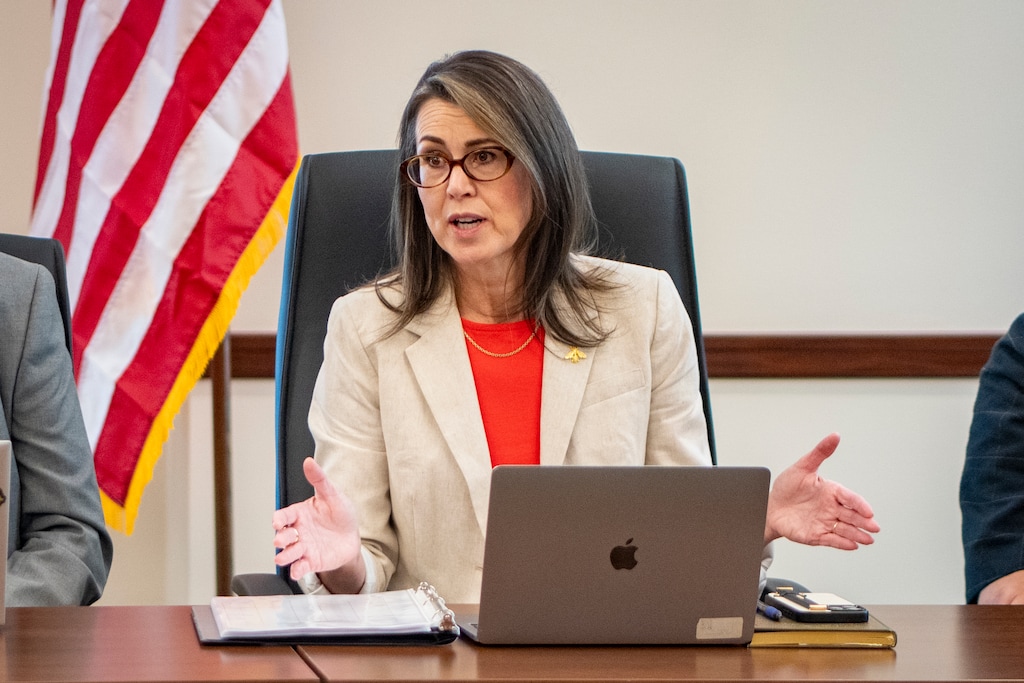
 Emily R. Anderson
In a letter to Utah’s top election official earlier this week, President Donald Trump’s Department of Justice said she could be subject to “criminal penalties” if noncitizens cast ballots in upcoming elections.
The threat to prosecute Lt. Gov. Deidre Henderson — a Republican — comes as she is fighting a lawsuit filed by the administration seeking to compel her to hand over the state’s entire, unredacted voter database — a demand she argues has no legal basis and violates Utah law.
Harmeet Dhillon, who oversees the Justice Department’s civil rights division, sent largely identical letters Tuesday to leaders in all 50 states, according to The New York Times.
“Got another love letter this morning from the DOJ sprinkled throughout with threats of criminal prosecution,” Henderson wrote in a social media post that same day.
Henderson said she’s sure the administration is targeting other chief election officers “for following state and federal laws” by not turning over private voter data. The administration’s demands, she noted, have been ruled illegal by several courts.
“This is truly bizarre behavior by the federal agency that is supposed to be protecting civil rights,” Henderson wrote.
The letters are the latest effort in the White House’s campaign to wrest election administration from states — a power granted to states in the U.S. Constitution — as it furthers unsubstantiated claims of widespread election fraud.
Trump has pushed for policies that would make it more difficult to cast a ballot by implementing strict proof-of-citizenship requirements for voters. He also has sought to end mail voting, a system Utahns widely use.
“This letter is sent to you as the chief election officer of the state of Utah,” Dhillon wrote to Henderson. “This letter serves as a notice of the federal laws applicable to state and local election officials to ensure free, fair, and transparent elections.”
The notice continued, “Also attached to this letter is a memorandum titled, ‘Federal Law Requirements for State and Local Election Officials,’ which outlines various responsibilities for state and local election officials under federal law and the potential criminal penalties for those who fail to carry out their duties.”
The department sent a copy of the letter to Utah Attorney General Derek Brown, whose office is defending Henderson in the lawsuit.
Dhillon asked Utah to respond within five days with its plan to comply at both the state and local levels.
“Any election officer, including the chief election officer of the state, who knowingly retains noncitizens on the state’s [statewide voter registration list] or facilitates noncitizens in receiving and casting ballots could be subject to criminal liability,” the letter concludes.
Henderson’s office completed a comprehensive audit of Utah’s voter database in May, and found the vast majority — 99.72% — were verifiable U.S. citizens.
Of the 2,069,640 voter records it reviewed, officials found 27 alleged noncitizens and 25 “probable noncitizens.”
Henderson told reporters in May that the review shows noncitizens are not voting en masse and that states are capable of managing their own voter databases.
“It does beg the question of: What is the purpose of the federal government trying to get their hands on all this private data?” Henderson said at the time.
According to a database maintained by the University of Wisconsin’s State Democracy Research Initiative, Utah is among 30 states and Washington, D.C., that the Justice Department has sued in an effort to obtain complete voter registration lists.
Those include voters’ sensitive personal data, such as birthdates, partial Social Security numbers and driver license numbers.
So far, no federal court has ruled in the Justice Department’s favor.
Judges in 11 district courts have thrown out cases, which the administration is appealing. In the only lawsuit so far to be resolved at the appellate level, the 6th Circuit Court of Appeals affirmed the dismissal of the case against Michigan.
Utah’s federal district court has not yet scheduled a hearing in the Henderson lawsuit.