 Emily R. Anderson
Utah’s popular vote-by-mail election system was again this year a target for the state’s supermajority Republican House of Representatives. After GOP colleagues in the Senate rejected their bill, representatives in the final days of the legislative session pushed for — and won — a taxpayer-funded study on “the security of ... voting by mail.”
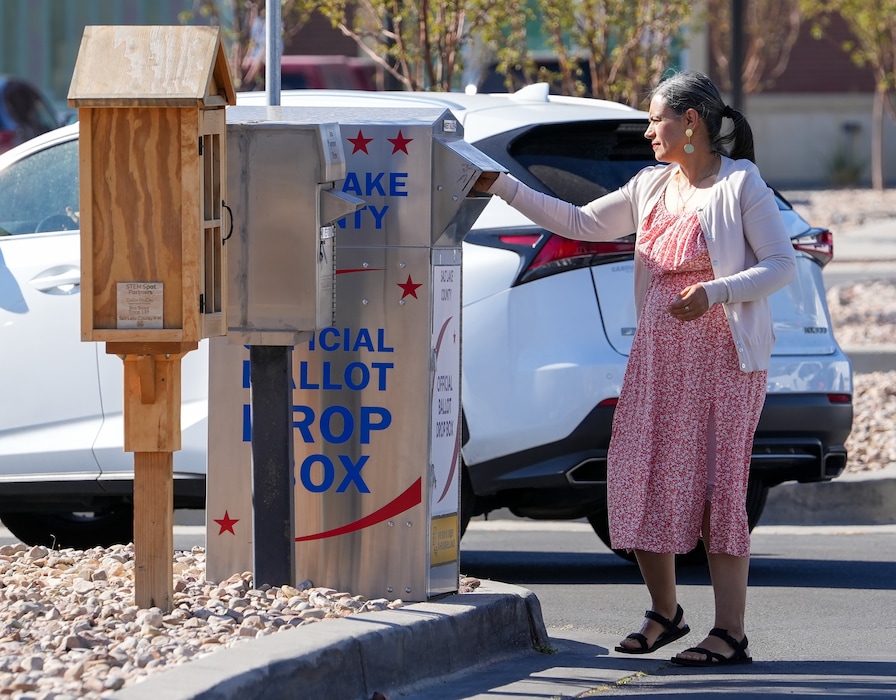
The Legislature will give $100,000 for researchers at Utah Valley University to compare the trustworthiness of sending a ballot through the mail to casting it in person. They are also tasked with identifying “the best practices for conducting and implementing a process where identification must be presented before depositing a ballot in a ballot drop box.”
That measure replaced the text for HB311, a bill that previously would have made largely technical changes to election laws. The version of the bill lawmakers published and passed Thursday night sets a deadline for the university’s Herbert Institute for Public Policy and Center for Constitutional Studies to complete and share their work with the Government Operations Interim Committee at or before its October meeting.
“This is a kind of compromise,” Sen. Mike McKell, R-Spanish Fork, told his colleagues on the Senate floor. “We’ve been working with the House to come up with some type of study. We had some other election bills that were logistically challenging, so we’re going study the issue.”
Two days prior, McKell successfully blocked Rep. Jefferson Burton’s, R-Salem, Election Code Modifications, or HB479, which would have further restricted voting by mail. Last year, Burton introduced a bill that will eventually end Utah’s practice of sending a ballot to every active, registered voter’s mailbox.
McKell stepped in 2025, too, to change the bill’s trajectory. Then, Burton initially proposed effectively terminating vote-by-mail altogether, the senator negotiated an alternative that will, starting in 2029, require voters to opt in once every eight years to receive their ballot in the mail.
Burton wanted to go beyond that this year by also mandating Utahns indicate when registering to vote how they will return their ballot — to a drop box or through the mail.
Those who returned their ballot to a drop box would have only been able to submit it during certain hours when the box would be watched by two poll workers. Poll workers, beginning in 2027, would check the voter’s ID and determine both whether they believe it belongs to the person returning the ballot and whether it matches the information on the envelope.
(Trent Nelson | The Salt Lake Tribune) Rep. Jefferson Burton, R-Salem, speaks during a news conference in Spanish Fork on Tuesday, July 15, 2025.
House Speaker Mike Schultz, R-Hooper, posted a video last month endorsing Burton’s bill.
“As I’ve had a chance to work on this with my colleagues in the Senate, I think there are a lot of things you’re trying to accomplish that I think there’s a lot of support for,” McKell told Burton during a Senate Government Operations and Political Subdivisions Committee hearing Tuesday.
“But I also think that, logistically, we’re still concerned that — how do we move forward and implement some of the things that are recommended in this bill? And I know some of the [county] clerks [who manage elections] are here, and they probably have some of those concerns,” he added before motioning to table the bill.
Senators on the committee voted unanimously to hold it.
Recurring attempts to eliminate or add barriers to voting by mail stem from unsubstantiated doubts held primarily by Republicans about election integrity.
In the years since he lost the 2020 election, President Donald Trump has falsely claimed vote-by-mail elections enable widespread fraud — despite casting his own ballot through the mail that election — and has called for state and federal officials to end or restrict the practice.
Burton’s proposed election changes last year were driven by the group that drafted the controversial Project 2025 playbook in anticipation of Trump’s 2024 victory, urging the president to exert more control over elections.
When presenting HB479 to a House committee last month, Burton alleged, without evidence, “We do know that 300 dead people voted” in Utah elections.
When The Salt Lake Tribune asked if he could share the source of that information, Burton declined to disclose where the data came from, but told a reporter he would share documents related to the figures. Burton later said he was mistaken.
A 2024 legislative audit identified two votes cast for deceased people in 2023’s municipal elections, and three individuals who appeared to have voted twice in an election. But auditors noted, “We did not find significant fraud.”