 Emily Anderson Stern
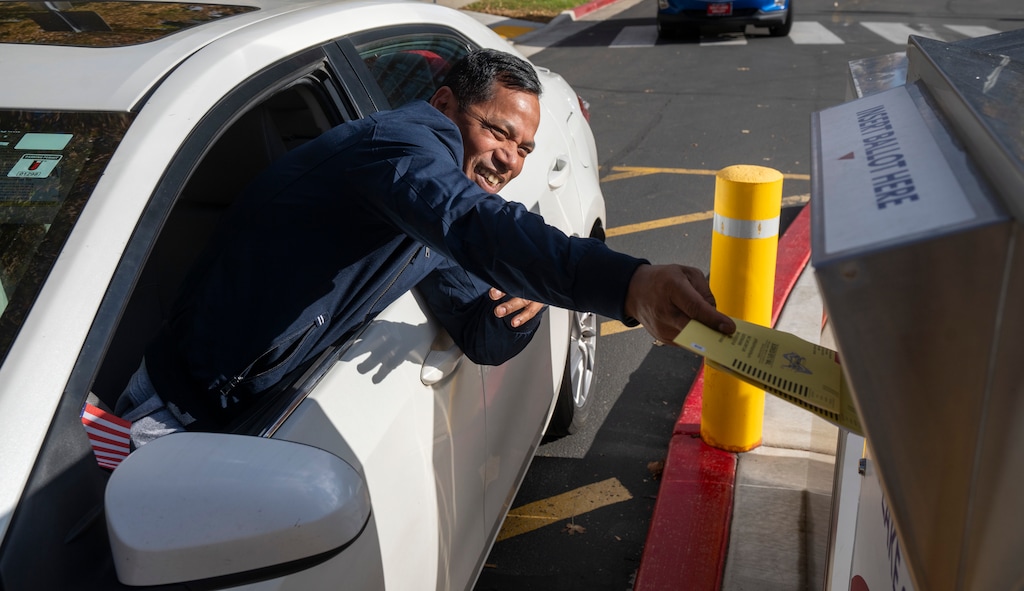
Utah is one of eight states which allows for universal voting by mail. But, within months of President Donald Trump taking office again, the state’s Republican-led Legislature passed a law to begin moving away from that system.
Now, as many of those lawmakers face reelection, postal workers are launching a campaign to remind Utahns of the value they see in vote-by-mail.
In a TV ad that began airing in Utah on Thursday, a series of Americans who volunteered to be in the commercial — a nurse, a farmer, a firefighter, a young mother, a disabled woman — explain why they need to cast their ballot through the mail.
“With Utah having a rich tradition of vote-by-mail, we couldn’t think of a better place than Utah to run this ad,” Utah Postal Workers Union President Amy Parke said at a Thursday news conference.
Union leaders emphasized that the campaign is nonpartisan, and their union supports any politicians who champion the postal service.
(Bethany Baker | The Salt Lake Tribune) Amy Parke, the president of the Utah Postal Workers Union, speaks during a news conference in support of vote-by-mail by the American Postal Workers Union in Salt Lake City on Thursday, May 28, 2026.
Utah’s by-mail election system is popular. A poll commissioned by the union concluded that 93% of Utahns use the ballots they receive in their mailboxes.
That number aligns with the findings of a 2024 Salt Lake Tribune analysis of that year’s primary elections, which found that among the 26 counties that provided data on voting methods, 96.7% of Utahns cast a primary vote via the postal service or by using a drop box.
Lawmakers nonetheless voted the next legislative session to begin requiring voters to opt in to receive a ballot in the mail beginning in 2029, and to no longer count ballots postmarked before Election Day that arrive in the mail afterward.
The changes were backed and largely lobbied for by The Heritage Foundation — the conservative activist organization that compiled the Project 2025 playbook in anticipation of Trump returning to the White House.
“Our Legislature says they are not doing away with mailed ballots, and yet this opt-in and opt-out method is intended to move voters away from the mail. The League of Women Voters calls this blatant voter suppression,” said Katharine Biele, the president of Utah’s chapter of the voting rights organization.
State senators rejected another effort to restrict vote-by-mail during the most recent legislative session, subsequently landing on a compromise with GOP representatives to commission a $100,000 study on “the security of ... voting by mail.”
Researchers will collect data from June’s primary elections, as well as reference past election numbers, according to Justin Jones, the spokesperson for the Gary R. Herbert Institute for Public Policy at Utah Valley University, which was enlisted to conduct the study.
He said research will likely be completed by the end of the summer, and that the institute will then begin drafting a report. The institute is required to present findings at or before October’s interim meetings.
In March, Trump — who has repeatedly attacked vote-by-mail election systems despite voting through the mail himself — issued an executive order limiting who can receive mail-in ballots.
It would require postal workers to reference lists of eligible voters and sift through ballots to determine whether or not they should be delivered. Multiple lawsuits are challenging its legality, and Utah’s top election official, Republican Lt. Gov. Deidre Henderson, compared it to “nonsensical dialogue.”
(Francisco Kjolseth | The Salt Lake Tribune) Mail trucks are parked for the night at the temporary postal annex in Salt Lake City on Friday, Feb. 11, 2022.
“That is something that fundamentally isn’t possible for the postal service to do,” said Russ Franklin, president of Utah Area Local 6, adding, “and that’s up to each individual county clerk’s office.”
The League of Women Voters has joined one of the legal challenges to the executive order, and union officials are working with the U.S. Postal Service to seek information on how the order would be implemented.
Ultimately, “we will do whatever the law tells us to do,” Franklin said. “But we’re going to reach out individually, and to our customers and the public to say, ‘Help us protect vote by mail,’ because it’s fast, it’s efficient, it’s secure, and [there’s] virtually zero fraud or lost ballots through the U.S. mail.”
Emily is a statewatch reporter at The Salt Lake Tribune, where she has worked since 2022. She received her master's degree in journalism from Northwestern University. There, she worked on investigative projects for The Washington Post and ProPublica. While writing, she's probably spinning something from her ever-expanding shelf of punk records.