 Emily R. Anderson
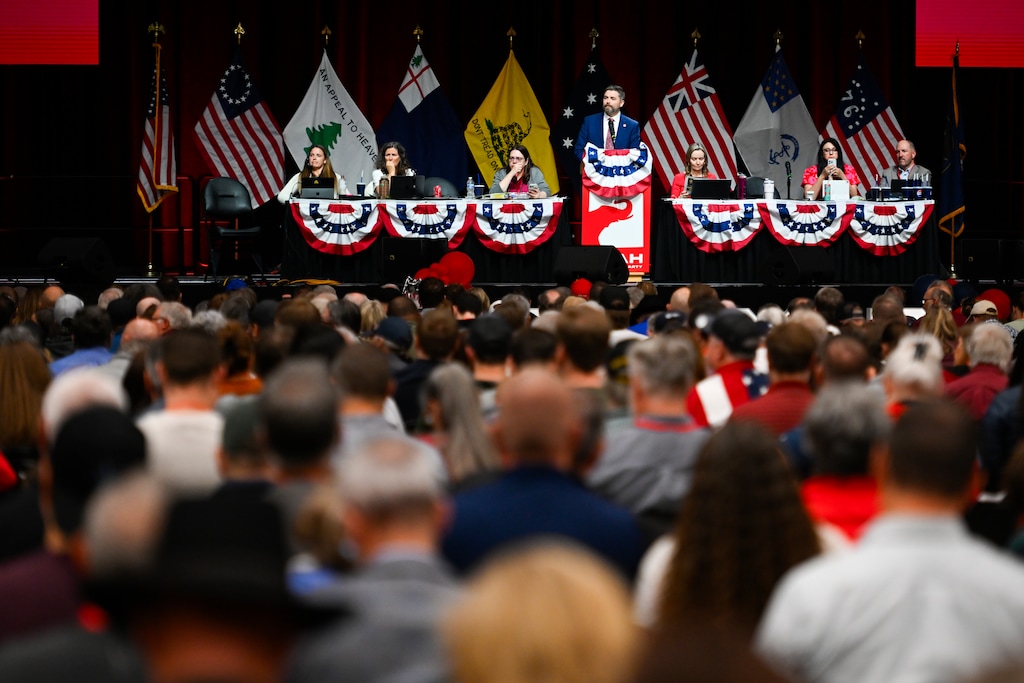
A cloud hung over Utah Republican delegates as they gathered Saturday to vote on their midterm election picks — come November, the party is poised to lose one of Utah’s four red congressional seats to a Democrat.
Leaders of the Beehive State’s majority party signified at the annual convention that it will move into a new territory with its campaigning as they made an unprecedented call for Utahns to vote against retaining two nonpartisan Utah Supreme Court justices.
“Go find a job in the private sector. We don’t want you anymore,” Utah Republican Party Chair Robert Axson said from the stage. “Diana Hagen and Jill Pohlman, see you later.”
Conservatives have for months now blamed their probable electoral failure in the new 1st Congressional District on the state’s judiciary.
Utah’s high court ruled in 2024 that the Legislature overstepped its authority in rewriting a voter-approved ballot initiative that established an independent redistricting process and outlawed gerrymandering. After lawmakers failed to draw maps that met the standards required in 2018’s Proposition 4, the anti-gerrymandering law, a district judge subsequently ordered Utah to adopt a new congressional map that includes a left-leaning district.
“We are going to have two Supreme Court judges who will have retention votes,” Axson said. “Vote no. These two people who ignore the Constitution have zero business being in the robe. They have zero business making decisions for us. This is our state — we believe in representative government.”
In Utah, judges are appointed, not elected.
(Alex Goodlett | Special to The Tribune) Utah GOP Chair Robert Axson speaks during the 2026 GOP nominating convention at Utah Valley University on Saturday, April, 25 2026 in Orem.
But voters get a say on whether to retain them once every six years, and in the case of Supreme Court justices, once every decade. The newest members of Utah’s courts also receive a retention vote “at the first general election held more than three years after the judge or justice was appointed,” according to state law.
Both Hagen and Pohlman were appointed by Gov. Spencer Cox, a Republican, and confirmed by the Republican-led Utah Senate. Hagen was confirmed to the Supreme Court in May 2022, and Pohlman joined her on the bench that summer.
[READ: Rep. Blake Moore defeated at Utah GOP convention — will face primary challenger in June]
Judges need only a simple majority of “yes” votes to remain on the bench, and it is extremely rare for them to lose retention elections. According to Ballotpedia, Utah Supreme Court justices receive an average of 80.6% of voters’ support and have won every retention vote in the last three decades.
The Utah Republican Party attempted to launch its own ballot initiative for voters’ consideration this November that would have repealed Proposition 4, but failed to do so.
(Trent Nelson | The Salt Lake Tribune) House Speaker Mike Schultz, R-Hooper, with Utah Supreme Court Justices John Nielsen, Jill Pohlman, Diana Hagen, Paige Petersen and Chief Justice Matthew Durrant before the State of the Judiciary address in the House Chamber at the Utah Capitol in Salt Lake City on Tuesday, Jan. 20, 2026.
Backed by the GOP, Utahns for Representative Government’s effort did not meet signature thresholds after thousands of voters withdrew their signatures. Opponents alleged signature gatherers used deceptive tactics to trick people into signing the petition, while UFRG countered that adversaries of the repeal effort resorted to intimidation to derail it.
“All is not well in Zion,” said U.S. Rep. Burgess Owens ahead of Axson’s comments. “The reason why, guys, is we have a republic we need to fight for and defend.”
As it became apparent Republicans would have one less seat in Utah, Owens announced in March that he would retire at the end of this year.
He defeated Utah’s most recent Democratic member of Congress, Ben McAdams, to win the seat in 2020. McAdams is now running again in Utah’s new blue district.
“[Justices] put their hands up and give an oath that they will protect our constitutional republic, and then go out and vote for majority rule,” Owens told the crowd. “We have this coming November a chance to correct the ship for the first time.”
[READ: Liban Mohamed wins at Utah Democrats’ convention — but it will be a crowded 2026 primary]
Owens made a similar call to action when he spoke at the Salt Lake County Republican Party’s convention the week prior.
Earlier this year, he sued Lt. Gov. Deidre Henderson — Utah’s top election official — in federal court in an effort to keep her from implementing the new congressional map. In 2023, Owens joined other Utah congressional representatives in signing onto a brief submitted in the larger redistricting lawsuit, declaring, “There’s no constitutional right to be free from partisan gerrymandering.”
“My message today is this: Let’s not sit on the sideline,” Owens, a former Super Bowl champion, told delegates. “Many of you guys got out and collected signatures, many of you didn’t. We cannot afford to have anybody stand on the sideline at this point.”