 Emily R. Anderson
 Robert Gehrke
Republicans’ decision to send a lawsuit over Utah’s abortion trigger ban to a newly created three-judge panel will keep the law un-triggered, likely delaying a decision for several more months, while the parties wrangle over the legality of the constitutional court, judges ruled Tuesday.
After a series of legal losses in cases challenging lawmakers’ actions — enacting the abortion ban, adopting gerrymandered congressional maps, and others — GOP lawmakers wanted to revamp how legal challenges to state laws are heard. The shift, legislative leaders said, would hasten decisions in such cases.
“These cases are very complex,” Gov. Spencer Cox told The Salt Lake Tribune last month on the final day of the legislative session. “They take a lot of time and deserve to have judges that can really focus on these issues so that we can get them decided quicker and hopefully get good decisions.”
But in the abortion case, the new court is seemingly doing the opposite.
The new law randomly assigns three judges, each from a different judicial district in the state, to hear such cases.
After Cox quickly signed the bill into law, Attorney General Derek Brown filed to have four cases reassigned to the newly established panel. That created a domino effect that ultimately resulted in the indefinite cancellation of the next hearing in the case.
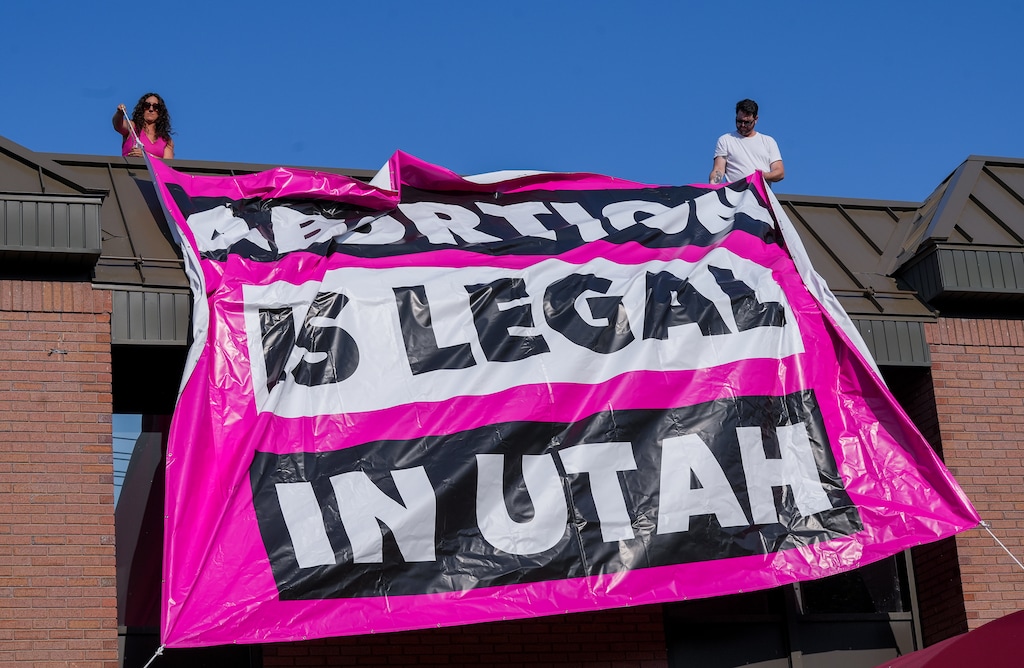
Parties in the fight over a near-total abortion ban have waited over 1 ½ years for that hearing, scheduled by a district judge in September 2024 for later this month. Abortion in Utah remains legal up to 18 weeks as the nearly four-year-long lawsuit continues without a date for a future hearing.
The decision follows a mid-March filing by the Utah attorney general’s office asking the judges to clarify “whether the Court intends to proceed with the hearing on April 16, 2026, or whether it will postpone the hearing to a later date.”
‘Hearing is CANCELLED’
In the Tuesday order, the panel responded, “To clarify, the April 16th hearing is CANCELLED. Once the Utah Supreme Court resolves the Petition, the parties may request a new date for the hearing, whether before the panel or Judge Stormont if Plaintiffs’ requested relief is granted.”
State Sen. Dan McCay, R-Riverton, who sponsored Utah’s near-total abortion ban, said “this case should have been decided by now.”
“While Utah courts have seen significant delays, more than a dozen state courts [outside Utah] have already ruled on similar abortion laws,” he said.
McCay said he supports the Legislature’s creation of the three-judge panel and respects “the courts’ role in getting this right. But Utahns deserve clarity. The law should be settled by now.”
Oral arguments before the Supreme Court have not yet been set. It can take the court several months from the time arguments are heard to issue an opinion, although it can take much longer.
Because the Legislature also expanded the Utah Supreme Court from five justices to seven, and those new positions are still vacant, two judges will be selected to fill the empty positions.
The Legislature passed the near-total abortion ban — which outlines exceptions for rape, incest, fatal fetal defects or serious risk to the mother’s health — in 2020, and set it to take effect if the U.S. Supreme Court overturned Roe v. Wade, the decision that said the Constitution protects the right to an abortion.
The high court did just that in 2022’s Dobbs v. Jackson Women’s Health Organization ruling.
Planned Parenthood Association of Utah immediately sued, contending Utah’s trigger law was unconstitutional and, in July of that year, 3rd District Judge Andrew Stone blocked the law from being enforced while the case worked its way through the courts. The Utah Supreme Court upheld Stone’s injunction in 2024.
After Brown moved the first batch of cases to the constitutional court, lawyers for plaintiffs in the abortion case, as well as two other cases — the long-running dispute over congressional redistricting and another challenging the state’s reliance on fossil fuels — quickly filed challenges with the Utah Supreme Court contesting the constitutionality of the new panel.
“This reconfiguring of the judiciary is yet another example of how the supermajority of the Legislature and Governor Cox will change the rules whenever they fear that the laws they pass — session after session — violate the constitutional rights of Utahns,” Planned Parenthood said in a statement announcing its challenge. “They clearly want to be not only legislators and the executive, but judge and jury too.”
Over the last few years, there have been several attempts by lawmakers to hasten and influence a decision in the trigger law case.
Following Stone’s ruling, GOP lawmakers in 2023 attempted to effectively ban abortions in Utah by prohibiting abortion clinics from operating, but that law was challenged and immediately blocked as part of the initial trigger ban lawsuit. The Legislature subsequently repealed the law in 2024 to “simplify the question before the Supreme Court of Utah.”
Then-Rep. Brady Brammer, R-American Fork, also in 2023, successfully introduced a retroactive change to court rules that targeted the language Stone used in his ruling to halt the trigger ban.
Although the joint resolution was aimed at stopping Utah’s courts from enjoining “controversial” laws soon after they are passed by the Legislature, Brammer explained during a committee hearing, “the trigger law was also a trigger to this.”