 Robert Gehrke
A nominee for Utah’s Supreme Court said Friday he believes he is eligible to fill one of two newly created spots on the court, despite questions raised about whether he meets the constitutional five-year residency requirement.
Jay T. Jorgensen, who currently serves as senior counsel for The Church of Jesus Christ of Latter-day Saints, said the three-year mission he served for the church in Chile does not mean he gave up his Utah residency, since he planned to return to the state when the mission work was complete.
Sen. Todd Weiler, R-Bountiful, the chair of the Senate Judicial Confirmation Committee, said some from the public had contacted the committee to question whether Jorgensen was eligible for the seat, pointing to the residency requirement in Article VIII of the Utah Constitution.
Jorgensen said he had been living in South Korea, where he was corporate counsel for Coupang, a Korean version of Amazon, until he moved to Utah in December 2020. He and his wife bought a home in Provo in 2021 and were living in a condominium while it was being renovated when they were called for the church mission.
When Jorgensen returned to Utah, he began working as an attorney for the LDS Church, so they sold the home in Provo and have a home in North Salt Lake.
“There was never a time where we evidenced any desire to go anywhere else,” he told the senators. “It’s not for me to decide. It’s for you to decide. You’re the decision makers here, but given that standard, when Utahns temporarily leave for three years and intend to come back, they are legally a resident for the time that they are gone.”
And despite working as a senior lawyer for the LDS Church, Jorgensen said after the hearing he does not anticipate he would have to recuse himself from cases before the court involving the church. He said he has worked exclusively with Brigham Young University Pathway Worldwide, which engages in educational work in parts of the world like Nigeria, Ghana and the Philippines.
“I would need to recuse from BYU Pathway work, but the church is organized by geographic areas, and I am not assigned to the Utah area and never have been.”
“So I wouldn’t need to recuse,” he added.
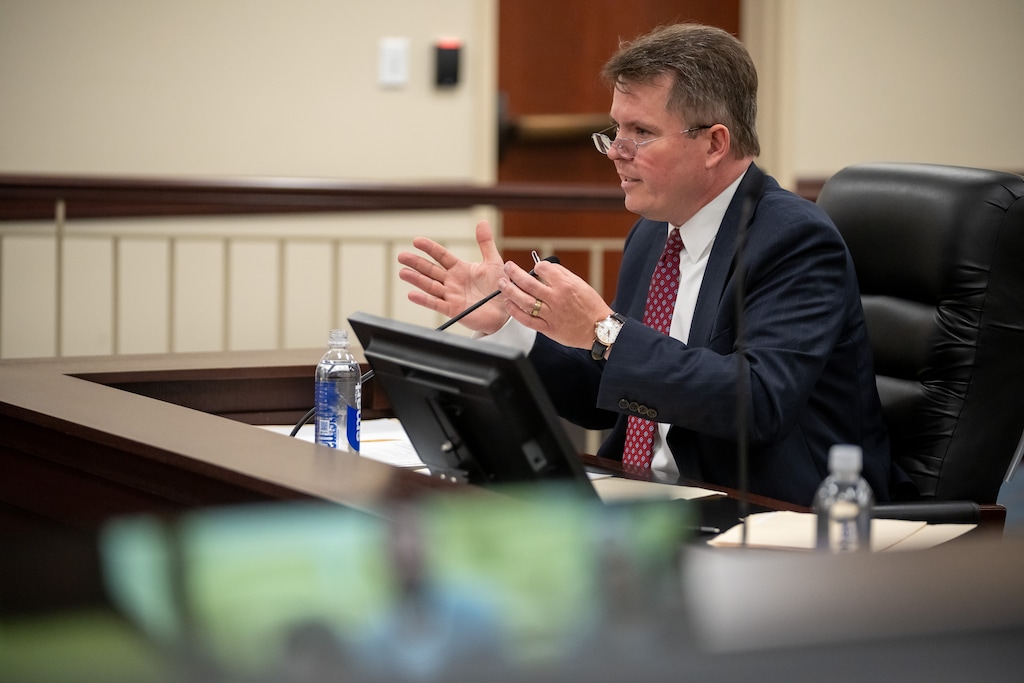
(Trent Nelson | The Salt Lake Tribune) Stephen Dent speaks to the Senate Judicial Confirmation Committee during a hearing on two of Gov. Spencer Cox's nominees to the Supreme Court — Dent and Jay Jorgensen (onscreen with his wife Melissa, behind Dent), in Salt Lake City on Friday, June 12, 2026.
The bulk of Friday’s confirmation hearing — the first of two — was spent exploring the judicial philosophy of Jorgensen and the second nominee, Stephen Dent. Both said their approach to the law is rooted in “originalism” and “textualism,” an approach that looks to the letter of the law or constitution and the original meaning of the words when it was written.
Jorgensen said his perspective was shaped by clerking for U.S. Supreme Court Chief Justice William Rehnquist and, before that, Judge Samuel Alito, who now is on the high court.
“When a judge takes to himself the idea of, ‘I’m going to expand beyond what [lawmakers] intended,’ some people say, ‘Well, what the judge is doing is expanding people’s rights,’ but it’s actually the opposite,” he said. “Justice Rehnquist and Justice Alito taught me that what you’re doing is stealing from the people. … [You’re] actually taking away the most precious right that people have … which is to organize their own government, organize their own society and decide for themselves.”
Sen. Karen Kwan, D-Salt Lake City, said that some see the Legislature’s decision to expand the court from five justices to seven as “opening the door to abandoning the court’s analysis of the citizens’ right to make law through initiative,” and asked if Dent believes the court’s 2024 decision that lawmakers need a compelling reason to repeal ballot initiatives as “binding precedent.”
Dent demurred, saying that it is precedent, but rules of conduct “prohibit me from speaking on what I would do and how I view that case” during the hearing. He said he would look at it “from an independent lens” and apply the principles of originalism and textualism to his analysis.
The second hearing before the committee is scheduled for Monday at 10 a.m., with a confirmation vote before the full Senate scheduled for Wednesday.