 Robert Gehrke
Lee este artículo en español aquì.
Democrats haven’t had much to get excited about in Utah in recent years, but due to new, court-ordered political boundaries, the party is favored to win a seat in Congress for the first time since Ben McAdams lost reelection in 2020.
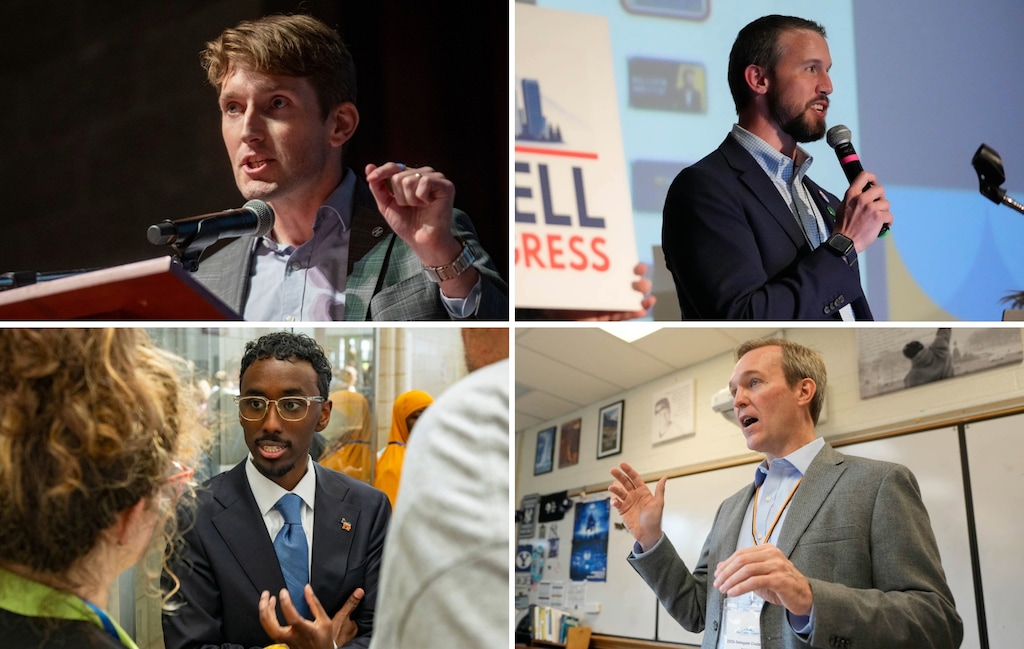
The primary race has brought out a slew of candidates and, after the party convention, the field has been winnowed to four — McAdams, Nate Blouin, Liban Mohamed and Mike Farrell.
The winner of the June 23 primary will face Republican Riley Owen, who won the GOP nomination at its convention in April. The district favors the Democrats by as many as 17 percentage points.
The Salt Lake Tribune posed the following questions, based on a reader survey about the issues Utahns felt were most important this election season, to each of the four candidates. Their answers — listed in alphabetical order — may have been edited slightly for length, style or grammar.
A plurality of voters, more than 30%, said elected official corruption is the primary issue driving who they’ll vote for, with another nearly 14% of voters saying it is their second-highest issue. Why are so many Utah voters concerned about corruption in politics? How will you build trust with Utahns?
Blouin: Utahns are tired of watching their government work for billionaires and corporate donors instead of for them. Like when the Legislature handed out tax breaks for a massive data center before most people even knew it existed. When campaigns are funded by corporate PACs and powerful special interests, the people writing our laws end up answering to money, not to us. That’s why I don’t take any corporate PAC money, so my only allegiance is to you. In Congress, I’ll fight to overturn Citizens United to get money out of politics, ban members from trading stock and crack down on corporate lobbying.
Farrell: Utah voters are rightfully concerned about corruption in politics, from both sides of the aisle, because so many elected officials have become wealthy trading stocks based, quite obviously, on insider knowledge and because the revolving door of lobbyists becoming elected officials and vice versa. If honored to serve the folks of CD1, I will fight for legislation banning congressional stock trading, imposing a lifetime lobbying ban for members of Congress, advancing campaign finance reform to limit the power of big money in politics and overturning Citizens United.
McAdams: Their concerns are valid. Trump is the most corrupt president in history, enriching himself while everyone around him gets richer and families struggle. In Utah, we’ve watched the Legislature gerrymander maps after voters passed Prop 4, ignoring the public at every turn. Trust comes from action. My entire career, I’ve stood up to corruption: Big Pharma, payday lenders, developers and the president himself. I voted to impeach Trump from a district he won, knowing it would cost me my seat. It did. I’m ready to continue standing up to corruption for you.
Mohamed: The reason so many Utahns are so concerned with corruption is simple: the Trump administration. From accepting the Qatari 747 to making millions off a worthless crypto meme coin and covering up for Epstein and his millionaire buddies, Utahns are tired of having a government that looks out for its own interests instead of responding to the people. There is a lot to repair, but we must meet the moment. I would start out by supporting policies that again restore voting safeguards, policies that take money out of politics and by holding those who have committed these acts accountable.
(Scott G Winterton | Pool) Nate Blouin speaks in the 1st Congressional District Democratic primary debate in Salt Lake City on Wednesday, May 27, 2026.
After corruption, more than 16% of Utah voters said everyday affordability — like the cost of housing, groceries, gas, etc. — is the first thing on their minds as they vote this year. Another 15% said it is their second-highest issue. What will you do to help make life more affordable for Utahns?
Blouin: Utahns are working harder than ever and still falling behind. That’s not an accident; it’s a system rigged for corporate profits over working families. I ran a bill to raise the minimum wage in Utah to $20 an hour and I’ll fight to raise it to at least that at the national level and index it to inflation. I’ll repeal the Faircloth Amendment so we can build public housing again, ban algorithmic rent-fixing and pass Medicare for All to reduce monthly healthcare costs. I’ll also vote to stop war and genocide – let’s build schools and housing here rather than bomb them abroad.
Farrell: It’s not just the rent that’s too damn high. In Congress, I’ll fight to drive down costs across the board. I’ll get us universal healthcare to lower healthcare costs and take medical debt off the table; increased federal investment to build millions of new homes and a ban on hedge funds buying single-family homes; $10-a-day childcare; tuition-free public college; a $20 federal minimum wage tied to inflation; capped credit card interest rates; a ban on junk fees and overdraft charges; limits on corporate price gouging; and a generic version of prescription drugs to drive down drug prices.
McAdams: My mom raised six kids on a teacher’s salary. We had foreclosure and crushing medical debt. I know what it means to get a bill you didn’t create and can’t afford. Trump’s illegal wars are driving up gas and groceries while corporations post record profits. I’ll end the tariffs, restore Affordable Care Act subsidies, reverse Trump’s tax cuts for the wealthy and fight Medicaid cuts. I’ve spent five years working on housing since leaving Congress, working with cities nationwide and writing legislation for walkable, affordable transit-oriented housing. Utah families shouldn’t be priced out of their own state.
Mohamed: When elected to Congress, I will support a federal affordability package. This package will include a wide range of policies that will immediately alleviate some of the costs that regular Americans struggle to cover, such as: Medicare for all; universal Pre-K and childcare; building more housing and preventing private equity from owning single-family housing; student loan debt relief; and rent-stabilizing measures for fast-growing economies. Living in America is more expensive than ever, and the federal government must step up to ensure its citizens’ prosperity.
(Scott G Winterton | Pool) Mike Farrell speaks in the 1st Congressional District Democratic primary debate in Salt Lake City on Wednesday, May 27, 2026.
Utah has experienced drought for much of the last two decades. The availability of water is the third-most-pressing issue for voters this year. What can elected officials do to ensure Utahns have enough water for the future?
Blouin: The Great Salt Lake is collapsing and, as it shrinks, it’s exposing a toxic lakebed that we’re all breathing, especially frontline communities on the west side. We’re amidst a climate crisis and a public health emergency. In the Senate, I sponsored legislation that later became law to get more water to the lake. In Congress, I’ll fight for resources to secure permanent flows, pass a Green New Deal to create good union jobs while transitioning to clean energy and hold AI data centers accountable when they try to siphon off our water without oversight. And I’ll take on Big Agriculture to ensure they stop wasting water on alfalfa.
Farrell: The Great Salt Lake is dying and federal action is overdue. Elected officials should, and I will, sponsor legislation setting federally mandated minimum water levels for the GSL, securing federal restoration funding and reforming Utah’s water rights system so water actually flows to the GSL instead of being hoarded under use-it-or-lose-it rules. I will also ban new data centers in Utah. They are massive water consumers and no one should sacrifice the GSL for Big Tech’s bottom line. Saving the GSL is a public health, economic and moral imperative for every Utahn.
McAdams: The Great Salt Lake is a public health emergency. Exposed lakebed releases toxic chemicals into the air above one of the fastest-growing metros in the country. We need 800,000 additional acre-feet annually, and half must come from reforming agricultural water use. The outdated use-it-or-lose-it doctrine forces farmers to consume full allocations or lose future rights. Federal dollars should compensate farmers and fund water monitoring. I’ll block projects like the Stratos data center drawing massive water from a dying lake, as I did when I blocked the Facebook data center in Salt Lake County.
Mohamed: We live in a desert and our current environmental policies are not prepared for the future we face. Much of Utah’s water depends on yearly snowpack and climate change is making drought and extreme weather worse. We must move faster on climate action by investing in renewable energy, reforming western water law to ensure efficient use, pursuing sustainable farming practices and prohibiting hyperscale data center projects that consume massive amounts of water. Water for survival is non-negotiable.
(Scott G Winterton | Pool) Ben McAdams speaks in the 1st Congressional District Democratic primary debate in Salt Lake City on Wednesday, May 27, 2026.
Should the state continue to pursue nuclear energy? What can be done to address Utah’s growing energy needs?
Blouin: No. I’ll take the fossil fuel industry on like I’ve done during my career and focus on clean energy like geothermal, solar and wind. We can put oil and gas workers on geothermal rigs where their skills will transfer. We need to fully staff agencies like the EPA to scrutinize permits and make sure regulations are followed. And I’ll fight to pass a Green New Deal to modernize the grid and ensure frontline communities and workers aren’t left behind. New clean energy that gets built should serve people first and big business second. And I’ll take on monopoly utilities so we pay less and shareholders pay more.
Farrell: No. Utah’s growing energy needs should be met by accelerating geothermal, wind and solar resources that Utah has in abundance — and that could go online faster and cheaper than nuclear ever will. I will cosponsor the Green New Deal to drive federal investment into clean energy infrastructure and high-quality union jobs. We should also ban data centers in Utah. They are the biggest drivers of unsustainable energy and water demand. Anyone with a stake in a data center, like Ben McAdams, or who “was instrumental in public policy and data center strategy at Meta,” like Liban Mohamed, cannot be trusted to do the right thing for Utahns.
McAdams: No. Utah can lead in clean, affordable, American-made energy like solar, wind and geothermal, with a modernized grid and transit infrastructure that creates good-paying jobs while lowering family costs. Since leaving Congress, I’ve worked on implementing clean energy solutions in communities across the country. Doubling down on fossil fuels dirties our air and deepens the droughts already threatening our water supply. Those costs compound, and Utah families end up paying them. I’m committed to building an energy future that works for both families and the environment.
Mohamed: No. Utah’s growing energy needs should be met by modernizing and maximizing the efficiency of our current grid while rapidly investing in solar, wind, geothermal, energy storage and other renewable technologies. Nuclear energy is too costly, too slow to deploy and poses long-term environmental and water resource concerns for a water-stressed state like Utah. Our future should be built on clean, sustainable energy that protects both our environment and future generations.
(Scott G Winterton | Pool) Liban Mohamed speaks in the 1st Congressional District Democratic primary debate in Salt Lake City on Wednesday, May 27, 2026.
In 2018, voters narrowly passed the Better Boundaries initiative, creating an independent redistricting commission and prohibiting partisan gerrymandering. The Legislature’s attempts to significantly weaken the Better Boundaries initiative spawned years of litigation, culminating in a court adopting new congressional boundaries. Who should be responsible for drawing Utah’s political boundaries? Why?
Blouin: We need to stop politicians from rigging the system to suppress voters and undermine our democracy. That’s why I support an independent redistricting commission, the kind Utahns already voted for in 2018 before the Legislature gutted it. Fair districts are the foundation of everything else. When the maps are rigged, our representatives never have to listen to the communities they claim to serve.
In Congress, I’ll fight to pass the Freedom to Vote Act to ban partisan gerrymandering nationwide and gut the influence of special interests that rig the system in their favor and against our communities.
Farrell: Utah voters answered this in 2018 when they passed Proposition 4 and created an independent redistricting commission. The Legislature has spent every year since trying to overturn that vote, culminating in the court-ordered map I’m running in today. Boundaries should be drawn by an independent commission. I’ll sponsor the Fair Representation Act for independent commissions and ranked choice voting, and the Freedom to Vote Act to ban partisan gerrymandering. Politicians choosing their own voters is the original corruption. Voters should choose their politicians, not the other way around.
McAdams: The independent redistricting commission created by Prop 4 should draw the maps. Voters decided that in 2018. The Legislature has spent nearly a decade fighting it by gutting Prop 4, gerrymandering their own districts and burning tax dollars on litigation until courts stepped in and enforced the fair boundaries law voters adopted. Voters should choose their politicians, not the other way around. In Congress, I’ll fight to pass the John Lewis Voting Rights Act, which I voted for when it passed the House, and work to restore the protections the Supreme Court stripped from the Voting Rights Act.
Mohamed: Utah’s political boundaries should be drawn by an independent redistricting commission, not politicians protecting their own power. Voters made that clear when they passed Better Boundaries to prohibit partisan gerrymandering and create a fairer system. Districts should reflect real communities so voters choose their representatives, not the other way around. Gerrymandering fuels extremism, erodes trust and weakens democracy. Elections and representation should be fair, impartial and equitable.
Is there an imbalance of power between the Legislature and the courts? If so, what should be done about it?
Blouin: Yes. After the Supreme Court ruled against the Legislature on redistricting, the GOP supermajority moved to expand the court and pressured a sitting justice to resign. These are the actions of politicians who refuse to accept any check on their power. An independent judiciary is one of the last protections voters have against a Legislature that overrides us at every turn. We need constitutional guardrails that prevent court-packing, protect judicial tenure and ensure justices can rule on the law without fear of retaliation, because our weak governor has ceded too much power to the Legislature.
Farrell: Yes, the imbalance is severe, and it runs in one direction. The Utah Legislature has repeatedly tried to override the courts, the Constitution and the will of voters – gerrymandering after Proposition 4, Amendment D in 2024 and ongoing efforts to weaken judicial retention. Courts are the only check left on a supermajority that treats the will of voters as suggestions. And at the federal level, I am the only candidate running in CD1 that has set forth detailed plans for Supreme Court reform, including binding ethics rules, term limits and mandating one justice per federal circuit.
McAdams: Yes. The Legislature introduced 9 bills in a single session to restructure how judges are selected, retained and removed — tools to punish courts that rule against them, dressed up as accountability. Restructuring the judiciary in response to rulings you dislike is retaliation. When the branch that checks the Legislature is controlled by the Legislature, there’s no check left, and the judge in your case is no longer impartial. Utah’s merit-based courts were a national model. I’ll fight to restore that standard here and push for Supreme Court term limits and a binding ethics code federally.
Mohamed: Yes. The current Republican majority in Congress has weakened the balance of power by refusing to fully exercise its constitutional responsibilities and allowing too much authority to concentrate in the executive branch. Congress must reclaim its role by passing laws, debating and authorizing war powers and using its oversight and investigatory authority to hold the executive accountable. I also support stronger judicial ethics rules, Supreme Court term limits and structural reforms to restore trust and accountability across the judiciary.
What do you believe is the most pressing issue before voters this year? What can be done to address it?
Blouin: The most pressing issue is that our system is rigged, and everything else flows from that. We can’t bring down the cost of housing, healthcare or groceries when the people writing the laws answer to billionaires and corporate PACs instead of the families paying the bills.
Unrigging the system means banning partisan gerrymandering so voters actually pick their representatives, rooting out corruption in Washington, and ending the corporate PAC stranglehold on Congress. I don’t take a dime of corporate PAC money, and in Washington, I’ll fight to make sure no one else is able to.
Farrell: Healthcare. Americans are struggling with a broken healthcare system that allows someone to lose everything when they get sick. My mom died of a rare disease when I was 21 and left behind a $150,000 hospital bill. After she passed, the hospital offered to settle for $40. That isn’t healthcare, it’s extortion.
The answer is universal healthcare: Cover everyone, spend less, eliminate the profit motive. We’re the richest country on earth and can guarantee every American the high-quality care they need and deserve. Our elected officials choose not to. I will fight to change that choice.
McAdams: Corruption and affordability are connected. Trump and his allies are enriching themselves while cutting healthcare for 180,000 Utahns, slashing food assistance for working families and handing tax breaks to billionaires. Someone made those choices. Utah families are paying for them.
We need representatives who’ve already proven they’ll pay a price to fight back and who have the courage to sit across from people they disagree with to make actual progress. I voted to impeach Trump, knowing it would cost me my seat. It did. I’ll bring that same commitment to every vote in Congress.
Mohamed: The most pressing issue facing voters is that our government prioritizes corporate power and endless military expansion over working people. Families are struggling with housing costs, healthcare, wages and economic insecurity while billionaires and corporations gain more control over our politics and daily lives.
We need a government that puts people first by lowering costs, expanding affordable housing and healthcare, protecting free expression and privacy online, creating good-paying jobs, and getting corporate money out of politics.