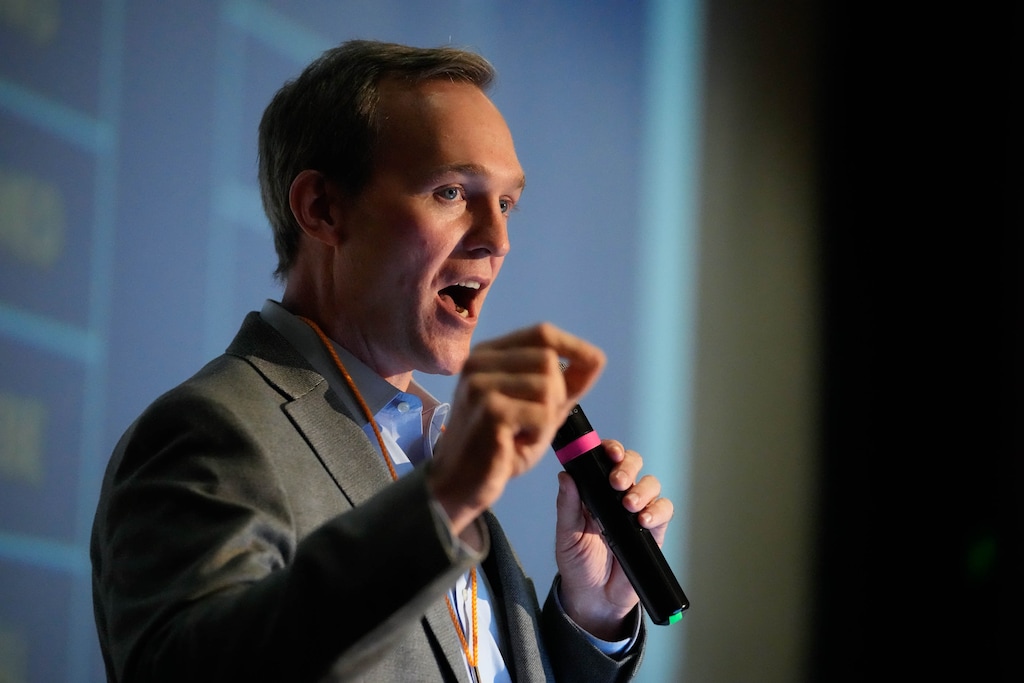
 Robert Gehrke
When he ran for Congress twice before in a Republican district, Ben McAdams built his brand around being a nonthreatening, consensus-building moderate who distanced himself from the party’s establishment to work across parties.
Now, as he seeks to return to Washington to represent a new Democratic-leaning seat imposed by the courts, McAdams is being assailed by a crowd of contenders as being too conservative on progressive policy positions to adequately represent the state’s most liberal population.
“It’s not that Ben is squishy or malleable,” says state Sen. Nate Blouin, who is currently McAdams’ closest rival for the party’s nomination. “Actually, he’s very consistent. He’s always been willing to work very closely with big corporations and take their money to run his campaigns and I think people are sick and tired [of that].”
McAdams, for his part, says he isn’t rebranding or changing his stripes.
“I’ve always been pro-choice, pro-equality,” McAdams said. “I led the effort to pass statewide LGBTQ non-discrimination, led the effort to expand Medicaid. … I’ve always been somebody who believes that progress is what you get done and making people’s lives better, not what you said on Twitter. None of that has changed.”
The campaign is revealing the divisions within the Democratic Party, between the largely older, moderate pragmatists and the rising generation of progressive idealists inspired by the likes of Vermont Sen. Bernie Sanders and New York City Mayor Zohran Mamdani.
Utah’s new 1st Congressional District, imposed by the courts after the previous maps were deemed an unlawful partisan gerrymander, favors Democrats by about 14 points — although Vice President Kamala Harris Beat President Donald Trump in the district by 24 in 2024.
The prospect of a seat favoring Democrats for the first time in decades drew a flood of seven candidates in the running — McAdams, Blouin, Salt Lake City Councilperson Eva Lopez Chavez, attorney Michael Farrell, Liban Mohamed and Luis Villareal.
(Francisco Kjolseth | The Salt Lake Tribune) Nate Blouin, running for Utah’s newly drawn 1st Congressional District, speaks during the Salt Lake County Democratic Party's convention at Highland High School on Saturday, April 11, 2026.
State Sen. Kathleen Reibe dropped out of the race Saturday and threw her support behind McAdams over her Senate colleague, Blouin, saying the district needs a “statesman” and not a “loose cannon.”
But the slew of young, liberal contenders creates a stark contrast with McAdams, who — according to an analysis of his voting record by the UCLA political science professors — was the most conservative Democrat in the House. And, in 2022, he rankled some Democrats by convincing the party to back independent Evan McMullin’s challenge to Sen. Mike Lee.
According to Lopez Chavez, the McMullin gamble doesn’t register with the average voters, but for party insiders and activists, “they’re not forgiving people. They do not forget.”
Thus far, only Blouin and McAdams have enough verified signatures to qualify for the primary ballot, although Chavez, Farrell and Mohamed say they have submitted enough signatures to qualify ahead of the Democratic convention on April 25. Villareal is hoping delegates advance him to the primary at the convention.
Baggage or experience?
According to a recent poll released by Blouin’s campaign, McAdams leads the field by a margin of 36% to 23%, with the rest of the field in single digits. As the front-runner, McAdams has a target on his back and is being assailed by his opponents as soft on abortion, having voted against raising the minimum wage, cozy with corporate special interests, weak in defending labor unions and, overall, not liberal enough to represent a liberal district.
(Rick Egan | The Salt Lake Tribune) Candidate Liban Mohamed on Friday, Jan. 2, 2026.
“I respect his years of service,” said Mohamed, who worked in government affairs for the tech industry,” but this moment is clearly calling for leadership that reflects, not what this district has been, but where it’s going. [McAdams] is trying to reposition himself for this new district, but voters deserve clarity, not recalibration.”
Mitchell Vice, chair of the Utah Democrats’ Progressive Caucus, said he hopes one of the left-leaning candidates is able to consolidate support and defeat McAdams, who he sees as having a track record harmful to the working class.
“I’ve had the conversation with all the candidates [in the primary], and I said, ‘Look, if you guys all get on the primary ballot and you split the vote and Ben McAdams wins with 16%, I’m going to f---ing come unglued,” Vice said.
Early on, Blouin won the endorsement of Sanders and the Congressional Progressive Caucus, which includes some members who served with McAdams during his term in office. Evan Brown, executive director of the CPC, said the heavily Democratic seat poses an opportunity for progressives who have been “clamoring for a bolder, stronger, more assertive Democratic Party.”
“These are the kind of seats that Democratic voters should elect champions for the progressive agenda and representatives who are willing to fight for immigrants, for working class families, for labor, for reproductive rights,” Brown said. “Nate is the one with the record to do that.”
For McAdams, the criticism of his liberal bona fides is a contrast to what he has faced in the past.
During his 2018 campaign, then-Rep. Mia Love accused McAdams of being in the race to push for “unrestricted abortion and use your money to pay for it.” McAdams shot back that he was just as pro-life as Love. Now his opponents are using those statements and some of his votes while he was in Congress to make the case that he won’t stand up for reproductive rights.
In Congress, McAdams twice voted for bills that included a provision allowing doctors to not perform abortions due to personal beliefs and was one of three House Democrats who joined an effort to force a vote on a bill requiring doctors to provide medical care to a baby that survives an attempted abortion. He said at the time that he “believes in the sanctity of life” and abortion is “too common.”
In an interview, McAdams said he has always believed the choice to have an abortion should be between a woman and her doctor. With the Supreme Court overturning Roe v. Wade, which had assured abortion access, McAdams said women have been denied life-saving care and he would support Congress passing a law restoring Roe.
(Rick Egan | The Salt Lake Tribune) Eva Lopez Chavez speaks during a groundbreaking ceremony celebrating the start of construction at Pioneer Park on Thursday, Feb. 26, 2026.
Riebe, before leaving the race, said in an interview that she had a miscarriage during her first pregnancy and needed an abortion. She said McAdams’ voting record and past statements on the issue “makes you question if he’s going to stay true to those statements he’s making again.”
“To take [abortion] off the table, we are putting women’ s lives at risk,” she said. “It’s a non-starter for me.”
McAdams is also being criticized by his opponents for his 2019 vote against raising the minimum wage from $7.50 to $15 by 2025, one of just six Democrats to vote against the bill.
“When it comes to wages, specifically,” said Mohamed, “[McAdams] has a poor record.”
(Francisco Kjolseth | The Salt Lake Tribune) Michael Farrell, running for Utah’s newly drawn 1st Congressional District, speaks during the Salt Lake County Democratic Party's convention at Highland High School on Saturday, April 11, 2026.
Blouin contends once Democrats hear about that vote, they will jump ship and support him instead.
McAdams said he knew the bill, as it was proposed, would die in the Senate — and it did — because critics would say it didn’t do enough in places like New York City but hurt small businesses in parts of the country where the cost of living was lower. He said he was working on a bill that would set regional minimum wages based on the cost of living.
“Anybody can send a tweet,” McAdams argues, “but actually being able to move the needle in a way that makes people’s lives better, that takes real work and coalition building, and I’m the only candidate who’s done that.”
McAdams points to his vote to impeach President Donald Trump in 2019, even though he knew it would likely cost him his reelection, as proof of his Democratic bona fides.
Rhetoric vs. results
Results versus rhetoric has become a common theme in the campaign, as others in the field point to Blouin, in particular, as someone who posts about popular progressive stances on social media, but doesn’t have the accomplishments to back it up.
Farrell, who is a tax attorney, noted that in four sessions as a state senator, Blouin has yet to pass a single bill.
“I’ve never run for elected office and he and I have the same number of bills passed. … That’s a four-year resume to show that he doesn’t know how to do anything,” Farrell said. “If Nate literally was sick and in a coma for four years, he would have passed as much legislation.”
(Villareal campaign) Luis Villareal, a Democratic candidate for Congress.
Villareal, who is a self-described Democratic Socialist and a software engineer, said McAdams “represents, on the state level and national level, the old guard” of the party.
“I just don’t think that’s what this district is looking for,” Villareal said.
The other candidates in the field see that as their opening — appealing to voters who want someone more liberal than McAdams but more focused on results than Blouin.
Lopez Chavez said, from what she has seen, McAdams has strong support among older voters who want someone who can work with Republicans. Young progressives, she said, want to upend the system.
“There is a dire urgency — economically, environmentally, with housing, with healthcare and education,” she said. “We want someone that’s going to create change immediately, urgently, and we don’t care how it’s done.”
But it can’t just be about saying what liberal voters want to hear, Lopez Chavez said. Voters want someone who can do the work to deliver solutions and tackle the underlying problems.
Blouin says too much is being made of his legislative record and Utah’s Republican supermajority will always block meaningful progressive bills.
“I’m sick of people falling into the trap that the only way to be effective is to pass legislation, regardless of what that legislation does,” Blouin said. “Passing small bills that actually don’t do a lot for the community in a lot of places is a short-term strategy.”
(Francisco Kjolseth | The Salt Lake Tribune) Kathleen Riebe, who announced that she is dropping out of the 1st Congressional District race and endorsing Ben McAdams, right, joins him moments before taking the stage during the Salt Lake County Democratic Party's convention at Highland High School on Saturday, April 11, 2026.
Blouin said he has fought against Republican legislation he finds objectionable and, as a result, is better prepared to stand up to Republicans in Congress. “We’re going to need that fighting spirit,” he said, “to make sure we have a democracy in a few years.”
McAdams agrees that the next representative needs to fight, but one who can actually deliver.
“I’ve never been more alarmed about the direction that our country’s headed,” he said. “We’re watching Donald Trump trample the Constitution, threatening to prosecute political opponents, sending ICE into the streets of American cities, really undermining the foundations of our democracy. And so I would say my tone is different in this election, for sure, because these times demand leaders who won’t sit quietly by, who won’t normalize extremism, and people who are willing to go on the defense for our democracy.”
Note to readers • This story is available to Salt Lake Tribune subscribers only. Thank you for supporting local journalism.
This story has been updated to include a statement from the Congressional Progressive Caucus.