 Robert Gehrke
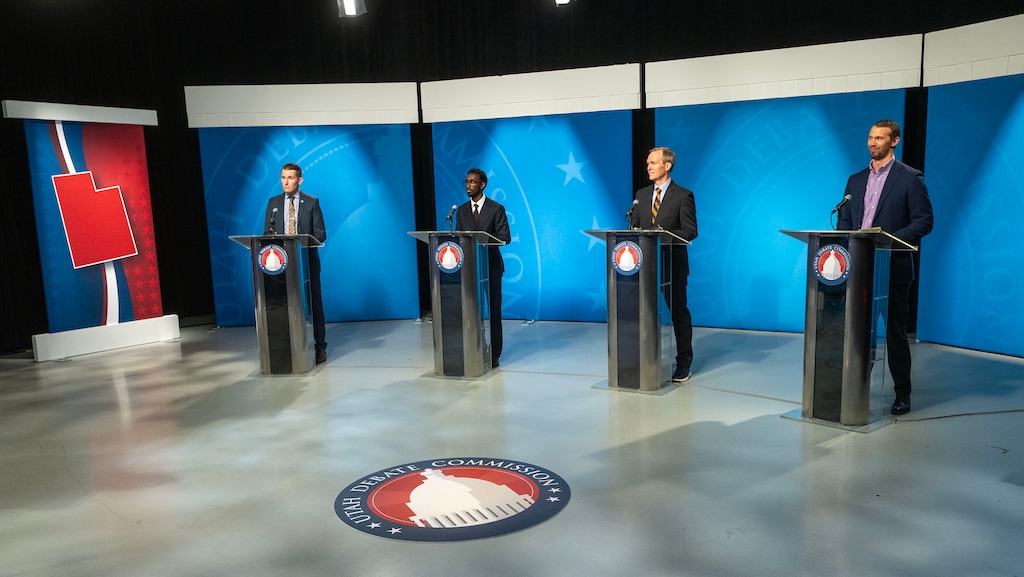
Contenders for the Democratic nomination in Utah’s 1st Congressional District sparred Wednesday over the future of hyperscale data centers in the state during the only broadcast debate ahead of the June 23 primary.
The issue, driven to the forefront by a controversial project proposed in Box Elder County, pitted candidates Mike Farrell, who wants a nationwide ban on new data centers, Liban Mohamed, who said they should not be built where water is scarce, state Sen. Nate Blouin, who called for a moratorium on new construction, and former U.S. Rep. Ben McAdams, who said regulations were needed to separate the good actors from the bad.
In the process, the candidates traded accusations of conflicts of interest when it came to guiding data center policy.
“I feel like I’m taking crazy pills here,” said Farrell. “Ben owns an interest in a data center. Liban lobbied for data center strategy when he was working as a lobbyist for Meta. I support a full prohibition on data centers nationwide. We cannot be using our precious natural resources for what purpose exactly? To give money to people like Kevin O’Leary,” the celebrity investor behind the Box Elder County proposal.
(Scott G Winterton | Pool) Ben McAdams participates in the 1st Congressional District Democratic primary debate in Salt Lake City on Wednesday, May 27, 2026.
The Salt Lake Tribune reported last week that McAdams held a small amount of stock — less than $10,000, according to his recently filed personal financial disclosure — in the Creekstone Energy data center near Delta that, when fully built, would use even more electricity than O’Leary’s Stratos data center in Box Elder.
McAdams said he was paid in stock to do consulting work aimed at increasing the amount of renewable energy available for the Delta project.
McAdams said the Creekstone project is different from the Box Elder project in that it went through a public process, envisions using solar power for part of its power supply and touted his role during his tenure as Salt Lake County mayor in stopping a proposed Facebook data center in West Jordan.
“I’m the only candidate who has worked to make a data center better by adding renewable energy to a data center in southern Utah, but I’m also the only candidate who ever stopped a data center,” he said.
Mohamed said he worked on a policy team during his time at Meta and TikTok, but did not lobby on data centers. He said he thought he was “living the American dream” when he got the job, but left after learning more about the technology companies.
“I ask you to judge me by the integrity that it took to leave that golden ticket … to stand on this stage today and guarantee that I’ll never get a job like that again, because I’m willing to do what it takes to hold them accountable,” Mohamed said.
(Scott G Winterton | Pool) Nate Blouin speaks as Liban Mohamed looks on in the 1st Congressional District Democratic primary debate in Salt Lake City on Wednesday, May 27, 2026.
Blouin accused Mohamed of working for a lobbying firm helping to advance the Box Elder project, leading to one of the testier exchanges of the evening.
“I’m having a hard time understanding how folks who are watching this debate will trust someone like Liban Mohamed, who has actually worked in the past for the same lobbying firm that is pushing Kevin O’Leary’s data center into our backyard,” Blouin said.
Years ago, Mohamed interned for a lobbyist who was part of a now-defunct lobbying firm that included Lincoln Shurtz, who subsequently formed a new firm and was hired a month ago to work for O’Leary. According to lobbying disclosures, that arrangement ended Wednesday.
Mohamed said Blouin’s allegation showed his character and demonstrated why he has not passed any legislation during his tenure in the Utah Senate — a point also hit upon by McAdams and Farrell.
Blouin compared himself to New York City Mayor Zohran Mamdani — one of several comparisons to the Democratic Socialist mayor of the night — and said he has focused on “fighting for my constituents and I think people take notice of that.”
“They notice the coalitions that I’ve built, the people that I’ve brought up to the Capitol that would otherwise not be weighing in,” Blouin said. “And I have challenged Democrats to be better, to stop taking corporate contributions like they are here in Utah, and unfortunately, that puts me in a box sometimes.”
(Scott G Winterton | Pool) Michael Farrell participates in the 1st Congressional District Democratic primary debate in Salt Lake City on Wednesday, May 27, 2026.
The exchanges during the debate fell very much in line with the prevailing theme of the campaign, which has centered on the three progressives in the field — Blouin, Mohamed and Farrell — painting McAdams as too conservative for the new, Democrat-leaning district.
The courts imposed the new 1st District boundaries last year after voiding the maps drawn by Republican legislators that had assured the GOP four safe seats. The new district, covering much of Salt Lake County, favors a Democrat by as much as 17 percentage points and drew a host of progressive candidates to the field.
The field was narrowed to four at the nominating convention in April, where Mohamed won a majority of the support from the party delegates, narrowly edging McAdams.
[Watch: Democrats debate on television in race for Utah’s new, blue congressional district]
After one critique of McAdams during the evening, moderator Max Roth, a Fox13 news anchor, said, “Mr. McAdams, you will get rebuttal time if you need it. And I think you’ve all seen that people will get more time on camera if you mention their name, just so you know.”
McAdams is leading the field, according to an internal poll conducted in March by Blouin’s campaign, and tripled his closest rivals’ fundraising totals, as of the latest disclosures filed last month.
(Scott G Winterton | Pool) Liban Mohamed participates in the 1st Congressional District Democratic primary debate in Salt Lake City on Wednesday, May 27, 2026.
This week, Blouin urged Mohamed and Farrell to agree to drop out of the race and coalesce support behind whichever of the three is leading in a poll Blouin’s campaign has commissioned. Blouin pledged to do the same if he is not the leader.
Following the debate, Mohamed said it is an example of “white privilege” for Blouin to suggest that Mohamed, who won among the party’s 700 delegates at the nominating convention, should step aside based on a poll of 400 voters.
“The three progressives are in this race because they want to fight for beautiful things. They have their heart in the right place. They wanna see healthcare as the human right at a cheaper price. They want to see affordable housing,” Mohamed said. “And there’s only one person that beat McAdams when it was one vs. one. We showed what we can do.”
The winner of the June 23 primary will face Republican nominee Riley Owen, who won the nomination at the party’s convention.
Note to readers, May 28, 5:30 p.m. • This story has been updated to clarify Liban Mohamed’s role at two social media companies.