facebook-pixel

‘Extreme’ gerrymander: Utah judge rejects GOP lawmakers’ congressional map, picks districts favoring Democrats

The map submitted by Republicans “does not comply with Utah law,” Judge Dianna Gibson wrote.
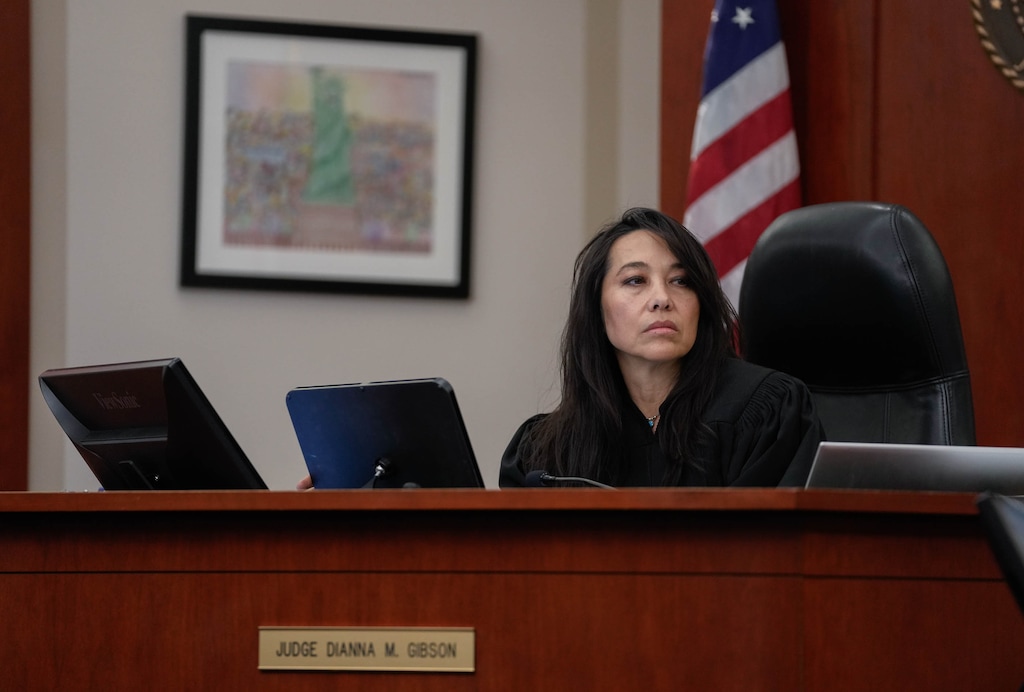
(Francisco Kjolseth | The Salt Lake Tribune) Third District Judge Dianna Gibson holds a hearing on Utah’s congressional district maps in Salt Lake City on Thursday, Oct. 23, 2025.

Third District Judge Dianna Gibson rejected new congressional boundaries proposed by Republican legislators late Monday night, instead choosing a map that will create a heavily Democratic-leaning district in Salt Lake County and shake up Utah’s political landscape.

“In short, [the Legislature’s map] does not comply with Utah law,” Gibson wrote in her ruling. “Because the Lieutenant Governor’s November 10, 2025, deadline for a map to be finalized is upon us, the Court bears the unwelcome obligation to ensure that a lawful map is in place, which the Court discharges by adopting” a map submitted by the plaintiffs in the yearslong lawsuit.

The map Gibson selected makes a district of the northern portion of Salt Lake County, and splits Utah County into eastern and western districts, ultimately creating a district that truly favors Democrats for the first time in a quarter century.

Gibson’s decision is a watershed moment in a legal battle that has stretched nearly four years since the Legislature’s repeal of Proposition 4 — also known as the Better Boundaries initiative, adopted by voters in 2018.

Last year, the state Supreme Court ruled that legislators violated Utahns’ constitutional right to make law through the initiative process when they gutted Proposition 4 and sent the case back to Gibson for further proceedings.

In an August opinion, Gibson said “Proposition 4 is the law in Utah,” and the boundaries used in the 2022 and 2024 congressional elections did not comply with the law. She barred them from being used in the 2026 elections and required new maps to be prepared.

Republican legislators redrew the boundaries “under protest,” sending an option to the court that would have created four districts favoring Republicans, as well as a set of three statistical tests they said the judge had to use to determine if the map unduly favored the GOP.

Experts hired by the Legislature asserted that the map lawmakers approved passed those tests and that the two maps submitted by the plaintiffs failed.

The Salt Lake Tribune

The plaintiffs — the League of Women Voters, Mormon Women for Ethical Government and a handful of Utah voters — argued that the tests mandated by the Legislature were well known to be a poor measurement in a state like Utah and, taken together, would weed out maps with competitive districts and ensure that maps with four safe Republican districts would pass.

They also argued it was a backdoor attempt by GOP lawmakers to circumvent Proposition 4 and that it unlawfully limited Gibson’s discretion.

Gibson agreed, rejecting the Legislature’s constraints and opting to appraise the options in, as she put it, a more “holistic” manner.

The judge also noted that the map submitted by the Legislature was drawn while partisan data was displayed, which was expressly prohibited by Proposition 4.

That led her to choose the first of the two maps submitted by the plaintiffs, which she said “better satisfies the redistricting standards and requirements contained in Proposition 4.”

“In order to ensure that Utahns cast ballots under a congressional map that is equally apportioned under both federal and state constitutional requirements and that otherwise complies with Utah’s law on redistricting in Proposition 4, this Court must now choose a congressional map by the November 10, 2025, deadline,” Gibson wrote. “The Court’s ruling on which congressional map will be adopted is not based on any policy. Rather, it will be based on the law.”

[READ: A judge picked Utah’s new congressional map for the 2026 midterms. See which district you’ll be in.]

Rep. Candice Pierucci, R-South Jordan, who was the co-chair of the Legislature’s redistricting committee, called Gibson’s ruling a “clear example of judicial activism.”

Pierucci said that Gibson “decided that her personal opinion outweighs Utah’s Constitution and the will of the people,” and despite the Legislature’s efforts to comply with her orders, it “turns out, she was orchestrating it from the start.”

Legislative Democrats, meanwhile, said that they “feel a deep sense of hope and relief” after Gibson’s ruling and called it “a win for every Utahn.”

‘Extreme’ gerrymandering

(Trent Nelson | The Salt Lake Tribune) Elizabeth Rasmussen of Better Boundaries speaks at a news conference in Salt Lake City on Monday, Aug. 25, 2025. A judge earlier ruled that the Legislature will have 30 days to adopt new maps that comply with the 2018 Better Boundaries initiative guidelines.

The map Gibson chose is the type that is often referred to as a “doughnut hole” design, with a compact district covering the northern portion of Salt Lake County, including Salt Lake City, and extending south to West Jordan, but not including Sandy.

There is a separate northern Utah district, another in the central-western portion of the state, and a large district that encompasses the eastern and southern counties.

Of the three options before Gibson, it is, by far, the most favorable to a Democratic hopeful.

An analysis by The Salt Lake Tribune found that, based on recent election results, the district concentrated in Salt Lake County would favor Democrats by more than 17 percentage points, while the other three would be dominated by Republicans by at least 2-to-1 margins.

It has been 25 years since a Utah congressional map has included a district that favors a Democrat.

(Francisco Kjolseth | The Salt Lake Tribune) Sean Trende provides testimony for the state during a hearing on congressional redistricting maps before Judge Dianna Gibson in 3rd District Court in Salt Lake City on Friday, Oct. 24, 2025.

Gibson wrote that the map submitted by the Legislature was an “extreme” partisan gerrymander that did not comply with the standards in Proposition 4 and was built using partisan data.

During a hearing, the legislative expert who drew the map, Sean Trende, said that the program he used to design the districts was displaying partisan election results from several years as he worked. He said the data, results from elections between 2012 and 2020, were a “worthless composite” that “wouldn’t have told me anything.”

Proposition 4 prohibits the Legislature from using partisan data when making the maps. It was an issue that Sen. Scott Sandall, R-Tremonton, was adamant about, to the point of dismissing scores of maps submitted by the public because there wasn’t time to verify that the citizens who created them didn’t have access to party data when they were drawn.

Even before Gibson had chosen a map, Democratic hopefuls were jockeying for position.

Former Congressman Ben McAdams, who served one term in the U.S. House and before that was Salt Lake County mayor and a state senator, sent an invitation to a campaign launch party to be held Nov. 13.

“Shhh. It’s a secret … Utah’s worst-kept secret,” the invitation said at the top.

State Sen. Kathleen Riebe, D-Cottonwood Heights, has said she is exploring a potential bid. Others are also rumored to be interested.

It is unclear which seats they might seek. It also remains to be seen which seats the four current Republican members of Congress might pursue.

Federal House members are not required to live in the district they represent.

‘Whatever means necessary’

Republican lawmakers have not been shy about expressing their frustration with Gibson’s previous rulings.

State Sen. Dan McCay, R-Riverton, said in August that her decision ignored the Constitution and questioned if Gibson could “be the first judicial removal for ignoring the Utah Constitution that she took an oath to uphold?”

During the special session where the Legislature adopted its new map, Sen. Brady Brammer, R-Pleasant Grove, said it would be “malfeasance” — a term used in law as one of the justifications for impeaching a judge — for Gibson to not pick a map drawn by the Legislature.

And House Speaker Mike Schultz, R-Hooper, said the Constitution gives the Legislature the power to create boundaries, “and we will adamantly defend that to whatever means necessary.”

Shortly after the ruling Monday night, Rep. Matt MacPherson, R-West Valley City, posted on social media that he had opened a bill file to initiate an impeachment of Gibson for a “gross abuse of power, violating the separation of powers and failing to uphold her oath of office to the Utah Constitution.”

(Francisco Kjolseth | The Salt Lake Tribune) Plaintiff Malcom Reid testifies during a hearing for congressional redistricting maps before Judge Diana Gibson in 3rd District Court in Salt Lake City on Thursday, Oct. 23, 2025.

It is likely still not the final word in the battle over Utah’s congressional boundaries.

Republican legislative leaders have previously said Gibson overstepped her judicial authority when she forced lawmakers to redraw the congressional boundaries and that they would appeal to the Utah Supreme Court and possibly the U.S. Supreme Court.

And the Utah Republican Party has filed to gather signatures for an initiative seeking to repeal Proposition 4 entirely. If they gather around 141,000 valid signatures and meet the initiative requirements, the repeal vote will go on the 2026 ballot, but it would not impact the map used for that election.

The party had announced its plans to gather signatures for a referendum repealing the Legislature-approved map — which, if successful, could have kept it from being used in 2026 — but the party abandoned that effort. That push would have been moot now, because Gibson rejected the Legislature’s submission.

Lt. Gov. Deidre Henderson had previously told the court that Nov. 10 was the latest that a map could be adopted in order for county clerks to make the necessary preparations to administer the election.

After the ruling, Henderson posted on social media that she would “comply with Judge Gibson’s order” and begin implementing the map selected by the judge “unless otherwise ordered by an appeals court.”

Utah’s process has taken on heightened national significance since Republicans hold a narrow majority in the U.S. House, and as red and blue states have begun the process of shoring up congressional districts for their own advantage.

At stake could be control of the U.S. House after next year’s midterms. The party that controls the White House, in this case Republicans, typically loses seats in the midterm elections and currently the GOP holds a slim six-seat majority in the chamber with one Democrat from Arizona waiting to be sworn in.

The party that controls the House not only can steer policy but also has investigative powers and could even bring forward articles of impeachment, which is why both parties are clawing for every advantage they can get.

This story is breaking and may be updated.