 Emily R. Anderson
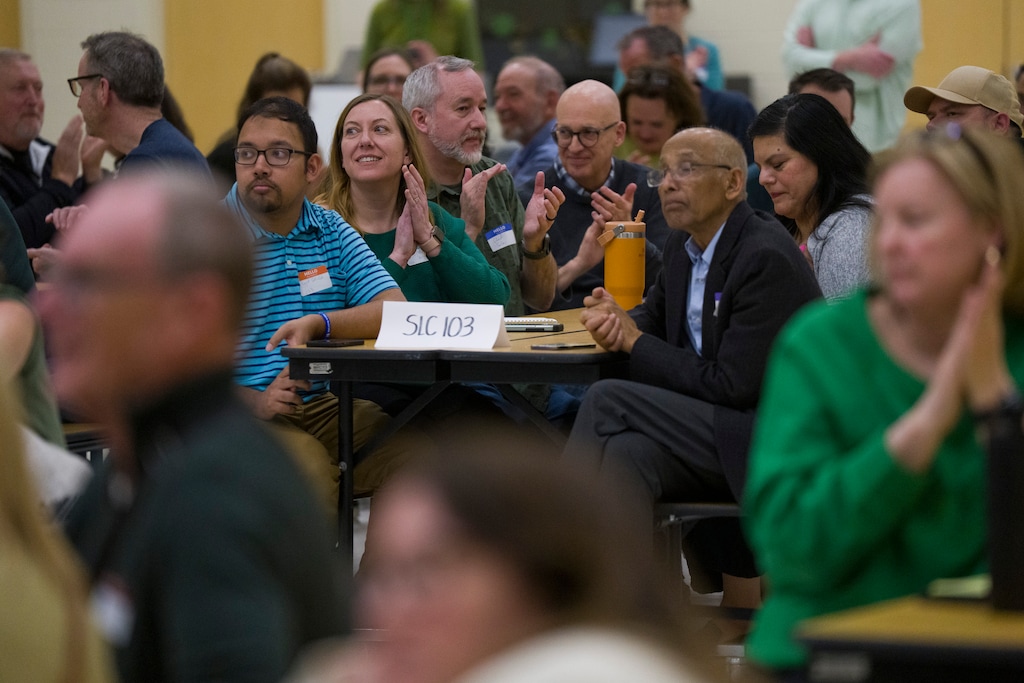
With a practically guaranteed chance to select a new congressional representative, hundreds of Salt Lake City Democrats crowded into a cafeteria at Beacon Heights Elementary on Tuesday night, donning green cardigans, button-ups and T-shirts.
According to the Utah Democratic Party, the voters who spent St. Patrick’s Day hunched over lunch tables selecting delegates instead of sitting in bars or eating corned beef broke caucus night participation records — high numbers a news release attributed to a new congressional map that creates a solid blue district in Salt Lake County.
“I have to say, I’m particularly excited that we have a congressional district that might give us our voice back … ,” Matt Janke, the Democratic Party’s House District 23 chair, said as he gave attendees instructions. Caucus-goers’ cheers obscured his next comments.
Over 5,000 more people across the state registered for Tuesday’s caucus meetings than in 2024, per the party, which represented a 34.4% increase and “the highest total in a decade,” Utah Democrats said in a news release.
Tuesday’s turnout was last topped in 2016 when voters were choosing between Hillary Clinton and Bernie Sanders for Democrats’ presidential nominee.
Salt Lake County, where the 1st Congressional District is located, reportedly saw sign-ups jump from 1,827 registrations in 2024 to 3,050 this year — and as the party continues to tally participation, it expects that number will go up. The 1,200-person increase was the highest in the state.
“In Utah, we consistently vote about 40% of the state, but we do not have 40% of the representation in Congress,” Salt Lake County Democratic Party Chair Michelle Rivera, dressed in an iridescent shamrock costume, told the Beacon Heights Elementary crowd.
(Bethany Baker | The Salt Lake Tribune) People begin voting during caucus night for the Utah Democratic Party at Beacon Heights Elementary in Salt Lake City on Tuesday, March 17, 2026.
In 2024, President Donald Trump secured just under 60% of votes in Utah, while the Democratic nominee for president, then-Vice President Kamala Harris, won the support of about 38% of voters. But that same election, all four of the state’s congressional districts went to Republicans.
“It’s very important that you today make a concerted choice to understand the candidates who are before you, so that you pick the ones that are going to hear you, that are going to voice your concerns, who are going to stand up to the fascist regime right now that is in Congress,” Rivera said.
The new 1st Congressional District is the product of years of litigation over the gerrymandered congressional boundaries drawn by the supermajority-Republican Legislature in 2021. A district court ruled the map violated a 2018 voter-approved ballot initiative that outlawed gerrymandering, Proposition 4.
A judge ordered the state to adopt the map in place for the coming elections.
Three of the seven Democratic candidates in the crowded field for the open seat showed up at the Salt Lake City elementary school to chat up prospective delegates and deliver a minute-and-a-half speech.
They were former U.S. Rep. Ben McAdams, who was Utah’s most recent Democrat in Congress, state Sen. Nate Blouin and attorney Michael Farrell.
While some attendees wore buttons for their favored candidate, multiple delegates elected Tuesday said they were still researching where each of them stand on various issues.
Delegates can vote to automatically place their preferred candidate on the primary ballot at the party’s April 25 annual convention. All of the Democratic candidates have indicated they are also gathering signatures in an effort to qualify for the June 23 primary election.
David and Danielle Rollo were the only voters in their precinct to attend the House District 23 caucus night, so they had to decide between themselves which one of them would be a delegate at the convention next month.
But neither of them had decided which congressional candidate they would vote for. “I don’t know, there’s a lot of people in the race right now,” David Rollo said.