 Leia Larsen
Note to readers • This story is made possible through a partnership between The Salt Lake Tribune and Grist, a nonprofit environmental media organization.
Most Utahns say they want to preserve and refill the beleaguered Great Salt Lake, and new research shows they’re also willing to open their wallets to see it happen.
Residents would pay more than $100 per household each year, as long as they feel moderately sure their contribution would make a difference for the lake, according to a recent economic survey by Weber State University. The researchers behind the analysis suggested the money would either come from increased utility bills or state income taxes.
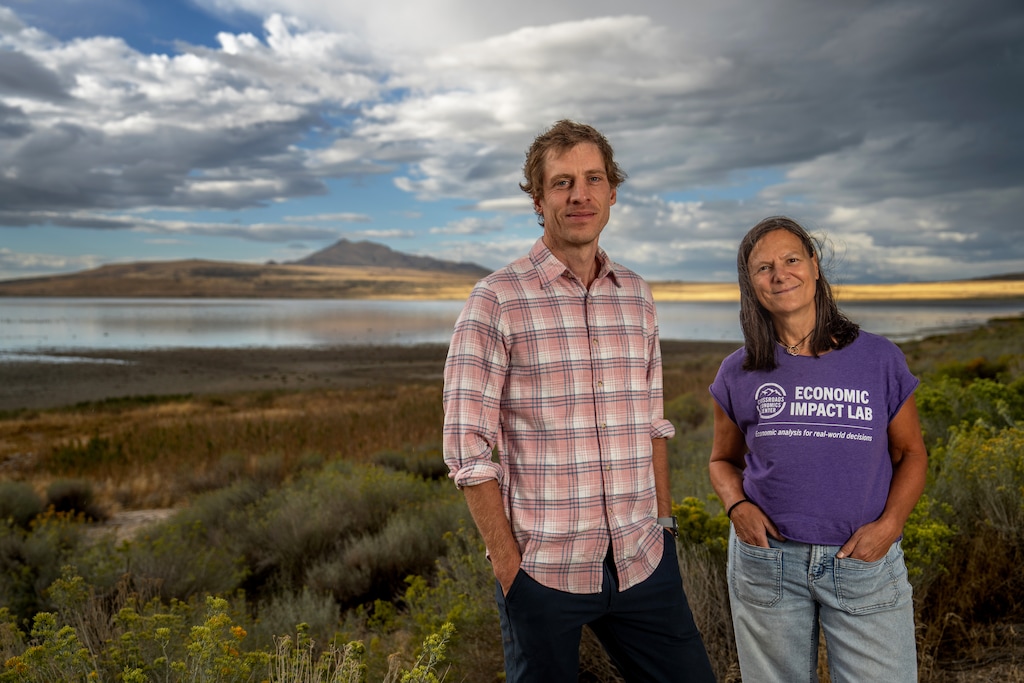
“People value the lake just because it exists — [they] want it to exist, [they] want it to be there in the future,” said Therese Cavlovic, an economics professor who was the lead author of the study.
As the Great Salt Lake hit its first modern record low in 2021, and again in 2022, multiple surveys showed a spike in Utahns’ awareness about its precarious situation. The vast exposed lakebed is drying into a colossal source of dust pollution. The naturally shallow saline lake is currently only about half full, and about 8 feet short of a minimum healthy elevation.
Many surveys, including a 2022 poll by the Great Salt Lake Strike Team, a Utah university and research partnership, have also shown a strong majority of state residents want to see government action to help it recover.
But Cavlovic, Weber State economics professor Matt Gnagey and Carie Frantz, an Earth and Environmental Sciences associate professor, wanted to find out just how motivated residents would feel when it came to opening their pocketbooks.
The researchers sent surveys to 1,050 Utahns in August 2025 using the online platform Qualtrics. They made sure their sample reflected Utah’s adult population across gender, race, ethnicity and income. About 73% of the respondents lived on the Wasatch Front, and 34% identified as members of The Church of Jesus Christ of Latter-day Saints, the state’s predominant faith.
Forty percent of the respondents said they or a family member had respiratory issues that could become exacerbated by the lake’s dust emissions. And 12% said they currently or previously worked for a lake-based industry.
(Department of Atmospheric Sciences, University of Utah) A dust storm from the Great Salt Lake sept across Salt Lake City on July 8, 2026.
The manuscript documenting the results is still undergoing peer review. But it highlights some notable findings.
A whopping 95% of respondents said they found the lake at least “somewhat” important. They were willing to chip in between $36.56, when the participants were less certain their payments would make a difference for the lake, to nearly $369 via increased water bills each year.
If the payments came through state taxes, respondents were willing to pay between $41.60 and $485.10, depending on their confidence levels.
Those who were moderately sure their financial contributions would make a difference were willing to pay between $113 and $144 per household each year.
Latter-day Saints were willing to pay almost four times more than respondents who are not members of the faith. And Wasatch Front residents neighboring the lake and directly downwind of its dust storms reported they were willing to pay rates only slightly higher than those elsewhere in the state.
(Bethany Baker | The Salt Lake Tribune) Dry lake bed is seen for miles along the northern portion of The Great Salt Lake on Monday, July 13, 2026.
People were more inclined to send payments to the lake through their water bills versus state taxes. Utah lawmakers typically aren’t enthusiastic about raising taxes either. But if they choose that route for saving the lake, the survey results may help show policymakers where their constituents want to see their dollars funneled.
“I don’t think that necessarily means that they want to raise taxes to do this,” Gnagey said, “but maybe they want to shift how taxes are currently being used.”
The researchers tapped an economic method called contingent valuation, developed to specifically pin a practical dollar amount to a community’s willingness to preserve an environmental asset.
“If someone asked me how much I might be willing to pay for the lake, I could say $3 billion, right?” Gnagey said. “But I don’t have that much money, and I clearly would not be willing to actually pay that.”
The payment methods in the Weber State survey were hypothetical, of course, but it strived to get people to reflect rationally on their finances.
“It elicits real behavior on how people vote in referendums,” Gnagey said. “We’re confident that based on this, we can get a realistic value ... which I think is important when we think about making sure that policy aligns with people’s preferences.”
Another study, nearly 40 years old, took a similar approach to California’s Mono Lake. The City of Los Angeles had bought up water rights for the tributary rivers that feed that salty, terminal lake. After a few decades, it appeared headed down the same path as Owens Lake — another saline lake where the city had acquired water rights and dried it to dust.
(Spenser Heaps | Deseret News) Geoffrey McQuilkin, executive director of the Mono Lake Committee, and Phill Kiddoo, air pollution control officer for the Great Basin Unified Air Pollution Control District, take journalists on a tour of the north shore of Mono Lake in Mono County, Calif., on Tuesday, Aug. 9, 2022.
(Spenser Heaps | Deseret News) Dust kicks up on the north shore of Mono Lake in Mono County, Calif., on Monday, Aug. 8, 2022.
A 1987 contingent valuation economic review found the California public was willing to pay to ensure Mono Lake thrived. Residents valued preservation of the lake at around $1.5 billion, or about $4.5 billion today, adjusted for inflation.
The Great Salt Lake is about 25 times larger than Mono Lake.
Crucially, however, the Weber State survey found the amount of dollars Utahns are willing to shell out for Great Salt Lake protections align with previous estimated price tags for its recovery.
“It definitely overlaps,” Cavlovic said.
On the moderate end, the findings show Utahns are collectively willing to pay up to $162 million per year across the state’s 1.1 million households each year.
A 2025 study, the Weber State manuscript notes, estimated it would take $98.6 million to $421.6 million annually to compensate Utah farmers with incentives to reduce irrigation and conserve enough for the Great Salt Lake to stabilize and refill.
“We were all pretty excited that was what we found,” Frantz said. “It indicated that it’s possible to make this happen.”
The Weber State findings build upon a growing body of understanding around the public’s attitudes about Utah’s inland sea, one of the largest salty lakes in the world.
Specifically, the Great Salt Lake Strike Team 2022 poll found most Utahns felt a collective responsibility for the lake’s health.
(Trent Nelson | The Salt Lake Tribune) The Great Salt Lake at Farmington Bay on Saturday, May 23, 2026.
Agricultural irrigation depletes between 65% to 71% of the water that would otherwise flow to the Great Salt Lake, according to Strike Team reports. Uses by cities, towns, businesses and industry, however, are taking an ever-growing piece of that water pie — about 27% of watershed depletions, based on the latest revised estimates.
And because the Great Salt Lake is a terminal lake, where water only leaves by evaporation, it’s sensitive to depletions upstream, the Weber State study notes. Without enough water inflows to compensate for the water that evaporates away, the lake shrinks. Almost all of the lake’s 30-year trend of decline is due to human water use, but climate change, a warming West and booming population growth will likely compound the problem.
The strike team’s 2022 survey further found most residents said they would contribute financially to help secure water for the Great Salt Lake to rebound.
But that money question was open-ended. The Weber State researchers’ new findings offer further clarity on what citizens are willing to sacrifice in exchange for the lake’s recovery, they said.
“The willingness to pay to make that happen exists,” Frantz said. “Now ... from a legislative standpoint, we need to take it seriously to actually do the hard things, and make the hard decisions, to get water to the lake.”
This article is published through the Great Salt Lake Collaborative with funding from Love the Lake, an initiative of the nonprofit Great Salt Lake Alliance. Editorial decisions are made independently by the Collaborative and partner newsrooms.