 Addy Baird
Kim Duffy describes herself as a “lifelong Democrat.”
“My ancestors came across the plains,” she said in an interview. “We were Mormon Democrats from childhood. I’m no longer Mormon, but I feel very strongly about that heritage that I was raised with.”
But in 2020, Duffy registered to vote as a Republican, as she wanted to vote for former Gov. Jon Huntsman, who was at the time challenging incumbent Gov. Spencer Cox, in the GOP primary.
Duffy is one of an untold number of Democratic-minded Utahns who have historically registered as Republicans in an effort, they say, to act as a sort of moderating force and vote in GOP primaries, which are closed to only registered Republicans in Utah.
Republicans control all three branches of government in Utah, hold supermajorities in the Legislature and fill every seat of the state’s congressional delegation.
Democratic primaries, meanwhile, are open to all voters, regardless of affiliation — but voters can only cast a ballot in one primary.
But this year Duffy is switching back.
Duffy lives in Holladay, putting her in the newly drawn 1st Congressional District, where Democrats are expected to have an advantage for the first time in many years. She’s excited about the possibility of a Democrat representing her in Congress, and though she could’ve requested a Democratic primary ballot even as a registered Republican, she said switching back feels “cleaner.”
“I feel like it’s time to come home,” she said.
This year, Utah voters registered with a political party but who want to switch ahead of the primary election must do so before 5 p.m. on Wednesday, April 1.
State lawmakers, concerned about voters like Duffy who they believed were “infiltrating” the GOP, passed a bill in 2021 to ban party switching in the three months prior to a primary election.
A study from that same year, however, found that the vast majority of voters who switched parties in Utah in 2020 were unaffiliated voters who registered as Republicans, rather than Democrats switching parties. Still, in presidential years, the deadline to change parties is even earlier, with a cutoff in early January, while unaffiliated voters can register with a party up until Election Day.
‘Clear as mud’
The many different deadlines can be confusing for voters.
“It’s about as clear as mud,” Salt Lake County Clerk Lannie Chapman said in an interview Friday.
Chapman said her goal, in every election, is to educate voters on their options and “make sure that people understand what their rights are so that they can have their voice heard in whatever party speaks to them.”
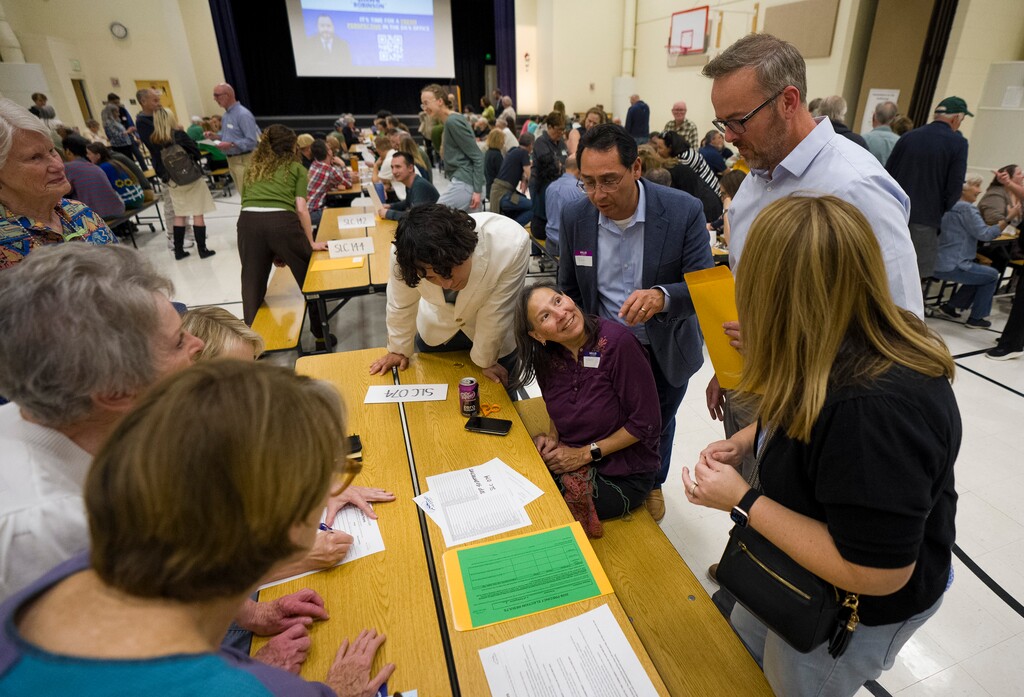
(Bethany Baker | The Salt Lake Tribune) Salt Lake County Clerk Lannie Chapman speaks during caucus night for the Utah Democratic Party at Beacon Heights Elementary in Salt Lake City on Tuesday, March 17, 2026.
Recently, as part of that effort, many voters in Salt Lake County received mailers from her office about the deadline for switching parties, and several thousand people in the county have already done so.
There are, according to figures supplied by Chapman, about 600,000 registered voters in Salt Lake County.
Among those, as of Friday, are 131,905 Democrats, which is up by 2,849 voters since the start of the year. Republican affiliation, meanwhile, has fallen from 240,106 registered Republicans on January 1 to 238,422, despite the fact that the total number of registered voters has grown in that time.
The number of unaffiliated voters has also grown significantly, up from 181,773 on January 1 to 188,933 today.
“It’s not, obviously, a huge number, but we’re talking a few thousand,” Chapman said.
For Salt Lake City resident Trisha Veenema, deciding how to affiliate is an evolving question.
“I used to be Democrat, and then I switched over to independent because I thought it gave me more flexibility to vote either way,” she said Friday. “But come to find out, obviously, it doesn’t in this state.”
For now, Veenema is considering staying unaffiliated, as it would be easier to switch to the Republican party if there was a candidate she wants to vote for in the future, given that unaffiliated voters can join a party up until primary day.
But she’s concerned, she said, about the Democratic party not having accurate information about their voter base if she doesn’t register with the party.
“They don’t know the numbers out there, and they don’t know how much money to raise, how many exact people there are that are actual Democrats,” she said.