 Addy Baird
After a yearslong redistricting fight, Utah Democrats are battling it out in the new 1st Congressional District. But further north, the fallout has also crept into one of the state’s remaining Republican-friendly districts.
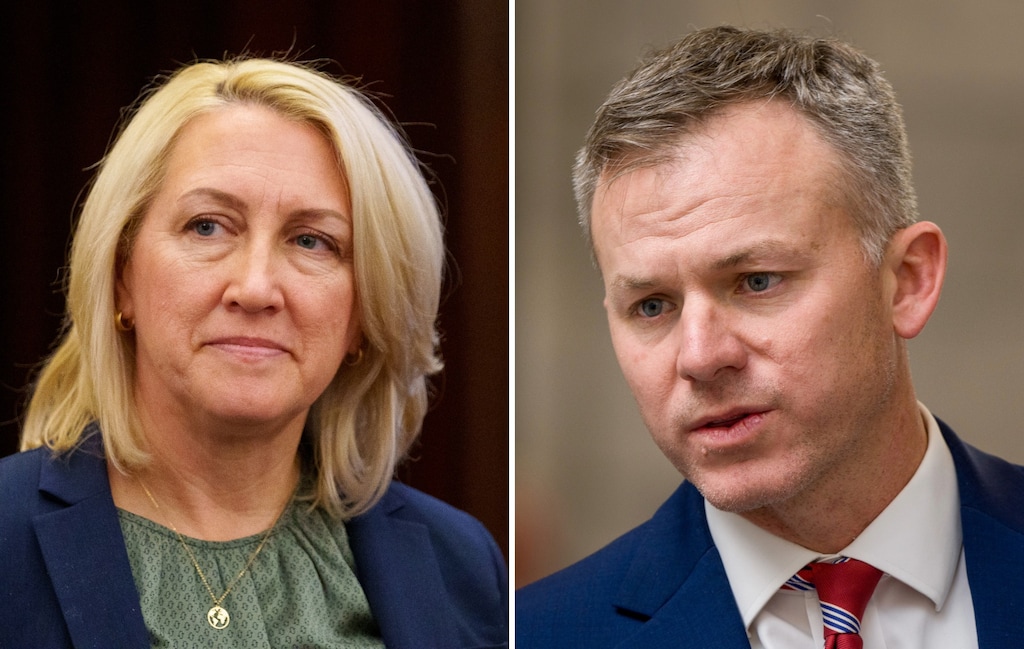
There, in the new 2nd Congressional District — which houses much of the old 1st District — two Republicans are brawling over their conservative credentials, as U.S. Rep. Blake Moore faces a primary challenge from outgoing state Rep. Karianne Lisonbee that will likely decide the outcome of November’s general election.
Moore is Utah’s only member of congressional leadership. He has the backing of his national peers and, according to internal polling shared with The Salt Lake Tribune, his constituents, while Lisonbee — a former member of Utah House leadership and an anti-abortion crusader — says her dedication to the conservative movement will secure her victory come June.
“There’s always something in the primary,” Moore said during a recent interview, noting that primary challenges are nothing new for him, as he’s been contested in both of his reelection campaigns after he was first elected in 2020.
But the recent fight over congressional redistricting in Utah has been central to Lisonbee’s campaign, as she argues the newly drawn maps that will almost surely deliver a Democrat to Congress from Utah are Moore’s brainchild — and that his conservative credentials are not up to snuff.
“Blake has often sided with Democrats when casting votes on important amendments concerning our civil liberties, the department of education, USAID, Climate Change, and spending,” Lisonbee wrote in a statement to The Salt Lake Tribune. “But maybe most egregious was his involvement with Better Boundaries. … He delivered a gerrymandered seat in the name of anti-gerrymandering.”
Prior to running for Congress, Moore was a co-chair with Utah nonprofit Better Boundaries, which backed 2018’s Proposition 4, a successful ballot measure to ban gerrymandering in the state. It’s a role Moore seems to minimize today and an argument he called “silly.”
“To claim that a graduate school student back in 2017 who wrote a paper on gerrymandering has more power than the entire state legislature, which [Lisonbee] is a member of, that’s pretty silly to think that I would have that much power, more so than the speaker of the house and the entire state Legislature,” he said.
(Bethany Baker | The Salt Lake Tribune) Rep. Blake Moore (UT-01) participates in a congressional round table during the Conservative Climate Summit 2024 at Utah Valley University in Orem on Friday, Oct. 4, 2024.
And despite his previous involvement, Moore says he doesn’t fully agree with the group today and concurs with Republicans who say the judge who implemented the new maps overstepped.
“I’ve been very clear,” he told The Tribune this week. “I’ve pushed back. … I think the judge should have continually gone back to the legislature if she didn’t feel that the boundaries that were drawn adhered to the standards that were statute.”
And in 2023, Moore joined other Utah representatives in signing onto an amicus brief in which they wrote, “There’s no constitutional right to be free from partisan gerrymandering.”
But he has still been a rare voice in the party speaking out against partisan efforts across the country to redraw congressional boundaries and was the sole member of Utah’s congressional delegation — and the only member of Republican congressional leadership — to criticize a GOP push to gerrymander Texas’ congressional districts.
“It undermines established norms and gives Blue States a glaring green light to do the same,” Moore said in a statement to The Salt Lake Tribune. “Partisan gerrymandering is clearly done by both sides, but to allow this wildfire to spread mid-decade is a step too far.”
(Trent Nelson | The Salt Lake Tribune) Rep. Karianne Lisonbee, R-Clearfield, at a meeting of the House Education Committee where HB0182 (Student Survey Amendments) was passed, at the Utah Capitol in Salt Lake City on Tuesday, Jan. 23, 2024.
And asked about Lisonbee’s allegation that he is not a strong conservative, Moore said his challenger is “just grabbing at straws, trying to come up with a false narrative.”
“It’s part of the process, but it’s not accurate. It’s not true,” he said. “I wouldn’t have earned an endorsement from key conservative leaders. I wouldn’t have been selected by my colleagues as a leader within the GOP conference if I wasn’t [a conservative].”
While Lisonbee responded to questions The Salt Lake Tribune shared over text, the state representative declined to give an interview in person or over the phone.
‘I’m not a rubber stamp’
So far, the endorsement battle between Moore and Lisonbee has a near-perfect split between state and federal leaders.
On Tuesday, Lisonbee released a list of Utah lawmakers who endorsed her against Moore, including a majority of her Republican colleagues in the House. Having the endorsement of Speaker Mike Schultz, she said, is particularly powerful.
“He’s been a conservative fighter in the legislature and has seen my work ethic, morals, and principles up close,” she wrote. “It means a lot that he and the rest of the leadership team trust me to be a good representative in DC.”
Moore has racked up endorsements from some of the country’s top Republicans, including President Donald Trump, a blessing the president bestowed last fall, before Lisonbee joined the race, when he called Moore a “Tremendous Champion for Utah’s 1st Congressional District!” on social media.
Lisonbee said she’s not concerned: “I will continue to be a supporter of America First Policies whether I have President Trump’s endorsement or not,” she wrote to The Tribune.
(Trent Nelson | The Salt Lake Tribune) Utah Rep. Blake Moore campaigns at the Utah Republican Nominating Convention in Salt Lake City on Saturday, April 27, 2024.
And despite the president’s endorsement, Moore said one of the best compliments he’s received recently was someone saying that he is still willing to push back “in a thoughtful way” against the White House.
“I really appreciate it, because, yeah, I’m not a rubber stamp,” he said.
Last month, Moore was also endorsed by Speaker Mike Johnson and Freedom Caucus founder U.S. Rep. Jim Jordan of Ohio. The pair of Republican leaders described him as an “America First patriot and conservative leader.”
Lisonbee concurred, sarcastically, on social media.
“I agree with Speaker Johnson that Blake would make for a great Republican candidate in Utah’s new CD1, the district where he lives and the one he helped the Dems create,” she wrote at the time.
It’s true that Moore does not live in the district, and it’s not a critique he’s contesting.
“I’m from Ogden,” he said. “I’m Ogden made.”
When the districts were redrawn in 2021, Moore said he and his family moved to live in the district. With new boundaries now in place just a few years later, he said he does not want to uproot his family again, as his wife and four sons have settled into their current home.
“With the way that redistricting is going across our country, they’re probably going to change every two years,” Moore said.
‘A fierce advocate’
Lisonbee previously served as House majority whip in the Utah House — a role she lists on her campaign website, which does not make clear that she is no longer in the position.
Lisonbee resigned from the role last year to run for House majority leader, but lost the election. She later announced she would not run for the Legislature again following the end of her current term.
Moore, meanwhile, has ascended to a leadership role in the Republican caucus in recent years.
It’s a role that has put Moore at the forefront of a number of recent national conversations, including the passage of the Big Beautiful Bill, which included a Moore-sponsored expansion of the child tax credit, a benefit for families with young children.
As a state lawmaker, Lisonbee has not achieved the same national recognition, though she did make national headlines in 2022 when the anti-abortion advocate said she trusted women to “control their intake of semen.” It’s a statement she stands by, but she said she feels the remark has been “misrepresented repeatedly by the media.”
“I was defending babies who are victims of elective abortion,” she wrote to The Tribune. “But what I didn’t do was send a pro-abortion Democrat to Congress from Utah. Anyone who has followed my legislative career knows I’ve been a fierce advocate and effective policymaker for victims of heinous, violent crimes.”
(Trent Nelson | The Salt Lake Tribune) Rep. Karianne Lisonbee, R-Clearfield, during a meeting of the Education Interim Committee in Salt Lake City on Wednesday, Nov. 15, 2023.
Moore and Lisonbee are not the only candidates in the race. Colton Hatch, a former member of the Utah National Guard, has also filed to run as a Republican, as have a handful of Democrats and Independents, but Moore is undoubtedly the highest profile candidate in the race.
According to Moore’s internal campaign poll, done by the Virginia-based Tarrance Group, 96% of voters in the district are familiar with the congressman, while more than half of voters polled — 54% — said they were unfamiliar with both Lisonbee and Hatch.
Voters also had a highly positive view of Moore, who received a 65% approval rating among those polled by the campaign, compared to Trump’s 63% approval rating in the district. A campaign spokesperson said Moore currently has $2.4 million in his campaign account and raised more than $500,000 over the last quarter.
But Lisonbee says she thinks she can change that.
“I’m raising the money necessary to introduce myself to voters. I have the support of a majority of my colleagues, including the entire Utah House Leadership Team,” she said in her statement.
Several financial filings required for federal campaigns are due next week.
The first test of Lisonbee’s strength against Moore will come later this month at the Utah Republican Party Convention, as the two candidates are taking a split approach to getting on the primary ballot.
Moore is collecting signatures, while Lisonbee has elected to take “[o]nly the convention process” to the primary ballot, meaning she is placing her fate in the hands of the delegates.
Though the party technically allows for both the signature path and the convention path to the ballot, the convention path has been favored by the more conservative members of the party and is seen by some as a sort of purity test.
Moore, meanwhile, has not historically been successful with the delegates. In 2024, he lost at convention by a vote of 45% to 55%, but went on to win his primary with more than 70% of the vote. It seems likely that 2026 could be a repeat.
“The polling we’ve had done every single cycle has been almost to the decimal point, so we’re confident with it,” Moore said. “But we’re going to continue to operate like we’re ten points behind.”
Note to readers, Apr. 13, 4:50 p.m. • This story has been updated to add details about Karianne Lisonbee’s availability.