 Addy Baird
Utah Gov. Spencer Cox said he was not given any notice that the Department of Homeland Security was purchasing a warehouse in Salt Lake City to use as an Immigration and Customs Enforcement detention center.
“When the sale went through, we were not given any notice. No members of our congressional delegation were given any notice. No locals were given any notice,” Cox said at a news conference Thursday morning. “That’s, I think, a little frustrating for everyone. We want to work closely together to get things right.”
Despite his frustrations with the lack of notice from President Donald Trump’s administration, Cox said he supports having an ICE detention center in Utah.
The Utah governor said such a center is necessary in the West, as several states, he argued, lack space to hold migrant detainees. Cox said he’d discussed establishing a detention center in the state with President Joe Biden’s administration prior to Trump taking office again.
ICE quietly purchased the 833,000 square-foot warehouse from a real estate investment trust for $145.4 million last week, according to Salt Lake County property records. The federal agency later confirmed plans to convert the building into a holding facility.
Known as Building A in the Mountain View Industrial Park, the warehouse spans nearly 25 acres, records show, and is located near Interstate 80 and the Salt Lake City International Airport.
The facility is not the west side warehouse first reported to be of interest to ICE earlier this year.
Salt Lake City Mayor Erin Mendenhall said she directed attorneys for the city to explore “possible legal interventions as we work with our federal and state partners.”
”The mass detention of people inside a warehouse is inhumane and is contradictory to the function, values and desires of Salt Lakers," the mayor said in a statement, “and I will use every tool at the city’s disposal to stop it.”
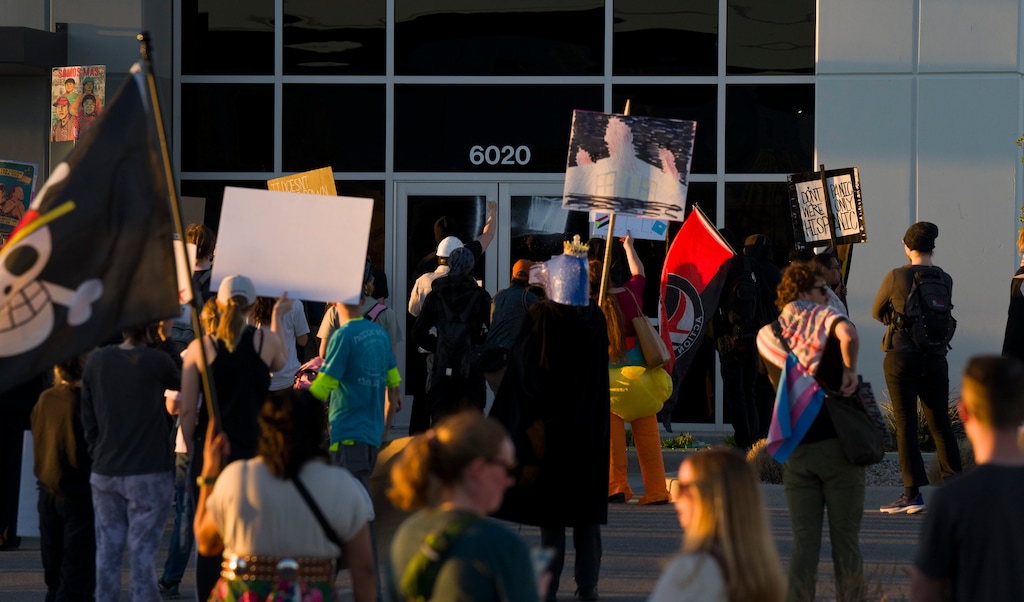
And over the last several days, Utahns have gathered at the warehouse and the Governor’s Mansion to protest the potential of ICE housing immigrants at the facility. Asked about the protests, Cox said he understands the concerns about the size and scope that some Utahns have raised since news of the sale to ICE broke last week.
But, he said, “There has to be a detention facility. Now there’s a right way to do that and a wrong way to do that, and that’s I think we’re working much more closely together.”
Cox, a Republican, blamed Biden, saying his administration did an “awful job securing the border,” which has resulted in the need for the new detention facility.
“We have millions of people here that should not be here,” he said. “President Biden admitted that they shouldn’t be here, and they did nothing about it.”
As it stands, Cox said he does not think the center will have any impact on the economy of the neighborhood or the culture of the city’s west side.
“I don’t think it does anything,” he said when asked about the potential effect on the neighborhood surrounding the warehouse.
And when asked about a potential chilling effect on other businesses in the area, he said, “We haven’t received any feedback from people that are worried about that.”
ICE claims that the facility would be an economic boon for the state, saying it would “bring 9,893 jobs to the area,” “contribute $1.1 billion to GDP” and generate “more than $238.7 million in tax revenue.”
The agency has not explained how it came to these numbers. An analysis by The Salt Tribune found that the estimates are likely inflated, and meeting them would make the center an extreme outlier compared to similar facilities.
In a statement to The Tribune earlier this week, U.S. Sen. John Curtis raised concerns about the lack of local input regarding the sale of the warehouse.
“The decision to move forward with this facility via back-door negotiations — bypassing input from local leaders — is shortsighted and likely counterproductive to supporting the strategic growth and long-term infrastructure plans of Salt Lake City’s west side," Curtis said in the statement.
And U.S. Sen. Mike Lee told KSL that he was “continuing to track this announcement and get additional details about how this facility will affect the community.”
He added, “I am grateful for the Department of Homeland Security and the courageous Utahns working with ICE who keep our families safe and our country secure.”
Salt Lake Tribune reporter Tony Semerad contributed to this story.